

- Contributed by
- Frank Yates
- People in story:
- Frank Yates,Ken Kenway
- Location of story:
- Caen, Falaise
- Background to story:
- Army
- Article ID:
- A7401935
- Contributed on:
- 29 November 2005
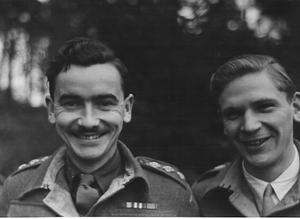
Ken Kenway and Frank Yates
Memories of Frank Yates CHAPTER 31
Towards the end of July, progress was desperately slow despite the massive “Epsom” and “Goodwood” attacks. The brigades were suffering heavy casualties in the fierce fighting, as 12 Corps (53, 43 and 15 Divs) sought to establish a firm bridge head over the river Odon. Div HQ moved north of the main road to Caen at Bretteville, our first move in three weeks. The three RWF Battalions of 158 Brigade failed to take the little town of Evrecy, but the Germans had to bring in reserves to hold the position. It was because of the RWF casualties that the decision was taken, in early August, to split up 158 Brigade and reallocate the RWF battalions.
At about this time, our Command vehicle, in which I had spent so much time, was replaced by an AEC Armoured Command Vehicle. This heavy, lumbering vehicle, apart from being safer to work in, was equipped with cooling fans which were very welcome.
I had the occasion to deliver a message to General Ross, in his caravan, which had been converted from a 3 ton truck. The half nearest the rear steps was panelled, with a smaller version of the “Ops” room map on the wall, two leather armchairs and a desk. The front half had a single bed, a dressing table and a shower and washbasin. A very comfortable pad indeed!
Despite the continual pasting that the Germans were getting from artillery, Typhoon fighter bombers and even shells from “Rodney”, they managed, to hold their positions, undoubtedly realising that an Allied breakthrough would put their Fatherland in jeopardy. However, in early August, the concentration of German defences, against the British and Canadian front, left the Americans, to the west, able to probe weaknesses on their front which led to U.S. advances to the south.
It appears that Von Runstedt and Rommel had pleaded with Hitler to sanction a retreat, to avoid more unnecessary casualties, but the Fuhrer, away in the fastness of East Prussia, had ordered them to stand fast. Eventually he had to give permission for a withdrawal, but almost too late. The Americans swung eastwards towards the Seine, leaving the whole German Army Group sandwiched, in the corridor south of Falaise. It is incredible that the Yanks did not turn north to join up with the British and Canadians, to close the escape route. Perhaps they thought that taking Paris was politically more important? Whatever misunderstanding caused the missed opportunity to shorten the war, the enemy was able to exploit the Falaise Gap and extricate a large part of its forces to the Seine and eventually to regroup as a formidable force.
The Germans, as is so well known, did not escape unscathed, the retreating army being bombarded with a frightful combination of heavy guns and fighter bombers firing rockets at the roads full of vehicles, tanks and troops. On August 16th Ken Kenway and I took a trip, out of curiosity, to have a look at the carnage on the roads along which the retreating Germans had passed.
The experience was never to be forgotten, the scene looking like a painting of hell by Hieronymus Bosch. As far as the eye could see, piled up in the ditches and verges were broken vehicles, tanks, horses and men. Most of the vehicles had been burned, the tanks, “Tigers” and “Panthers” had lost their massive turrets, blown off into the fields by the bombardment, the horses, bloated with gas and with their legs sticking out, made a pathetic sight, but the soldiers, strewn about the margins of the road, were truly a horrific spectacle, Missing heads, missing limbs and grinning teeth as the lower jaws had, frequently, been blown away. All this permeated with the miasma of death, such a common feature of life in 1944 Normandy. We noticed that none of the bodies had any weapons or watches, these having been collected by souvenir looters.
At the time, I was little affected by these terrible scenes, they were, after all, the enemy, whose purpose in life was to kill the British but I often think, nowadays, of the terror those Germans had gone through. Imagine plodding along a country road, tired, hungry and dispirited, tending the largely horse drawn transport and then being subjected to thousands of shells, from field, medium and heavy artillery batteries from which there was no escape, Then out of the clear blue skies came the terrifying Typhoons, firing fearsome rockets, each of which could destroy a “Tiger” tank, followed by 20 mm cannon shells. Death would be a relief from the terror.
As a matter of interest, Ken and I were not the only people from Div HQ paying a ghoulish visit to the killing ground. The senior RAMC officer, the DMS and the senior bishop the D.Chap, both of Brigadier rank were perhaps looking for souvenirs.
A quarter of a million German troops escaped across the Seine, leaving most of their heavy equipment behind. All the bridges across the formidable river had been destroyed, by aerial bombardment, as far as Paris, before the invasion, in order to protect the Allied left flank. The Germans crossed, by ferries, largely at night, but many prisoners were taken. The Recce Regiment, who didn’t want to be encumbered by prisoners “sold” many hundreds to another battalion for a case of champagne!
© Copyright of content contributed to this Archive rests with the author. Find out how you can use this.


 Recommended story
 Story with photo