

- Contributed by
- wsyates
- People in story:
- William Steven Yates
- Location of story:
- Middleton-St-George, east of Darlington
- Background to story:
- Royal Air Force
- Article ID:
- A6536135
- Contributed on:
- 30 October 2005
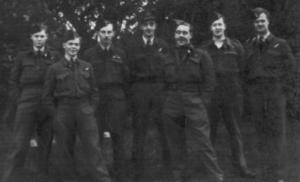
The gallant crew of Q for Queenie of No. 428 Squadron - Canadian 6 Group - stationed at Middleton St George. Left to right: Sgt Harry Pritchard, Sgt Stan Swartz, F/Sgt Wilf Gay, F/O Bill Cullen, Sgt Steve Yates, Sgt Pete Smith, Sgt 'Chuck' Woychuck.
My Service Story - see www.syates.co.uk
I volunteered for the R.A.F. in the summer of 1941. On my 19th birthday and after air attestation, medical etc., at RAF Uxbridge, I was told I would be training as a wireless operator/air gunner.
I had a knowledge of Morse, aldis lamp and semaphore at that time having learnt them in the boy scouts and was assistant Scout Master at the time of volunteering. Within a month I received a railway warrant and was told to report to Blackpool to begin my "square bashing" and initial Morse training.
After learning to march, to use a rifle, increase my Morse speed etc., I was posted to RAF Yatesbury, Wiltshire for wireless training and air and ground wireless procedures. After passing my exams I was posted to RAF Upwood near Peterborough, a pilots flying school where I helped to service and air test the R.T. equipment on short/long nose Blenheims. I enjoyed flying with the staff pilots whilst testing the R.T. sets but, alas, after a short period I was posted back for further training to RAF Madley to experience air to ground radio communications whilst flying, this time, in "Proctors". I suffered air sickness a couple of times on these trips but managed to complete the exercises. However, once back on the ground, I was told to clean up the mess or pay the ground crew to do it. In those days, having little money, I did the cleaning! "Yuk"!
Passing the final exams, I was posted to RAF Bracknell in Scotland for gunnery training, flying in Botha aircraft for air to air, air to ground firing etc. Where the Botha was concerned, it had a habit of engine failure! Thank God, the one I flew in kept going!!
At the passing out parade, we were issued with our A.G. Breive, wireless flash and Sergeant stripes. We were given an all too brief leave, receiving a railway warrant to report to RAF Wellsbourne Mountford, Wiltshire for O.T.U. training, joining a crew for operational flying training on Wellingtons.
My first crew consisted of a Canadian Pilot, Ernie Fisher and the rear gunner, Freddie Fry. The Navigator, Bomb Aimer and myself being English.
Sadly, on a night flying exercise, flying in 10/10ths cloud, we got lost. My wireless packed up and the RT equipment started causing concern. Tuning and retuning to no avail we eventually spotted searchlights and circled until we saw the aerodrome — RAF Halfpenny Green. The skipper tried to contact the ground and eventually assumed that they had heard him because he said that he had received a green signal from the station to land and was going in. Unfortunately on approach to the runway the aircraft struck a house or tree and we crashed to the ground at the beginning of the runway.
With a terrific bang all went black and when I came to I found my head was sticking out of the fuselage — below was the port engine hissing as the rain hit it. I tried to move but found that my right leg was trapped between the corner of my desk and the arm of my seat and I was stuck fast. It would appear that Ernie had switched off the fuel before crashing and in double quick time the station fire/rescue services were with us and began to see to our needs.
Apparently the door between the navigator and me had swung round in the force, breaking my leg and foot. In addition, as I was swung round on impact, I hit my right shoulder against the armour plating behind my seat and broke that too and finished off with the arm of the seat breaking my ribs. Apart from that I was ok!
Sadly, the skipper died from his injuries that were severe; the rear gunner received a fractured diaphragm of the stomach caused by the buckle of his harness. The navigator and bomb aimer received cuts, bruises and suffered shock.
For five months I convalesced in RAF Bridgenorth hospital with a full-length plaster on my right leg and foot and my shoulder was strapped. For the first month I had to lay on my back with a sand bag in the centre of my shoulders to allow the shoulder to drop and heal.
The surgeon who fixed me up was Squadron Leader Leggett. He did a good job for within five months I was sent to an RAF remedial centre next to Hoylake golf course. I guess the crazy type of golf and walking round the course helped me to get full movement back to my limbs and have just the slightest limp. Within 7 months I was pronounced fit and sent back to OTU at Wellsbourne. On arriving back I was told by the training CO to wait for the next course intake before finding a new crew.
The next intake arrived. One day whilst lining up in the mess for lunch there were three Canadians, a pilot, bomb aimer and gunner. They were in earnest conversation about trying to find a good wireless operator and I broke into their conversation and confirmed that I was a wireless op and was looking for a crew. "Would I do"? The pilot turned around, took a look at me and replied, "you certainly will"! The other two agreed, we shook hands and Wilf, the pilot asked me my name and when I told him "Bill", he said that he already had a Bill in the crew, so I told him to call me Steve (my second name), and this has stayed with me ever since, save from my late Mum and sisters.
After lunch I was introduced to Bill Cullen and after receiving his approval, was formally announced as one of the crew, which delighted me.
We sailed through our training at OTU. Wilfred, Chuck, Stan and myself shared a billet together at Wellsbourne — Bill Cullen being a F/O was billeted in the Officers Mess.
The four of us had some great times in that Billet and when the food parcels arrived for Wilf, Chuck and Stan, they always shared with me — even the cigarettes (in those days I smoked). Somehow we always managed to get food from the Mess having, it seems, plenty of tea and coffee as well as other liquid beverages! If I remember correctly, I think Chuck helped by charming the WAAFs on the Mess staff. All the girls fell for him and thanks to his charm and good looks on numerous occasions we had a good feed.
On the weekends we often went into Leamington Spa — the town not far from camp — and one night they got me drunk and had to carry me back to camp. I think it was Bill Cullen who spiked my beer — Happy Days!
At the end of our training at OTU, we, together with two other crews, were selected to fly our first mission. We were to destroy a bomb arms dump in northern France. To the best of my recollection there were possibly six aircraft on the mission in total with a round trip of about five to six hours of flying. I think the Mess staff thought we would be away for a week as the food we took was laughable. It consisted of 5 flasks of coffee and a large bakers wooden tray that contained neatly cut sandwiches of cheese, ham, sardines, egg and paste as well as some cake. On our return the ground crew polished off what was left, which, if you can imagine how strung up we were, was a large amount! In the Mess on our return, all three crews became heroes.
Eventually, it was time to move on and the five of us, Wilfred, Bill, Chuck, Stan and myself were posted to Croft, west of Darlington, so that Wilfred could convert from twin engine Wellington's to four engine Halifax's. Here we picked up two more crewmembers — Pete Smith — flight engineer and Harry Pritchard — mid upper gunner. We all had to familiarize ourselves with the new equipment on the Halifax.
Within a few weeks we moved to Middleton-St-George, east of Darlington, to join the "Ghost Squadron" 428 Squadron RCAF 6 Group Bomber Command. The Flight Commander, Squadron Leader McLean, informed us that the "Ghost Squadron" was so named because they were rebuilding the squadron after heavy losses. We shared the aerodrome with 419 Squadron RCAF.
Wilfred was told by S/L McLean that when we were on stand down from missions, it was a good idea for the crew to get into town to "imbibe the amber nectar", which would help to relieve any tension caused by sticky missions. Naturally, we had to obey our leader's instructions and were happy to take our ground crew along with us. They were a great ground crew, led by a Sergeant Games RCAF. They did us proud, keeping Q. Queenie in Tip Top condition.
Our initial quarters when we joined 428 were about four miles from the aerodrome where we slept in the gate house of a manor house called "Dinsdale Hall" in the village of Dinsdale which consisted of a few cottages, a church and a Pub! Each day we had to travel back and forth often getting to bed in the early hours of the morning after completing a mission only to be called at lunchtime and informed that we were "on again" that same night!
However, within a month or so we moved back to the aerodrome with the five of us sharing a nissan hut. This was, by now, November/December 1943 and was rather chilly to say the least and were all delighted to move into the Sergeants' Mess by Christmas. Wilf and I shared a room, Chuck and Peter in one nearby and Harry and Stan in another.
A little aside
One afternoon after pay parade, walking into the mess, I got involved in a game of pontoon with a few others. After about an hour my pay had sadly depleted and I had a long way to go before the next pay parade. Feeling very down I returned to our room.
Seeing that I was down, Wilf asked me the problem and when I told him of my stupidity, he immediately gave me some cash to tide me over. Like a dope, after the flight next day, I got involved in a game again but, thank God, lady luck must have been with me for I recovered my pay and was able to give Wilf back the cash he loaned me
It was wonderful to be a "Band of Brothers" and I heeded Wilf's advice about avoiding card schools. He truly was our older brother, keeping us in line on the ground, but having no problems in the air because we all worked as a well oiled team, following his example to the letter.
In Pete's Story, he mentioned our being shot at by our own "Ack-Ack" as we returned from a raid coming in over Southampton, hitting us, losing an engine and piece of wing, we landed at Newmarket (now a race course), but at the time, it was a Maintenance Unit. We left the aircraft for repair and traveled back to camp carrying all our gear and were given a weeks leave on the strength of it.
I spent a couple of days at home with my family and then met the crew in London. Wilf, Chuck, Stan and Bill and I stayed at the Canadian Legion Club. Pete and Harry went to their respective parents in Wales.
A rather exciting incident happened after a raid on Berlin and it must have been either December '43 or January '44, but can't remember the exact date.
As we returned to base, I received a message on my radio that we, and the rest of the Squadron on the Raid, were to divert to a Station near Norwich in Norfolk called Shipdham. Bill gave Wilf the course to steer and we landed safely along with the rest of the Squadron. After parking the aircraft, we climbed out with our paperwork and were amazed to be confronted by a number of American personnel in jeeps. It transpired that this was a US 8th air force base — flying Liberators and Super Fortresses and because the weather was so bad at Middleton-St-George, with thick fog and snow, we had to make the diversion. We were snowed in for five days before the weather improved sufficiently for us to take off and return to base.
Landing at another aerodrome, naturally all our cash and personal things were back at M-S-G, but the Americans were kindness itself and in the PX canteen they issued us with shaving kits, soap, towels, even cigarettes and the food, compared to ours, was "out of this world". After landing and after interrogation, the Americans took us to their mess for breakfast with the time being approximately 3:00am. Lining up for our meal the cook said to me "Hi, how many eggs do you want"? I replied, in jest, "oh, six should do it"! To my horror, he began to pile the six eggs on to a plate and I just yelled at him that I was only joking and that "two would do nicely". With slices of bacon and toast, it was a truly memorable meal. Those American boys really lived well, but good luck to them, they deserved it.
After breakfast we were taken to our sleeping quarters that consisted of five sided tents with a stove in the middle and the beds placed around it. Sheets and blankets were provided and the stove had been lit with spare bags of coke placed outside the tent for when we needed them. We were all in stitches of laughter when Chuck said, "Please may I have a single room"? "I can't sleep with these rough boys"! Although only at Shipdham for a short time, we had a lot of laughs with our American comrades.
I must put on record at this time that I have tremendous admiration for the US 8th air force crews. To fly over Germany in broad daylight in full view of fighter and "ack-ack" took a lot of courage. Sadly, a large number did not return — they took a hell of a beating. God Bless them all. We flew about two or three daylight raids and it was rough but, luckily for us as we reached the target, darkness was upon us giving us a chance to return safely although one or two of our planes did not return.
Continued in part 2 …..
© Copyright of content contributed to this Archive rests with the author. Find out how you can use this.


 Recommended story
 Story with photo