

- Contributed by
- Frank Yates
- People in story:
- Frank Yates, Dennis Leader, General Montgomery
- Location of story:
- Tilff, Eindhoven,Brussels,Sheffield,Reichwald Forest
- Background to story:
- Army
- Article ID:
- A7403834
- Contributed on:
- 29 November 2005
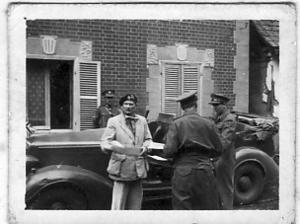
General Montgomery visiting Div HQ
Memories of Frank Yates CHAPTER 37
After leaving the battlefront we had a pleasant surprise, the Division being billeted in the pleasant resort of Tilff. This small town is a local beauty spot, about the size of Matlock and very like the Derbyshire town, a tributary of the Meuse replacing the Derwent. It was, clearly, the favourite resort for the citizens of Liege which lay on the other side of a high hill, a large town, on the River Meuse.
Ken and I were billeted in a house owned by a lawyer from Liege. It was ultra modern and had a good library. A very pleasant time was had, visiting the bars and cafes and enjoying doing nothing in particular. There was, however a nigger in the woodpile, or in the politically correct days of the 21st century, I should say, perhaps, a fly in the ointment. The Germans had been driven almost back into Germany and their V1 flying bombs could, no longer, reach Brussels or Antwerp so they were targeted on Liege. This meant that the dangerous things flew over our heads, cutting out after passing over the hill and exploding in Liege.
One morning, while wondering how long I could stay in bed without missing breakfast, a flying bomb was approaching. This caused no worries, it was on its way to Liege- No it wasn’t!! It stopped abruptly as it approached and I then had another decision to make- do I get out of bed and take cover? I decided to stay and held onto the frame of the bed. The explosion rocked the house and, as I found out, after surfacing, had killed four artillery men in their billet nearby.
After a week in this Matlock of the Ardennes, we set off on our travels again, this time back to Holland and the Eindhoven area. Another surprise awaited us when we were given a few days break in Brussels. The whole Division, no less! The organisation was arranged by the AQ., Lt Col Neilson, a Manchester stockbroker. It was an eye opener. An officer from each of the many units in the Div, had to drive to a rendezvous in Brussels, armed with the number of billets required. The AQ. would give them, each a map of the town with a district marked. They then had half a day to tour that area, informing the householders that they would be acting as the host to two or three soldiers, with rationing details. When the transports arrived, they were met by the representatives, who led them to the designated accommodation. As far as I know, everything went without a hitch, the Belgians looking after us brilliantly. I, with Dennis Leader, was billeted with another lawyer family in a suburb of Brussels called Alost. There was a photographic studio nearby and we had our portraits taken. I still possess the evidence, wearing a cap and a silly grin! The bars and cafes of the old City were jumping for a few days. There was a very nice Officers’ Club where we would enjoy oysters, half a chicken and chips, washed down with a bottle of champagne, for about a quid!
Dennis and I, after one of these unwarlike dinners, strolled down to the magnificent Grand Place, looking marvellous in the lights. Brussels had never been blacked out and, as far as I know, had suffered no damage. We were having a quiet drink and chatting to some people when a slightly excited friend of theirs beckoned us to follow him upstairs. We burst in on an artists’ life class, with a dozen painters and a very naked female model. The painters expressed anger and the model grabbed her gown and departed using choice French expletives. I think that Dennis and I were more embarrassed than she was!
All good things come to an end and we went back to Holland, ready for the next effort, clearly to be the push to the Rhine and the breaching of Hitler’s much vaunted Siegfried Line.
To my surprise, I was told by the G2 that I was due for a leave in England and duly arrived at the railhead at Bourg Leopold, a famous railway town, from where we entrained for Calais.(First class for officers, of course). On arrival in Calais, I was surprised to find a huge transit camp, where troops waited for trains or ships. They fed us and put us on a ship for “Blighty”.
There was a very thick mist in the Channel, and until we arrived we thought that the destination was to be Folkestone, but in the event, it was Dover, with a train standing in the quayside station, to take us to London. And then to St. Pancras and home, to Peggy, who was very pleased to see me!
The seven days leave passed all too quickly and, on the way back, I was routed through Liverpool St. to Harwich, where we boarded a ship which had been on pre war duty carrying livestock from Ireland to the Continent. All traces of its previous life had been removed and the accommodation was good. It had a fairly narrow beam and the sea was choppy. When I went to the wardroom, after a comfortable night, we sat down to a breakfast of the inevitable reconstituted egg, As the plates slid backwards and forwards between the table fiddles, as the ship rolled, there was a considerable exodus of breakfasters. The agony was soon over as we sailed into Calais, then to the Transit Camp and on a train back to the Netherlands, pulled, at the start, by one of the magnificent Chapelon pacific locomotives.
I arrived back to Div HQ in a village, just to the east of Nijmegen. The cold was intense and the village pond was frozen solid. There was a line of lads queuing up to run down the bank and to slide expertly across the pond. We had gained a newcomer, a major from Durban, in South Africa. He had, except in photographs, never seen snow or frozen water, apart from in a gin and tonic! Wearing so many clothes that he resembled the Michelin man, he looked on at the sliders enjoying their sport, until he could no longer resist and joined the queue and slid across the ice on his backside! He tried and tried for half an hour until he could stay on his feet, leaving very pleased with himself, and with, probably, a bruised bottom!
The date was February 6th 1945 and on the 8th we commenced Operation “Veritable, still in 30 Corps. The objective was to clear the mighty and forbidding Reichswald Forest, to overcome the double “Siegfried Line” defences and to clear the territory to the Rhine.
To give an idea of the scale of the assault, ninety thousand men, of six divisions and their equipment were carried by thirty five thousand vehicles, in total blackout, to their forward assembly lines near Nijmegen. Add to this, a thousand artillery pieces and over half a million shells. This massive force was, however, held up, as well as by the usual fierce German defence, as by the atrocious conditions in the forest caused by an unexpected thaw and days of teeming rain. The tracks in the Reichswald were reduced to seas of mud, passable only, at times, by tracked vehicles. Engineers and Pioneer battalions were called in, with bulldozers and picks and shovels, to improve the quagmires.
The assault was commenced by five divisions. From the North they were 3rd Canadian, 2nd Canadian, 15th Scottish, 53rd Welsh and 51st Highland. In reserve, to exploit the expected breakthrough to the N.E. of the forest were the 43rd. Wessex and the Guards Armoured Divisions. 52nd Lowland and 11th, Armoured were the second reserve divisions.
The battle was long and bloody, casualties, once again, being very high and it wasn’t for another ten days, before the sinister wood, in which no birds sang, was cleared of the Germans.
Our HQ was established just clear of the trees, in a farm, on the NE edge of the Forest. I was ordered to take a jeep and driver, to a crossroads in the woods, to meet Field Marshall Montgomery and escort him to div. HQ. I got to the rendezvous point and waited by the side of the muddy track for the great man. When he arrived, he was alone, in the back of an open Humber (Monty always liked to be seen).There was no escorting military column, unlike Eisenhower’s. I stood in the road and stopped the car, smartly saluted and said something like, “I am to take you to General Ross’s HQ Sir”. He told me to get in with the driver and we sloshed along the road, lined with gangs of Canadian pioneers, sitting, having a lunch break on relatively dry ground. They all waved at Monty, who, of course, waved back. The average private soldier thought the world of him, even if the higher ranks were not such avid supporters!
On arriving at div HQ, almost before the car had come to a halt, we were surrounded by almost all the other ranks in our HQ. The clerks, draughtsmen, batmen, drivers and cooks, crowded round asking him how the war was going, He told me to get packs of cigarettes out of the boot and distribute them to the admirers. It was a good ten minutes before he went to meet our general, patiently waiting to greet him. I understand that he was fulsome in his praise for the efforts of our division in the success of the first stage of “Veritable”.
© Copyright of content contributed to this Archive rests with the author. Find out how you can use this.


 Recommended story
 Story with photo