

- Contributed by
- buxeycooper
- Location of story:
- Brighton and Hove
- Article ID:
- A7094234
- Contributed on:
- 19 November 2005
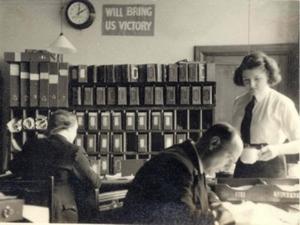
Serving cocoa to Chief Manley
SOME WAR, SOME HOVE, SOME VARIOUS
At the time that I joined the W.R.N.S. we were able to chose to live at home and be "immobile" or travel and be "mobile". I chose the former and lived at home the whole of the war. I was sent (“drafted” in Naval terms) to HMS Vernon, the Royal Navy Mining and Torpedo School which had been bombed out of Portsmouth at the end of 1940. Vernon took over Roedean School, the new St. Dunstan's building at Ovingdean, and the John Howard Home - now the Steiner School in Whitehawk. This was used as living quarters for mobile Wrens.
At first I was sent to Mowden School in the Droveway in Hove. Vernon occupied the ground floor as offices. The King Alfred Sports Centre on the seafront was being used to train R.N.V.R. personnel and some of their people were also working at Mowden. They exercised in the grounds and I remember seeing a man who was obviously trained for ballet pirouetting.
Our uniforms did not arrive for several weeks, but finally we were issued with a jacket and skirt, an overcoat, black stockings and black lace up shoes. We were given white collarless long sleeved shirts to which we had to affix a stiff white collar with studs, and, of course, a black tie in memory of Lord Nelson. The clothing was made of navy blue serge similar to sailors' bellbottoms. In the early days we had hats which were not as attractive as the sailors' caps or "titfers" as they were called. These came later in 1941 and it was the custom to tie a silver three-penny piece in the bow of the cap ribbon. The three-penny piece was known as a "ticky". -We were also issued with a sailor's belt. This was made of thick webbing and contained a small purse.
My job with Naval Stores was doing a mix of office work and general store work - ideal training for work in a hardware store! In the Navy stores people were known as "Dusty Jack" and the nickname fitted the job very well. Vernon was Royal Navy and some men had not worked with wrens at the time that I joined. One was our Chief Petty Officer, Mr. Manley. He told me that I should ask him if I wanted time off - especially at weekends! This did not last long. After some weeks the offices moved out of Mowden school and transferred to Roedean. Before joining them there I was sent up to work in the new St. Dunstan's building in Ovingdean. This was opened in 1938 as an eye casualty hospital for men and women and was in operation until vacated in 1940 to allow the Royal Navy to make use of the premises, providing for instructional classrooms as well as living accommodation for several hundred men attending Vernon on courses. I found the building truly remarkable. On each floor doorknobs, light switches, cloakrooms, bathrooms, dining rooms and staircases were identically placed. Indeed the design was excellent for the purpose for which it had been provided.
The day finally came when I was told to report to Roedean and make my way to No. 3 House where the Naval Stores offices were situated. Passing through the large iron gates just off the sea front road, which were guarded by armed sentries, I reported to the Officer in the Guardroom nearby and, together with a number of other naval personnel, began to walk up what seemed an interminably long driveway cut into the surrounding grounds. The extensive school buildings appeared to grow in importance the nearer I approached, and with only the sky as a background and with the White Ensign flying proudly in the foreground, they presented an impressive sight.
In No.3 House the Victualling Store office was on the ground floor while on the first floor was Commander Boyd's office. Commander Boyd R.N. was the Paymaster and, as with several older men he had been brought back out of retirement for the duration of the war. He was known as "Old Bugger Boyd" and certainly many of us found him very gruff and intimidating, but he was a just and fair man to work for and some said he had a good sense of humour. The Supply Stores office -the nuts, bolts and cleaning gear lot was on the second floor and this is where I was based. It was a large room which originally had been a House Mistress’s Drawing Room and it had a balcony which overlooked the grounds and sea. There was also a fireplace with small windows on each side from which we could see the school Quadrangle. This area became the Quarter Deck - out of bounds to other ranks - and the White Ensign was flown there each day.
The Clothing Store was in another building which the Navy had erected temporarily and was between the main school and the Ward Room - the officers' mess. The interior of the Store resembled a shop inasmuch that it had a long counter with many shelves and much storage space at the back. The Store contained not only clothing and footwear but also blankets for emergency issue to men coming in on "draft" overnight.
Each day at mid-day the men's rum issue, known in the Navy as Grog, took place on the ground floor of our House and the smell hung about for hours afterwards. In charge was the Regulating Petty Office, but whether he was there or not some men had more than their share. Some went to sleep for a couple of hours - many tried to hide the smell of rum by chewing cloves and one Petty Officer we worked with frequently became very unpleasant so we gave him a wide berth until he sobered up. A colleague of mine, Vi Sladen worked in the Victualling Store dealing with the provision of food and rum for a complement of some 2,300 personnel which varied from day to day. A daily record was kept of the rum issue and against the names of men taking it she wrote "G" for Grog and U/A ( underage) for those too young and “T” for Temperance. Each morning the Duty Officer would officiate as the rum issue was prepared by adding two parts of water to one part of rum for the sailors’ issue. Petty Officers and Chief Petty Officers had neat rum and the Temperance men received threepence a day instead of rum.
Leading Wren Vi Sladen The office — serving cocoa to Chief Manley
There were a number of civilians working at Vernon and we had two in our office. They were older men and one, Mr Mansfield who we liked to call Uncle Charlie was a great character. In civvy life he had sold vacuum cleaners and as he had a good “patter” for everything, he must have been successful. There was a good atmosphere and we all got on well. One day after I had made the morning cocoa for which Chief Manley had given us special tuition, he suggested that we ought to start two scrap books which he said should be called “The Dotty Ditty Book” and “The Dirty Ditty Book”! They were very funny and I decorated them with silly drawings. I celebrated my 21st birthday while at Vernon and Chief Manley arranged for me to have a long week-end off, and for a war time greetings telegram to be sent to me. I also received a Red Cross telegram from my aunt in Dieppe.
Although there was a canteen where we could eat if we wished, we made use of the fire in the office which we lit in winter and baked potatoes for our lunch. The canteen kitchens were staffed by wren cooks. On hand in the dining halls were bottles of sauces and it seemed to me that Naval men had two great likings. One of course was for rum and the other for brown sauce and it went on almost everything they ate.
When we were based at Mowden I used to cycle to work. There were no direct bus routes and transport for Naval personnel was geared towards Roedean where Vernon was getting established. Travelling there was much easier, we could pick up transport from various points around the town, but some of us cycled if the weather was fine. It was also fun meeting up with a good looking young seaman on a motorbike who was sent to Whitehawk each day to pick up newspapers for the Captain. If I was lucky he would give me a tow and on those days I was never late for work.
The office — A group photo to celebrate my 21st birthday
There was one day however when I was very late having overslept. That was not so surprising as we did sometimes enjoy parties that went on well into the small hours. In fact I was so late that I thought I might as well be hung for a sheep as a lamb. So when I got to Roedean I made my way across the fields of corn then growing in the grounds, to the office in full view of everyone from the Captain down. To his credit Chief Manley asked me why I had not come into the building via one of the back entrances - and if I had been successful - he would have "covered" me for being late. He told me off for, as he put it, "wandering lonely as a cloud" and being caught.
Of course I was put "on charge" together with other misdemeanours and was punished by having to scrub the "wrennery" stairs for three nights between 6 pm and 8 pm. My Service Sheet shows a drop in the conduct column for that year, but somehow I retained a good character rating.
Sometimes we had to do a night shift and there would always be two wrens on duty. One from Naval Stores and the other from Clothing or Victualling Stores. We slept on two tier bunks in
what had been a piano room at the back of the school facing onto the Downs. I used to bring my sleeping bag from the days when we went camping before the war. If a sailor came in on draft we had to get up and provide him with food and blankets for the night. The blankets were not cleaned every time and I caught Scabies from handling dirty blankets. The cure in 1942 was that all your clothes had to be put into a special bag to be disinfected. You would have a bath, scrub yourself where you had the rash and then rub a cream into the affected part. It was sore but it worked.
Our Stores were situated in various parts of Roedean - there was not the facility for a large warehouse. For instance the petrol store was in a locked area at the back of the school and the meths store was in a small brick building in the middle of a field opposite the main building. Both securely locked. The reason for the strict security in the case of the meths was that some old tars used to drink it. As a further precaution there were two of us present at the issue of Meths. Turps was kept in a large one storey building in the grounds. This building was surrounded by bushes, everything about Roedean seemed to reflect the care taken in placing buildings in situations that would please the eye, not that we took much note of that in war time ! In peacetime this would have been the school's Groundsman's general store where he kept all the necessary equipment to maintain the games fields. Now it housed a great variety of nuts, bolts, screws and tools of all sorts and sizes including electric light bulbs. These were packed in quantities of 100 to a case, and this is how they were issued -by the case.
The cleaning store was in one of the basements of the building and it was stacked with all necessary materials including cleaning cloth and cotton waste which was likely to ignite if it got damp. Measurements of amounts of cloth were done by giving one arm's length from nose to hand and calling it one yard and everyone agreed this. Soda crystals were packed in 112 lb sealed barrels and were issued by the barrel. We became quite adept at rolling barrels up a ramp and out of the storeroom.
One of my jobs was to prepare for the weekly delivery of petrol that came by lorry in 2 gallon cans. I had to drain the few remaining drops of petrol from the used cans, which were collected when the delivery of full cans arrived. The result of the draining was about a pint of petrol, some of which we used as lighter fuel.
There were obviously some advantages to working in Stores! Of course most of us smoked - we were encouraged to do so inasmuch that in the Navy cigarettes were available on issue. The amount was 500 per month and they were called "ticklers". If you wanted to roll your own you could have the equivalent weight in tobacco.
The Navy looked after the properties they used and were forever renewing and repairing the school building. Wren cleaners were employed to clean all woodwork and brassware including two large empty torpedo cases in the main hall. Unfortunately it did not seem possible to rid the building of field mice which were all over the place - even in our office. Nor was much done about the cockroaches which infested the kitchens at night. In normal times steps were taken to avoid these problems, but these were not normal times.
Roedean is an impressive structure high above the cliffs where, it seemed to me, the wind was always blowing a gale, but it looked really lovely when the grounds were given over to growing corn - it was beautiful. As summer turned to autumn so the corn became a sea of gold. Each year an old man came with a scythe and cut the growth which was later removed by lorries. In another part of the grounds was an open-air swimming pool. This had been empty since the School was evacuated and in the summer of 1943 permission was given for the pool to be filled using fresh water. Surrounding the pool were wooden fences which helped to keep the wind at bay and create a suntrap to warm the very cold water. During the lunch hour several wrens used the pool and as most of us no longer possessed a swim suit, we made do with cleaning cloth which was like a thick calico and not at all glamorous, but we really did not care - we were so grateful for the luxury of the pool. There is no doubt that the restrictions of Service life were adversely affecting some of the girls and however much social life and entertainment’s helped to "blanket" the pressures of war, some could not cope and at least two of the girls from the wrennery absconded. Some months later I met one of them. At the time she was living with a Polish Flying Officer at Chelsea Cloisters in London. Of the other - who was a close friend of hers - there was no news.
Frequent training and testing of gas masks which were much bigger and heavier than those given to civilians, was compulsory. For this purpose a concrete building somewhat in the shape of a Greek Key design, with doors at each end, had been constructed. The design retained any gas which had been inserted and ensured that it did not clear too quickly. We had to don our masks and walk through the building where some strong, unpleasant and, we hoped, harmless odour had been inserted. Fortunately we emerged each time none the worse. Much more exciting was the training in how to use a Sten gun, Wrens who wanted to learn were taken up to a field at the back of Roedean. After some instruction we were handed a loaded gun, I found it impossible to keep the gun on target. Despite all my efforts the gun was determined to point towards the sky, and I have never seen anyone move so quickly as a sentry posted on the ridge of the Downs hundreds of yards away! However, I did not want to admit failure and, after further practice, I managed the gun with a modicum of success.
All things considered I enjoyed my three years at Vernon. There was something quite special about being in the Royal Navy — albeit temporarily — as opposed to R.N.V.R. which I discovered when I was drafted via HMS King Alfred to HMS Lizard, did not possess the efficient working practices of HMS Vernon.
One of the things that affected me very much during my time with Vernon was attending Church Parade in the school Chapel. Each time I went the Chapel was full, and I am sure that it was the same every Sunday. The Service was voluntarily attended by several hundred men who, quite possibly, were not going to survive the war. It was emotional, touching and very special. I felt privileged to join in these Services and I have not experienced the like since.
The Naval Stores staff with Commander Boyd (front row centre)
© Copyright of content contributed to this Archive rests with the author. Find out how you can use this.


 Recommended story
 Story with photo