

- Contributed by
- cofepow
- People in story:
- Frederick Austin 'Bunny', Bob Fawshaw, Jim Arnold, General Wavell, Padre Noel Duckworth, Russell Bradon, Peter Rivron, Pte Scovell, Tommy Maclarty, Cecil Warn, Ronnie Woolard, Jock Bryce, Pte Philips.
- Location of story:
- Shornecliffe, Kent then to Malaya
- Background to story:
- Army
- Article ID:
- A5055734
- Contributed on:
- 13 August 2005
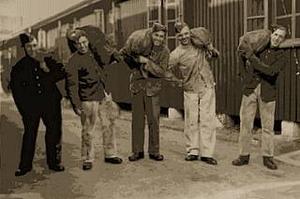
1939 Coal Fatigues Shanhai - China Mickey Berberry, Slasher Hudson, Frederick Austin, Skin Taylor, Ted Woolard
Besides our military duties we played at many concerts and dances.
I remember one New Year's Dance, it must have been December 1938/39. I was the drummer for this dance, I was usually the pianist, but for this, as it was the New Year, I had to take my set of tubular bells along, so as at the stroke of midnight I could play a peal of bells to herald in the New Year.
There were only two young boys in the band, myself and another pal of mine, the string bass player Bob Forshaw. The custom in those days (this still applies) was to keep the band well supplied with drinks, assuming, that the more they drank, the better they played.
So there was I, sitting at the back of the dance band, on my high drum stool, with all my drum kit around me, drinking all that was given me, and playing like a crazy man. Well I never did ring in the New Year. I was told afterwards that, at the height of my crazy drumming, my feet shot up in the air as I did a backward somersault off the drum stool.
When I eventually came to my senses, I was lying at the back of the stage with my pal Bob, who also had too much to drink. So I started off the year 1939 with a blinding headache.
Incidentally Bob Forshaw is still alive and living in Bognor Regis, but unfortunately he is now nearly blind, due to his prisoner-of-war life.
It seemed strange that Europe was engaged in a big conflict and here we were, part of the British Army, enjoying the facilities of Shanghai with no bombing or fighting to worry us.
Little did we know that hard times were to come, that in a few years time, 1941 to be exact, nearly a half of the East Surrey Regiment, now enjoying themselves in Shanghai, would be dead, slaughtered by the Japanese in the early battles in Northern Malaya.
One of the days in the year we used to enjoy, was April 23rd, Not only was it St George's Day, it also was our Regimental Day, the day our regiment was formed in 1704.
This special day was a holiday, and most of the different sections of the battalion had, weeks before the day, designed and built funfair stalls all around the square, so it looked just like one big fairground.
All our meals were served to us, waiter fashion, by the officers and senior ranks, a really relaxed and enjoyable day.
We, the band, started the day off, by going into the officers' mess, in the early hours of the morning, about 5 a.m., and waking them all up by playing a rousing march as loud as we could.
During the day there would be football and hockey matches, finishing with an all4anks dance in the evening.
I can also remember on one occasion, a few of us, on having had a night on the town, calling for rickshaws, then putting the rickshaw boys (the rickshaw boys were really mature men, but they were always called boys) into the rickshaw, getting between the shafts ourselves, and having a race. I don't know what the boys thought of us, mad I suppose, but they seemed to enjoy the fun.
Each day we listened to the news, and heard the fighting in Europe was not going our way, when suddenly we were told that all the British forces were going to leave Shanghai. The Seaforth Highlanders were going to India, and the East Surreys to Singapore.
So at last we left the luxury of Shanghai on the 21st August and arrived in Singapore on 3rd September 1940, to be billeted in the Chinese High School in the Buckit Tima road.
During our short stay here we managed to explore the delights of Singapore Town, which were many. But most of our time was spent in the two places of fun and entertainment, The Happy World, and the New World, making sure we kept away from the street of ill repute, which, to everybody's amusement was called Lavender Street.
After about five months we were ordered to move to a place called Jitra, about ten miles north of a small town, Alor Star, in the state of Kedah. 3itra was only a short distance from the Thailand border, and it was the first time a British regiment had been stationed this far north.
Here we had intensive training as stretcher-bearers, and digging defence positions to defend Malaya from attack from the north. This line would be the first position that an invading force would meet if an advancing army attacked Malaya from Thailand.
During our leisure times, usually at weekends, some of us would go to the river at Alor Star, hire a large boat, attach a small canoe to the back, load up with some food and drinks, then paddle down the river for miles, sometimes with the dense jungle coming right down to the river banks.
We used to swim in the river, but really we were not supposed to as you could get a nasty bite from iguanas that swam in it, also, these reptiles could carry various diseases. (Nowadays, people keep them as pets).
We would find a clearing on the river back and then swim and laze about, also one could, if one wished, use the small canoe to go off on their own and explore down river.
One of my pals, Jim Arnold, and I, used to go some afternoons out walking through the jungle, visiting some of the Malayan kampongs (villages) where we would talk with the people, using our little knowledge of the language, and sign language, then accept the offering of their sweet black coffee.
On one occasion we stopped at a hut in a kampong, where a couple of little children were playing. They were rather shy of us at first, but with a little persuading they soon got used to us. Suddenly an elderly woman came out (I guess she must have been the children's grandmother). She had obviously been watching us playing with them, and invited us in for some coffee.
In the hut was a long wooden seat, but before we could sit down, she got a cloth, then dusted and cleaned the seat before allowing us to sit down on it.
This lady, for lady she certainly was, took the trouble to see the seat was clean for us. Now wasn't that kind and thoughtful of her?
General Wavell came to visit us, and to inspect the defences. He told us that we all looked pale against the rest of the troops in Malaya, he thought it was caused by living all the time under rubber trees. So a rest camp was set up in the beautiful west coast island of Penang, and we then used to go, in turns, to rest and recuperate, and have a holiday.
Little did I know then, that I would be captured by the Japanese on this very same island, be imprisoned in the town jail, and put to work on the very same beaches that I used to holiday.
When it became obvious that war with Japan was coming very soon, we were moved up to our positions at Jitra, and joined the 6th Indian Infantry Brigade, in the 11th Indian Division. The only other British battalion in the division was the Leicestershire Regiment, and among the Indian units was a Brigade of Ghurkas.
After the attack on Pearl Harbour, which brought the Americans into the war, the Japs then attached North Malaya, landing on both sides of us, and also, further down the coast below our positions.
Jitra was over-run, the battle was a major disaster with hundreds killed. The Leicesters also lost about half of their men, so the remains of them joined what was left of the East Surreys, to form one battalion, to be called The British
Battalion.
I've no wish to go into the rest of the events of the war in the Far East, because it makes me so angry, when I think of the stupidity and ignorance of the British Government, in the way they underestimated the Japanese in the early part of the Malayan campaign, which resulted in hundreds and hundreds of young men being slaughtered.
Eventually, as we all know, Singapore fell to the Japanese on February l5th 1942. After the Jitra fiasco, we moved down country to Mor Star, and then further down to a place called Guran, where early one morning the Japs launched a ferocious attack, by mortars and aircraft, then the infantry over-run our positions. All the senior officers were killed so there was no one in command, chaos everywhere. Eventually it became an "every man for himself" situation.
I remember diving into a paddy field and lying with my head just above water, hidden among the rice sheaves, as the Japs crashed through us, killing everybody in sight.
When they had passed through, I found five other chaps were also in the same paddy field, so there were six of us now stuck behind Japanese lines. We had to try and rejoin our troops, so we started to trek southwards, using the sun to check our position.
Progress, as you can imagine, was very slow, and we had to be careful, as we didn't know how far away the enemy were.
I remember the six of us coming out of the jungle into a clearing where there was a Malayan village. Now we had to be so very careful, would they help us? or would they turn us over to the Japs?, and what was worse, were the Japs down in the village.
So it was with some caution that we approached. As we got near an old Chinese woman came out to meet us and said that if we went up into the hills nearby, she would bring us some food and drink when it got dark.
Should we trust her, or push on travelling south, we were very hungry, and needed to rest up, because we were tired after walking, and hacking our way through jungle all day. So we trusted her, and went into the hills, where we all had a good sleep, after drawing lots as to who was the unfortunate one to have to keep awake on guard.
Suddenly, when it had got dark, we heard movement in the undergrowth, was it the old woman with food, or had she brought the Japs with her? Then she appeared with about a dozen other people with plenty of food and drink and told us the Japs were just a couple of miles away. After we all had a good meal, they showed us the right way to go to avoid bumping into the enemy, wished us well, and off we went again.
I also remember coming to a road that we had to cross over, we were just about to do so when the Japs appeared coming down the road. The six of us lay by the very edge of the road, hidden in the dense undergrowth as they passed by.
I remember vividly that I could have stretched my arm through the undergrowth and grabbed the ankle of a Jap soldier as he walked past. We all kept very quiet, hardly daring to breathe, but the danger was soon over, and we were on our way again.
After about four or five days travelling, eating whatever we could find, not knowing if it was any good for us, and drinking mostly coconut milk, we found ourselves on the west coast opposite the island of Penang.
We decided to get a boat somehow, and row across to Penang, hoping, in their hurry, the Japs might have bypassed the island, then we could stock the boat up with food and drink, push off into the open sea, to try and reach Sumatra. Gosh, it was hard work, like rowing from our mainland to the Isle of Wight, as we were nearly all in by now.
When we got to the shore I remember staggering up the beach and collapsing on my back …… when I opened my eyes, there was a Jap standing above me with his rifle and bayonet about six inches from my chest - we were unlucky, they were there.
This was on the 20th December 1941, and so for the next three years eight months I was a guest of the Japanese.
We were put into Penang Jail, given two meals a day of boiled rice and some sort of green stuff, I never did find out what it was, but I ate it anyway.
Then we were put to work in the town, which, if you remember, was my holiday town.
After a while we were moved to another jail at a place called Taiping, which turned out to be a little better, as we now got three meals a day, of boiled rice and green stuff. Then eventually we were moved to Pudu Jail at Kuala Lumpor.
Pudu Jail became the central P.O.W. camp in Malaya for European captives and housed about 1,200 prisoners. Most of them had either been captured in battle or picked up later behind Japanese lines while trying to escape. Their worldly goods consisted only of what they stood up in, and most were exhausted, hungry, and some wounded.
During my stay in Pudu, about 100 of its inmates died.
I remember in Pudu, the Japanese authorities sent out a questionnaire on trades and professional qualifications, in an attempt to make use of the labour force. The fact that so many prisoners could still claim to be "beer testers", "brothel inspectors" or centenary bell ringers" testifies to their good humour after several months of strenuous labour, poor medical treatment and inadequate diet.
As well as British and Australians in the jail, there were also many natives, mainly Chinese, seized by the Japs for alleged British sympathies or rebel activities. The Japanese herded these natives in one part of the jail where they were questioned, tortured, and murdered. On one occasion six natives were informed that at dawn one of the six, anyone, would be taken out and executed. We could hear their moans and screams all night, then in the morning we would see another head stuck on a pole in the street outside as we went to work.
The most outstanding personality in Pudu Jail, more outstanding than anyone, was a rosy-cheeked little man, who had, a few years ago, been small enough to Cox the Cambridge Eight He had, at the battle of Batu Pahat, been big enough (though a non-combatant and ordered not to), and stayed behind with the wounded who could not be evacuated. This little man, with his cheerful grin and his mop of hair, eventually brought all his medical orderlies and his wounded to the comparative security of the jail.
His name is Padre Noel Duckworth, and his name will be remembered by many till the day they die. He was, without any doubt at all, the mainspring of the orderly way of life we managed to carve out for ourselves.
He created, out of a cell, a chapel to which we could all go to see him, and held his Sunday service, although the Japs tried to stop him; he suffered many beatings for doing so. He discovered a non-existent man whilst on his numerous visits to the cemetery to bury our dead, and from him obtained all the news.
Duckworth's news was always good, he was determined to keep our spirits up so the padre lied time and time again. But to the men, who were ill and starving, and dying off at quite a rate, the padre's news was exactly what was required. Russian tanks were swarming through Poland towards Germany, Britain planned a huge invasion of Italy, millions of Japanese were being annihilated in Burma. All lies of course - but it did cheer us up.
While we were at KL, as it was known, five men attempted to escape. Now these men should have done so, as they had all lived in Malaya before the war, they were planters, could speak all the languages fluently, but they only made a few miles before the natives betrayed them, so after just a few days of freedom, they were brought back into Pudu Jail.
A few days later we were all ordered on parade to witness these five men, who looked in a bad way, they had all been beaten up, marched out by the guards, all carrying shovels. As they looked towards us, we all gave a cheer and a thumbs-up sign as they walked out of the prison gates. We leamt afterwards that they were taken to a piece of ground, where they had to dig their own graves, then shot.
Also at Pudu Jail a few of us British made friends with a few Australian prisoners. One of them, a very interesting chap, turned out to be Russell Bradon who, after the war, wrote a best selling book about the campaign called "The Naked Island".
© Copyright of content contributed to this Archive rests with the author. Find out how you can use this.


 Recommended story
 Story with photo