

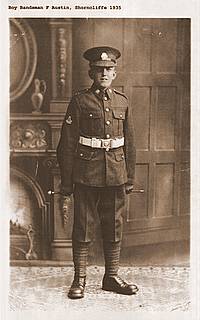
Boy Bandsman Austin
- Contributed by
- cofepow
- People in story:
- Frederick Austin 'Bunny'. Bill & Mary Manley, 'Peachy' Oram, Frank Butcher, Ted Warren, Bill Lazard, 'Lackery' Wood, Slasher Hudson, Peter Rivron, Len Fisher, Bill Edser.
- Location of story:
- Shornecliffe, Kent then to Malaya
- Background to story:
- Army
- Article ID:
- A5056030
- Contributed on:
- 13 August 2005
Friday May 26th 2000
I thought I would write an account of my Army life between the years 1935 to 1945, thinking; perhaps, it might be of interest sometime to my children, and grandchildren, or their children. I obviously have forgotten many things, but I have remembered quite a few, as though they only happened yesterday, so I think I will call this —
I Remember
I left school at the age of fourteen on the 25th January 1935, and eighteen days later, on the l2th February 1935 I was in the Army as a Band boy, in the Band of the 2nd Battalion East Surrey Regiment.
Normally when one joins the Army, they go to their Regimental Depot, in my case at Kingston-on-Thames, but I went straight to the regiment, which was stationed in Risborough Barracks at Shornecliffe, Kent.
The reason, I believe, was because my uncle was a Sergeant Instructor at the Small Arms School in Hythe, which was just a few miles from Shornecliffe, and he used to meet the Bandmaster of the East Surrey Band at their joint sergeant mess functions.
Now I can just imagine what happened Uncle would have mentioned to the Bandmaster, (Bill Manley) that he had a nephew who played the piano and cornet (1 had started to play the cornet in the local Sheppey Silver Prize Band), and then Bill Manley would tell uncle that he had some vacancies for boys in his band, (plus I also found out that they were both Freemasons) - so there you are, they both shook hands and I found myself a member of the East Surrey Band.
If you go to the Depot first, you have about two or three weeks training to prepare you before joining the Regiment, but due to uncle and Bill, I went straight to the Regiment, in other words, I was dumped in at the deep end.
I remember on the 12th February, going with mum and uncle to see the Adjutant of the Regiment, then after saying goodbye to them, going to the boys' barrack room, which was going to be my home for quite a few years.
When I entered the room, about twenty- four pairs of eyes turned to look at me, a most uncomfortable feeling. The boys were all between the ages of 14 to 18 years, and were kept separate from the men. We used the dining room for all ranks under the rank of sergeant, but the boys had separate tables.
They all wanted to know who I was, what instrument I played, and where I came from.
I remember lying awake at night thinking of the events of my first day in the Army, and getting my body used to the hard straw mattress.
I remember Reveille being sounded very early next morning, a cold February
morning, and all the windows frosty, as the only heat in these old barracks was
a large pot-bellied stove in the centre of the room, which, incidentally, was
only to be lit at 4.30 in the afternoon, and was coal fuelled.
After breakfast I had to have a medical, various papers had to be signed and sealed, then off to see the Bandmaster.
Now as I was learning to play the comet, I thought I would become a member of the band's comet section, but after inspecting my teeth and jaw, (I thought they only did that to horses), he said I would make a very good clarinet player. It was not until some time later I found out that he had plenty of cornet plays, but very few clarinet players.
I didn't settle down to Army life at first.
l remember writing a letter home to my mum asking her to come and buy me out; (in those days you could be bought out of the Army), but the price was very high, and I knew she didn't have that kind of money. Also, about half an hour after posting the letter, I felt much better and wished that I hadn't written it, because I realised mum would be so upset on reading it. But luck was on my side, my granddad, who was living with us at the time, saw the letter, and I don't know if he guessed the contents, but anyway, he opened it, read it, and tore it up. So my mum never did read it, for which I was very grateful. He then sat down and wrote to me, telling me not to worry, as things would get better eventually, which they did.
I soon got used to the discipline, spit and polish etc., and also began to enjoy my music. We also had quite a bit of fun.
I remember one incident: - we were not allowed into the men's' barrack rooms, but this time four us, myself "Peachy" Oram, Frank Butcher and Ted Warren decided to go into one of the barrack rooms when nobody was about, to have a look at their equipment, which was a lot different from ours. We had a skeleton kit, but they had a full kit, rifles, tin hats (the hats worn in wartime), and bayonets, so in we went.
Peachy was standing facing Ted, and me but Frank Butcher was standing behind Peachy. Now Peachy put on one of the tin hats and was banging on the top to test it. Frank, who, remember, was behind Peachy, picked up an iron bed leg, about a foot long, with the intention of helping Peachy's test. Unfortunately, as he did so, Peachy took off the tin hat to inspect the inside. Well the iron bed leg came down with a wallop onto Peachy's bare head, his eyes shot around and around like a fruit machine, and he fell to the ground, out to the world.
Frank was standing with a surprised look on his face, still holding the bed leg, while Ted and myself fell about laughing. I know now that we shouldn't have done, but we were all young then and just didn't realise the gravity of the situation. Anyway, after a while Peachy came back into the land of the living, and apart from having a massive headache and a large lump on his head, didn't appear to have any after-effects.
Eventually, when he came onto man service at the age of eighteen, went to the Officer's Training College at Sandhurst, and became a very efficient officer, so it couldn't have done him any harm.
At Shornecliffe, when I had time oft, usually Saturday and Sunday afternoons, I would go to see my uncle and aunt and also my cousins Billy, Patricia and Pamela, who lived at Hythe, only six or seven miles away. It used to be a bit of a rush, as we finished at midday, then I had to get myself cleaned up and dressed in my best uniform. This consisted of thick khaki trousers, with puttees (a strip of cloth worn wound around the leg from the ankle to the knee), a khaki jacket with brass buttons to be cleaned, a white buff belt, also cleaned with white blanco, a peaked cap with the regimental badge on the front, and to finish it of, a regimental cane, about two foot long with a silver knob at one end, also emblazoned with the regimental badge.
After getting myself dressed, I then had to present myself to the N.C.O. in charge of the boys for inspection. Woe betide you if you didn't come "up to scratch", you had to start all over again until he was satisfied you were smart enough to be allowed out of barracks.
The Band Corporal who was in charge of us at the time was a Bill Lazard, and all the boys hated him. We all said that if we ever met him out of camp, on a dark night, we would soon sort him out. Strangely enough, I met him after the war ended, and we became friends. I also realised that he had to be strict with us, as were an unruly lot, and it didn't do us any harm.
Now, having been passed smart enough to be allowed out, I had to walk about half a mile down through the countryside to the main road, and then catch a bus into Hythe. I didn't often see my cousin Billy, he was two years older than me, and had also become a boy soldier. However, he was stationed at a very well known academy for Army boys at Chepstow, where he eventually became Boy Regimental Sergeant Major and incidentally set a record for the mile, which stood for a few years.
After spending a very enjoyable time with them, and having a good tea, (also auntie always gave me plenty of cakes to take back with me, as being young I was always hungry), it was time to head back to barracks, as all the boys had to be ready to "stand by their beds" for the evening inspection at nine o'clock.
Friday was the best day of the week, payday. My pay, as a boy, was seven shillings a week, (about 35p). Of this, five shillings (25 p) was put into a credit account for me and what was left, two shillings (10p) was my pay. Of course, you could get much more for your money in those days, but even so, it wasn't much to live on, especially when I always seemed to run out of toothpaste, soap, black shoe polish, brass polish, all at the same time.
Sport played a very important part of our life, every Wednesday afternoon was devoted to sport, and you could go to the sports store and use some of the equipment. I used to take out a discus and javelin to the sports field. We also had a very good football team, and we won many matches in the garrison.
We used to play the old fashion formation of five forwards, three halfbacks, two fullbacks and a goalkeeper. Frank Butcher, who I have mentioned earlier, was our goalkeeper, - I used to play right half
After spending about twenty-one months at Shornecliffe, the Battalion moved in October 1936, to Goojerat Barracks at Colchester. This was a large garrison town, with about eight different regiments stationed there, and as each had their own band, the rivalry between each other was quite fierce.
We started to train for the garrison boxing competition, held between boys of all the regiments. I managed to get the runners-up prize, which was a small silver cup, and when I say small, I mean small, about three inches high; just like an eggcup. However, the next year, 1938, I won my weight, which was bantam weight, and now I was the proud owner of a winner's silver cup, but this one was bigger, four inches high. When I see the size of cups etc., that are won by sportsmen today and then remember ours! But I was as "proud as a peacock" when I was presented with mine. I still have it, a bit battered, and needs a good clean, but it brings back good memories.
Now I must tell you of another amusing incident concerning one of our band concerts. We were sitting on the stage, all-resplendent in our red and white uniforms, waiting for the Bandmaster to make his entrance at the top of the hall, and walk down the centre to the stage. However, one of our members was missing, the flute player, by the name of Wood. Now the Hindustani word for wood is lackery, so of course, he was nicknamed forever, as "Lackery" Wood.
There we were, the band on stage, and the audience patiently waiting for the conductor to make his entrance.
Suddenly, Lackery appeared at the top of the hall and started to walk down the centre aisle to join us on stage. However, right behind him the Bandmaster appeared and also began his walk down. The audience, who had been waiting for him, started clapping.
Now Lackery, who didn't know who was behind him, thought they were clapping him for being late, so he started acting the fool by giving exaggerated salutes, and bows to everybody to his left and right. It wasn't until he reached the bottom and turned around did he see the large six-foot figure of our Bandmaster, who never said a word, but allowed him to go to his seat and then started the concert.
I don't think he reprimanded Lackery, because besides being a fine musician, he also had a good sense of humour. It was shown one day when he and his wife, Mary, were walking arm-in-arm down the road that ran outside our band practice room. I was inside at the time playing on a piano accordion, and as he and Mary passed the open window, I started to play a popular tune of the day, which had a line in the chorus, "Why did she fall for the leader of the band" and the rest of the boys started to sing it. Suddenly the door opened and there he was, Bill Manley, the boss man himself He gave me a proper dressing down, but I sensed that underneath he was secretly amused.
Sometimes, when I think of what happened to Bill and Mary Manley, two lovely people, I feel so very sad.
Bill became, like the rest of us, a Japanese prisoner of war, and after suffering a terrible time down the mines in Japan, he died. His wife Mary, retired to Guildford where she lived on her own. (I don't think they had any children), but when she was in her sixties, someone broke into her home, raped her, and then murdered her. What a wicked world it is. No I'm wrong, it's not a wicked world, the world is a lovely place, it's the people that live in it that can be wicked.
© Copyright of content contributed to this Archive rests with the author. Find out how you can use this.


 Recommended story
 Story with photo