

- Contributed by
- buxeycooper
- Location of story:
- Brighton and Hove
- Background to story:
- Royal Navy
- Article ID:
- A7380128
- Contributed on:
- 28 November 2005
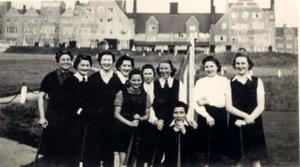
The Wren's hockey team
STRANGE ENCOUNTERS
Amongst David Windeler's colleagues in the Tank Regiment was Captain Michael Robinson. Michael lived in Wetherby in Yorkshire and after the Regiment had left for North Africa in 1942, I was invited to visit his family. So armed with a special long-week- end pass from the Navy together with a return fare rail ticket I set forth. Any journey in war time was likely to be difficult and uncomfortable, and this one certainly was. The train from Kings Cross to Leeds was full of Services people and any hope of a hot drink and a bun from the Buffet car disappeared after the first couple of hours of what turned out to be a 9 hour journey. It was cold, and the dull blue lighting installed because of the blackout made it impossible to read.
Michael's family were very kind and hospitable and I stayed in touch with them as well as Michael for some time. Then, like so many war time associations his letters stopped coming and all contact ceased.
It was to be forty years before a strange encounter took place……
In 1982 my husband and I were on holiday in Majorca. On the last afternoon while waiting for transport to the airport, we started a conversation with another returning couple. They told us that they lived in Wetherby whereupon I remarked that I had once known someone who lived there, but it had been during the war and I had no idea if my friend had survived. They seemed interested and I mentioned Michael's name. "Well" said the husband "if his wife's name is Gleam, then we had dinner with them last week".
Michael Robinson died a few years ago, but not before we had made contact again, and I am still in touch with his widow.
Fifty years after the war, Robert Edgley, who had served abroad with the Eighth Army and later transferred to No 2 Commando in Italy recountered the following story: While enjoying a game of golf at Pyecombe Golf Club with Euan Keat, a retired Consultant and fellow "veteran", he found a lost ball. He was surprised to see that it had "Commando 2" printed on it. He showed the ball to Euan and told him that he had been in No 2 Commando during the war. This started a conversation which both men found extraordinary, as it transpired that Euan himself had been in No 6 Commando. Although they had played golf together for some time, neither had any real knowledge of the other's past. Both were equally surprised when it turned out that Euan had been the doctor on 6 Commando and had attended to the officer who was my brother in law Marshall, who had been fatally wounded during the Ardennes battle and died on 30th January 1945.
AFTERTHOUGHTS
Changing Hove and childhood memories
We came to live in Hove in July1928. My parents bought a semi-detached Edwardian house in a road that led from New Church Road down to the sea front. The house is mentioned in “Carrington, Letters and Extracts from her Diaries”. Dora Carrington visited her Aunt, Mrs.Thornton who was living here in July 1917. Dora was part of the Charlston Farmhouse set and a talented artist.
In those days, the late 1920’s, it was possible to be driven home from Brighton station by horse drawn carriage and the horses were still in evidence around the town. For instance, Walsingham Road, which was a large Victorian development, had an area of brick built into the road near the intersection with New Church Road. In the centre of the brickwork was a channel for draining horse urine, as this was the ‘parking area’ for the taxis of the day.
There were some large detached houses in the road but few had a garage. Much of the development had taken place at the turn of the century and those who had a car or horse drawn carriage kept them in the mews in Richardson Road. The mews, together with a large orchard that occupied the area before 1900 can be seen in the photograph of St. Philip’s Church and includes part of Carlisle Road and Walsingham Road. The orchard was irrigated naturally by fresh water seeping through the Downs and flowing towards the sea at 2 to 3 feet below ground. It continues to do so today pouring never-ending supplies of fresh water onto the sands. Some fruit trees from the old orchard still remain and we have one in our garden, it is an old fashioned Charles Ross apple tree.
At the New Church Road end of Westbourne Villas there were grass tennis courts. The site is now occupied by a small block of flats and three houses with large rear gardens. One house was owned by Mr.Coleman Cohen, the brother of Lord Lewis Cohen, who was known affectionally as ‘Mr.Brighton’. In Princes Square there was a nine-hole golf course. When it closed in the early 1930’s a very fine large house was built on the site. Rumour had it that Mr. Miller, a millionaire, entertained film stars there. However, the house is now used as a Masonic Nursing Home.
Many things were different in the 1930’s from today. Police patrolled the streets on foot and were much more in evidence and they seemed very large! People said that if you wanted to know where some place was you could easily find a policeman to ask. At home one night we were woken by a policeman ringing the front door bell at 2.00 a.m. He wanted to warn us that we had left a ground floor window open. My father thanked him for his trouble and we were grateful that such care was taken for our safety. On patrol in the middle of the night policemen would very likely have seen the milkmen pushing trolleys laden with crates of glass-bottled milk, setting out on their rounds at 3.00 a.m., winter and summer. Their work was hard, not for them the motor trolleys of today, they walked the streets.
In the early 1930’s there was an ice rink near Hove Station called the Lido. It was large and luxurious with dark brown plush seats, similar to cinema seats, round the rink. Later it became a cinema called the Hove Odeon and, later still, a Cash and Carry store. The postal service now occupies the site.
The Hove Bandstand was situated in one of the sunken gardens bordering the beach. It has been demolished, but here, perhaps in happier days, wonderful military bands performed in the summer and there was no shortage of people willing to pay 2d for the hire of a deck chair to sit and listen to the lovely music. Sometimes in the evenings the band played dance music and these summertime dances were very popular. In 1937 a Fry’s Crunch Bar cost 2d. I used to buy one and go down to watch the dancers, enjoy my sweet and dream a little.
I went to school in Brighton and left in 1938. We travelled by bus without any problems. In those days there was a conductor on the buses which was a good deterrent to bad behaviour, although there was not the violence we see and hear of today. In the winter we used to jump off the bus, buy a 2d bag of hot roast chestnuts and jump on again before the bus moved on. The chestnut man was on the corner of Western Road and Farm Road near the Clock Tower. Western Road had not been widened when I started school and several buildings were demolished to open up the road we see today. The design of the buses was different from today’s. The entrance and exit was at the back of the bus. Many buses were open-topped and on the upper deck canvas flaps were fitted to the back of the metal seats. If it started to rain passengers could cover their knees with the canvas provided! Bus tickets were colourful and some carried advertisements on the back which would not be acceptable today.
On leaving school I attended Box’s Commercial College in Brighton in the mornings and the Art College in the afternoons. The motto at Box’s was “Be Businesslike” and we were required to dress appropriately — white blouse, navy skirt and low heeled shoes and stockings. Afternoon classes at the Art College were more relaxed and I spent two very happy years there. One of my tutors was Morgan Rendle, a brilliant artist. His large oil painting of the Barrage Balloons, which were installed in Wish Park during the war, is now safely stored in Hove Museum. The Principal of the Art College was Sallis Benney. The Sallis Benney Hall in Grand Parade, Brighton was named in his honour.
For some of us in the 1930’s life was good and I was fortunate in that I wanted for nothing, but I recall many troubled times around us during the Depression. I remember groups of Welsh miners coming down the road singing for money to buy food. My parents gave them bread and cheese and bowls of hot soup. There was poverty and sickness without the support of the Social Services and many families depended on charity and organisations like the Salvation Army for help. The whole way of life was different, and the class system much more pronounced than today — in fact right up to the outbreak of war - it was rigid in many areas.
There were no Shopping Malls or Super Stores and people did their shopping at small corner shops. Our greengrocer wrapped goods in newspaper or brown paper bags and we could have a delivery without a minimum purchase. However we all went shopping with a basket or bag and so the large plastic bags we are given today were not necessary.
Some businesses came round the town selling goods from a horse drawn cart, Gigins, a large bakery firm delivered bread and cakes daily, in this way. Another service was the Walls Ice Cream man. He cycled round all the roads selling ice cream and calling at houses which showed a card with W displayed in the window. The reverse side of the card urged customers to “ report any incidence of incivility to Head Office”!
Walls had a depot in Westbourne Place where we could buy a penny water ice wrapped in thick card. They were about 5” long and triangular in shape. Orange and lemon were the popular flavours.
Some homes had refrigerators but most did not. Very few had freezers as there was not the amount of commercial frozen food available then. We had an ice box which consisted of a large cabinet with a zinc lined compartment above a shelved storage area. Blocks of ice were delivered every week.
In Hove we enjoyed tennis parties at Derek House, 55 New Church Road, a lovely house with extensive grounds which had originally been built as Hove Bowling Club at the turn of the century. Later the green was turned into a tennis court — probably by the then owner, Sydney Wolfe, the founder of Wolf Electrical Tools. Several years after the war the house was demolished and the Hove Nuffield Hospital now occupies the site.
My holidays were spent with my Aunt in Dieppe. On the day that the Russian/German Pact was announced we were visiting the Palace of Fountainbleau near Paris. The news caused great concern and we returned to Dieppe the next day. On arrival we found a telegram from my parents urging me to come home as soon as possible. I returned one week before the outbreak of war on the cross channel steamer “Paris”. Captain Muntin, who was a friend of my father, was in command and I travelled on the bridge the whole voyage. The ship was crammed with people — some even in the lifeboats. It had been almost impossible to control the crowds embarking and the Paris was carrying many more passengers than normally would have been allowed. It was all so different from the time two years previously when my father had taken me on a day trip and Captain Muntin had allowed me to ‘take the wheel’ and steer. As we sailed past the jetty out to the open sea I looked back at Dieppe. The little town seemed bright and sparkling. The beaches were crowded on this fine warm summer day — as if the good times would go on for ever. I could see the tower of St. Jacques, the large church on the market square, men fishing on the jetty and my Aunt and Uncle waving. High on the east cliff I saw the little fisherman’s church whose interior is covered with prayers for those who did not return, standing alone and waiting. On the west cliff the Castle fortress was standing guard over the fine buildings along the sea front most of which, together with the Casino, would be destroyed within the next three years. Three and a half hours later we docked at Newhaven after what, very fortunately, had been a calm crossing. No sooner had the passengers disembarked than the Paris was turned and preparations made for returning to Dieppe. In normal times the British and French steamers operating the crossing would do a day crossing returning the following day, and likewise a night crossing returning the next night. But these were not normal times and the ships were crossing and returning without a break. The steamers flew the national flag of their country at the stern of the vessel and when the ships crossed in mid-channel the flag was lowered in salute.
The S.S. Paris met her end when she was being used as a hospital ship in 1940. She was bombed and sunk 9 miles off Dunkirk with heavy loss of life.
Before the advent of the ferries of today, freight as well as luggage and cars was placed in a net and hauled aboard into the Hold — not always with success. More freight went on a cargo vessel which took a longer time to cross. One thing in favour of the Steamers was that they were faster than the Ferries although they did bounce about a bit in rough weather. The interiors were divided into First and Third class, and there were dormitories for both men and women with attendants to look after those people who travelled badly and were prone to sea-sickness.
In the late 1920’s Dieppe had resisted much change, and indeed even in the 1930’s modernisation proceeded slowly. The Grande Rue, the main street, had not been pedestrianised. In many areas water, electricity and gas were not laid on. Many people still cooked on a stove or range heated by a wood or coal fire and had oil lamps to provide light. Milk was not bottled — a cart came round the roads each day and people collected their supply in their own jugs. Water was collected from a pump in the street for washing and cooking and we bought mineral water for drinking. Even where tap water was available it was considered unwise to drink it until in the late 1930’s the necessary steps were taken to purify the water. A large part of the harbour basin was still in use near the centre of the town. After the war this area was reclaimed and now the modern Town Hall and other offices occupy the site.
La Poissonerie, the wonderful fish market near the harbour, which employed women to prepare and sell the fish, was demolished when the new Marina was established in 1994. Gone also are the dogs harnessed to small carts to help to transport goods, as indeed are the families who made their living by shrimping and whose homes were in caves cut into the cliff face.
Dieppe, like Hove, still has charm and character, but in parts of both towns where the march of progress has had most impact, much has been lost in the search for modernisation.
© Copyright of content contributed to this Archive rests with the author. Find out how you can use this.


 Recommended story
 Story with photo