

- Contributed by
- Ted Lewis
- People in story:
- Edward Terence Lewis.
- Location of story:
- Indian Ocean.
- Background to story:
- Royal Navy
- Article ID:
- A6862728
- Contributed on:
- 10 November 2005
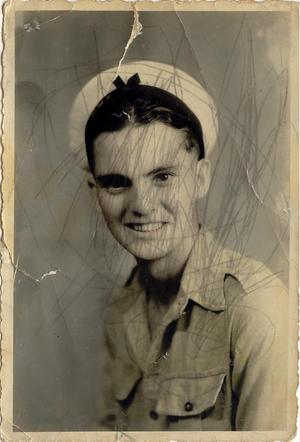
1945
1945
The next ship I was on was the LST (Landing Ship Tank) 3502.
As I walked across the parade ground at Devonport, to pick the ship up, I saw a bloke that I knew. He’d been a petty officer on the Beagle. As soon as he saw me he said: ‘Hello, Lew, how are you going?’
I said: ‘Not so bad, I’ve got to pick up a ship, the LST 3502’.
‘Oh’, he said, ‘that’s my ship. I tell you what, I’ll be down on the mess deck later, looking for volunteers for a job - don’t forget to volunteer’.
‘Oh no’, I said, ‘I’ve had enough of that, volunteering!’
‘No no no’, he said, ‘it’ll be a good job for you’. So I said thanks and off I went.
Now as it turns out, he did come down, marching on the mess deck and of course they all stood to attention and he said ‘I want one volunteer’.
Straight away I said ‘I’ll do it, what is it?’
He said: ‘Ship’s postman’.
Oh, ho ho — what a little number I had! I was the first one ashore whenever we went alongside anywhere and I could take my time too.
That ship was huge. Flat bottomed. Used to roll like a turkey. It had great big bow doors that opened and a ramp that came down. They used to carry tanks inside it, or lorries. We used to play football inside it. It’s where they got the cross channel ferry idea from - the landing ships.
So I was the ship’s postman. I got friendly with a Subby (Sub-Lieutenant) Deacon — he was a copper in Golders Green. He had an office and oh, I was landed there - I was even learning to type! First port of call was Gibraltar. You never knew where you were going so my first thought was ‘I’m not going back to bleeding West Africa again am I?’. But no, we went from Gibraltar into the Mediterranean — called in on Malta and then went right the way through the Suez Canal, out the other side to Port Said and across the Red Sea into the Indian Ocean. We called in at Calcutta and there we loaded up with Indian Soldiers and a couple of armoured cars.
Whilst I was in India, this insect bit me on the finger. First of all it was like a blister and it got bigger and bigger and hard, like a marble. The sick bay bloke that we had, used to be a plumber. Course, he didn’t know nothing, did he. He gave me some hot water and I spent several days with my finger immersed in hot water but that didn’t work and now there was a red mark going up my arm. There were other ships with us by now because they were all getting ready for the big invasion. They put me in a motor boat and we went across to a Canadian destroyer. They took me up into the sick bay and the Canadian doctor said to me: ‘When you wake up after the injection, you’ll feel like you’ve been on the booze.’’. He put his scalpel in the lump, cut it open and out they came like maggots — well they were maggots. Got ‘em all out, scraped it clean, washed it and he said to me: ‘ If it had been another 2 or 3 hours I would have had the pleasure of taking your arm off.’
Anyway, we sailed across the Indian Ocean and we were three quarters of the way across the Indian Ocean when I heard a load of cheering going on and someone said ‘The Yanks have dropped the atom bomb on Japan. The Japanese have packed it in’.
We finished up in Malaya — Port Dixon. We carried out the landing and I don’t know if the Captain had got excited about the end of the war or what, but he hit the beach too fast and there wasn’t a bleeding cup or saucer on the ship that we could use! Everything got smashed! The ship went right up the beach and you could stand on the edge of the ramp and touch the trees of the jungle.
Nelson, that Captain’s name was. He used to say he was a descendent of Horatio Nelson, but I don’t know if he was. Nelson wasn't too bad for a regular officer - he was regular navy. He had 2 dachshund dogs and a monkey called Jacko that used to follow him around. Jacko had a little Captain’s uniform that he used to wear.
Now my mate Bill was very fat — he weighed about 18 stone. He used to have a place down the back of the ship where the depth charges were, and he had some planks of wood set out on the depth charge which he used to use as his seat, or he used to lie out and go to sleep, especially in the Summer because it was very very hot, so he’d be down there on his bed. Well this monkey come along this day, messing about, and we were crossing the Bay of Biscay and this wave hit us and as I said, these flat bottomed boats used to roll terrible, so the boat juddered and tipped Bill over and he sat on the bleeding monkey!
Oh, what a performance. They sewed poor Jacko up in a shroud made from a hammock and then someone said you should always pass the needle through the nose — have you ever seen a monkey’s nose? We couldn’t find his bleeding nose! Then we were preparing to bury him at sea, which was what the Captain had ordered, when somebody said they saw him move. So we had to get him out of the shroud but of course he’d been squashed flat. He hadn’t moved.
Anyway, back to Port Dixon. My hand was bandaged up and the Captain said to me: ‘Can you handle a rifle?’
I said ‘Yes’.
He said: ‘What, with one hand?’
I said: ‘Yes. You only need one finger to pull the trigger.’
‘Oh yes’, he said.
Now, I’d seen this bloke in a canoe, coming aboard us just before we landed in Port Dixon and I found out that he was an intelligence officer who’d been a planter there in Malaya. He had a plantation with a bungalow that was high up on a cliff and the Japanese had done something to his power plant at the bottom, that used to pump his water up. We used to carry a jeep on board so we drove the jeep inland, followed the instructions on the map and eventually we go to this bungalow. We were met by a little Chinese bloke, his servant, who was still there; he’d stayed there during the Japanese occupation. We’d taken some bully beef with us and we shared that with him but the Sikh soldier with us wouldn’t eat the beef. Anyway, we had a look at this bloke’s power plant. It was a little brick house, with an iron door on it and the Japanese had thrown a hand grenade in there and shut the iron door. There were wires sticking out here and there — you couldn’t repair it. So of course we had to go back and report failure.
Let me tell you about a little incident that happened when we arrived in Port Swetnam, Malaya.
There was nothing there. All the shops were empty, the shelves were bare — the Japanese had taken everything. You can’t visualise a place like it unless you actually see it. Nobody on the streets. We walked into one shop and there was an old Chinese man — I suppose he was in his 60s — and when we went in, he put his finger to his lips for us to be quiet and he bent down under the counter and he brought out this old 1930s gramophone with the handle on the side, he put it on the counter and he put the record on, wound the handle up, and then we heard Gracie Fields: ‘Wish me luck as you wave me goodbye, cheerio here I go, on my way…’. Anyone who’d have walked in would have thought we were crackers! There were about 6 of us, all singing ‘Wish me luck as you wave me goodbye’!
Poor old bloke. We gave him a load of corned beef and some biscuits that we had with us — I don’t know if he ate it or sold it.
© Copyright of content contributed to this Archive rests with the author. Find out how you can use this.


 Recommended story
 Story with photo