

- Contributed by
- Eileen Pickering nee Gascoyne
- People in story:
- Eileen Pickering nee Gasgoyne( Halfpint ),Jack Pickering.
- Location of story:
- England
- Background to story:
- Royal Air Force
- Article ID:
- A6252428
- Contributed on:
- 20 October 2005
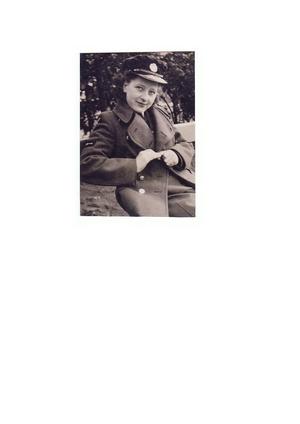
Photo Of 21 year old EILEEN GASCOYNE
I was 17 yrs. of age when declaration of war was announced, from the pulpit. in Church during the Sunday service. To say we were a little afraid of the unknown is an understatement war was expected, sandbags and Anderson shelters had sprung up all over the place and black-out curtaining was being bought by the yard. We had the first siren warning almost immediately but. thankfully it was a false alarm. Black-out was upon us and we carried our little boxes containing gas masks, all the time.
Life carried an normally for a little while but friends and workmates started to he called up for active service and a family circles gradually diminished.
Dec.12th. and 15th. 1940 (Thurs. and Sun.) Sheffield, where 1 was born and bred, suffered a Blaitz....it was dreadful. Wave after wave of bombers almost all night and we were couped up with neighbours, in the shelter, almost below ground. My Dad had built bunk beds for my twin brother and me but we never slept in them, it was too crowded to lie down because all the neighbours in the yard wanted to be to-gether. The only light we had was one candle and I remember the old lady next door to us sitting next to me drinking the brandy which was supposed to be for medicinal purposes only. The next day we had to "Shank's pony" to and from work, walking 3 to 4 miles each time, in to the City (no excuses those days) and that went on for weeks. All form of transport ceased and we had to walk in all weathers over rubble and dripping water mains, through a district that had had a lot of damage it was a nightmare
My boyfriend (who is now my husband) used to call for me and we would walk to work together most days
Jack had volunteered for the R.A.F. and in 1941 was called up for service and sent to S.Rhodesia for Pilot training supposedly for 9 months but he was held back as an instructor and didn't return until 1945.
In 1943, just before my 21st. birthday, I was conscripted into the services and was lucky enough to have my choice to join the W.A.A.F. I did my square-bashing (Drill) at R.A.F. Innsworth. Gloucestershire and at the end of the course we had to put on a show. I could tap-dance(and still do) so was roped in for the chorus and a solo ...... Dress material being almost none existent. the producer went in to Gloucester and came back with some patriotic serviettes which we sewed 1to our issue bras. and made little skirts to wear over our Air Force Blue "bloomers,” we thought we looked great and everybody thought the idea a good one, we just had to make sure that we didn't tear them, good thing they only had to last for the one performance.
From Innsworth, along with quite a few more "sprogs" (new girls), I was posted to Whitley Bay in Ncrthumberland, a hellish journey, having to stand up or sit. on our kit-bags all the way. Being a short-hand typist, I was put to work in the Orderly room of Station Headquarters and eventually promoted to the Adjutant's Office, even though I was still only ACH/GD (Aircraft hand/general duties) at the time.
We had a Pig of a W.A.A.F. Officer and when she came to inspect us had us drilled on the lower prom facing the sun which reflected on to the sea, not very pleasant. I remember her once saying "Now I know what it is like to drill 70 wet, dead fish“all done and said for the benefit of the holiday makers who came to watch us.There were a lot of barbed wire defences all over the place and she took great delight in marching us -towards them and not giving the order to about turn until we were about four aces away, she was not very popular.
After about three to four months we were allowed to re-muster and I applied to be a T/P/O (Teleprinter Operator ).I had quite a Problem with the aforementioned officer, to let me do this because at the time said 1 that I would like to go into Safety Equipment
(parachute packing etc.) as far as that was concerned she said "NO WAY" she would have me scrubbing the cook-house floors first. I stood my ground and and in the end she agreed for me to apply to be a T/P/0. I was accepted and was sent to R.A.F. Radio school at Cranwell College. in Sept.1943. It was a 10 weeks course, on shift work, 6p.m to 2p.m. and 2p.m. to 10.0p.m. alternate weeks, if my memory serves me correctly. We had to take a test at the end of each fortnight before being allowed to move an to the next step Of the training and if you didn't make the grade you were either moved back a fortnight or scrubbed altogether and sent to train as a cook. At the end of the 10 weeks we sat an exam and I passed ok which meant an upgrade in my pay to 2s.2d. per day.
From Cranwell I was posted to Grantham to a place called St Vincent’s House which was gradually being taken over by the Americans (it had been No.5. -Group Headquarters of the Dam Buster era). We shared watches (duties) with the Yanks and as some of them were new arrivals from the States we had the task of training them an a one to one basis, more or less. Because we were attached to their unit, so to speak we were allowed their P.X.(stores,) rations and it was like having Christmas every week. Plenty of gum, choc bars and biscuits as well as other small items such as face cloths, pens etc.We were allowed 140 cigarettes a week Camel ,Chesterfields, Lucky Strike to name but a few. Being a non-smoker I used to send mine in the laundry parcel I sent home, for my Dad to have.The Yanks had plenty of money too and were over generous to the girls who dated them but a lot of us refused to allow this to happen too often, it did not seem right to take advantage of their good nature; most of the ones I worked along side were gentlemen..
On New Year's eve, those of us who weren't on duty were collected by truck and driven to Cottesmore camp and we had a whale of a time dancing the year out, jitterbugging and feeding our faces with food we hadn't thought existed anymore. It didn't matter that we had a long uncomfortable ride back in an army lorry and on duty the next day, we were tired but happy.
Our watch arrived for 8.0.a.m duty on June 6th. (D Day) 1944 to lots of shushes and “Don't talk to each other" orders from the R.A.F. Sergeant in charge of us, stupid man, all signals were in code anyway! We were kept very busy, sparks almost coming out of our machines. We’d had a suspicion something was afoot 'cos a few days beforehand all leave and passes had been cancelled. However, this did not deter my friend and I from getting up early on our day off, walking to the outskirts of Grantham and hitching a ride to Sheffield. I had written home to say we would visit
( no telephone for us ) so we kept our promise. We had to come back the same day otherwise we would have been put on a charge. How we managed it all in the one day I don't know, I had no sense of direction and there were no signposts, but make it we did. There was one worrying moment on the way back when the truck driver stopped and got out of his cab ( it was a transport lorry) and left us for what seemed ages and we had no idea how much further we had to go or even where we were. We were also starting to wonder as to whether we would be back in time for our 23.30 duty. I remember we were late but can't think what excuse we gave but luckily we got away with it. How we made it through the night I don't know but we were young and managed not to fall asleep during the long hours of pounding our machines.
The Yanks eventually took everything over and we were posted en.bloc. to Bletchley Park in Buckinghamshire. I should have gone to Uxbridge but exchanged posting with a Londoner; worse days work I ever did.
Bletchley Park was known as Station X, very hush-hush so, as they sang in one of the war-time songs "We won't talk about that". All I can say is that before we could work in the Park we were vetted and as this took about three weeks we were put to all sorts of menial tasks. Unfortunately for me and my friend, we were put on ablution duties ........ cleaning toilets etc., it was awful. Despite discipline and hygiene lectures there were still the add bods who broke the rules and on occasions our duties weren't exactly pleasant.
The W.A.A.F. camp left a lot to be desired ( there were Army, Navy, Air Force and Civilians at the Park). Navy and civilians were looked after the best, living in private homes etc., Army and R.A.F. personnel had to put up with concrete huts with bitumastic floors, very sparse, and what seemed miles to the toilets and baths.
( enclosed copy of the hut next to mine, to give you an idea of living conditions, this was drawn by a friend of mine who I recently discovered at a W.A.A.F. re-union).
Conditions weren't good at all and the only way out of the place was in a ”box” on medical grounds, or by volunteering to go to India, which my friend did but at her medical, was found to have suspected T.B. and was posted to hospital for treatment. There wasn't much in the way of entertainment, morale was pretty low, and illness overtook some of us. The whole of our hut had dysentery (35 girls) except me. I was greedy and had scabies and the treatment for that was horrible. I had to go to sick quarters every day, have a bath and scrub myself until the sores bled, dry myself off and then the orderly with a brush, slapped an some sort of paste which stung and had to dry slowly before I could get dressed again. I felt very degraded and was spurned by everyone. They assumed that I was dirty, which made me very depressed. Sickness and depression dogged me all the time I was stationed there and eventually 1 had to face a Medical Board which entailed a trip to R.A.F. Halton Hospital. I was offered a discharge an medical grounds, but refused it. The alternative was a posting to R.A.F. Norton, Sheffield where I was allowed to live at home, attending camp only for duties and pay parades, etc.
I remained at Norton until my demobilisation in October, 1945 and during that time, my fiancee came home from S. Rhodesia and we were married just after V.E. Day on 19th May, 1945. That is another story.
A SYNOPSIS OF my WARTIME EXPERIENCE
Mrs E Pickering(nee. Gascoyne)
483863 L.A.C.W.
© Copyright of content contributed to this Archive rests with the author. Find out how you can use this.


 Recommended story
 Story with photo