

- Contributed by
- John Inman
- People in story:
- Anthony Inman Lt RNVR
- Location of story:
- The Pacific and Australia
- Background to story:
- Royal Navy
- Article ID:
- A8109326
- Contributed on:
- 29 December 2005
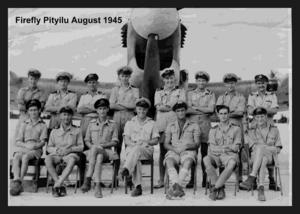
Pitylu 1945 Tony Inman, back row immediately right of prop
A View from the Back: The Recollections of a Fleet Air Arm Observer 1941-1946 by Tony Inman Part 13 of 14 (Jul- Sep 45)
Chapter 14:
South Sea Islands
Pityliu is an island towards one end of the lagoon that formed the anchorage for the Fleet in the Admiralty Islands, an Australian mandate. It was separated by about 1/2 a mile from the main island, Manus. At this time it was being administered by the Americans who had their main HQ on Manus and they also had a unit of some sort on Pityliu. There was one runway about 1 ½ miles long and perhaps 500 yards wide. No.1 RNFAP (RN Forward Aircraft Pool) was stationed here and the job was to repair aircraft that had been damaged in Fleet action and have them returned to the carriers. The aircraft were what was known as 'flyable duds', that is they could be flown but were not fully serviceable and could not be made so while at sea. During non-operational periods an escort carrier would rendezvous with the Fleet and these aircraft would be flown aboard her, pilots returned to their parent carrier and the escort carrier would then sail back to Pityliu, unload them for proper repair and then go back up with some we had mended, or occasionally some new ones.
Getting these duds ashore was a laborious task. They could be flown on to the carrier and I never found out why they could not have been flown off to the island. We used a barge (for want of a better word) which was a square floating platform, large enough to accommodate one aircraft. On one side of this thing was a powerful engine but you can imagine how manoeuvrable it was manned by several air riggers and air mechanics, someone to drive the thing. Quite frequently one or two of we aircrew would go as well, acting as captain of a warship, but really to go aboard for a drink. One of the carriers used was Charger where some genius had acquired air conditioning plant and installed it in the wardroom. The aircraft was lifted on slings attached to various points and lowered by crane on to the waiting barge where it was secured for the trip to shore. Transferring a dozen assorted Avengers, Hellcats, Corsairs and Seafires could take all day. There were not very often any Seafires as they were rather fragile for carrier work and tended to break. There was a story told that Charger had delivered five new ones to Indefatigable (I think she had the Seafire squadron) and within a week they had all been written off.
Once ashore they were repaired, engine serviced, re-rigged, radio and radar put on the top line and had the compasses swung, and then air tested. We observers (Bev, Noel and me) did the compass swinging and when required flew in the air test to check that radio and radar was working. Most of the air testing was done by the 5 pilots as the majority of aircraft being repaired were fighters so single seated.
(Avenger crews always knew that fighter pilots were ham-fisted and liable to break things.) After a bit of practice we three worked together and could swing the compasses on a plane quite quickly. Marked on the ground at dispersal was a compass about 25 feet across with the main points marked. The aircraft was pushed on to this compass rose and pointed towards north. This was checked by a hand held compass well clear of any aircraft magnetism and the kite pushed as near north as we could get it. One of us then inserted a key into the side of the compass and adjusted its magnet until the compass bearing was the same as the hand held compass bearing. This procedure was repeated with the aircraft pointing east. And again at south and west except that on these last two bearings only half the compass error was taken out. We then went round again noting on a specially printed card the amount the compass was wrong on each bearing. This time round, we stopped at each of the 16 main bearings, NNE, NE etc. This card was stored by the compass so that the user could correct for compass error. I remember that the compass magnets on a Seafire were behind the pilot's seat and access was through a panel underneath so that whoever was doing this part had to crawl under the fuselage, open the panel and wriggle your body up inside. As at this time I weighed close to 16 stone, I wanted the hand compass when doing Seafires as the cockpit was too small for me, especially in the tropic sun as the Admiralties are only about 2 degrees from the equator.
The unit was primarily an engineering unit with a few airmen attached to test the work done and a small detachment of Royal Marines who ran the transport section. The C.O. was a Lieutenant Commander (Engineer), there were several other engineer officers and then 3 naval pilots, 2 RAAF pilots, 3 observers and 1 telegraphist Air gunner (Jim Smart). Jim and I were crewed and it was the intention that we would eventually be sent back to Australia to join up with a new pilot whenever a new squadron was being formed. The 2 Australians were waiting to go home to be demobbed (they called it 'bowler-hatted') and in honour of this one of them, whose name happened to be Hambly, acquired, and wore, a bowler hat - even when flying. Clearly discipline, especially among we noble aviators was not very tight.
Apart from compass swinging and the occasional test flight there was not a great deal to do so I took the opportunity to continue my driving lessons, but now in a 30 cwt. The island was run by the Americans so there were all the comforts, an open air cinema and a baseball diamond. Supply ships brought a steady supply of new films, some of them so new that they did not come to London cinemas until I had been home some 6 months. The cinema was open air and films were shown whatever the weather, so it was not unusual to sit on the palm log seats in pouring rain. We had been given some cricket equipment and were having some gentle practice watched by some Americans who thought it a cissy sort of game until a few joined in and when batting, one was hit on the elbow by a full toss - accidentally, of course.
We had acquired an amphibious vehicle (DUKW) which we used to drive across the neck of the lagoon up the beach and along to the Officers Club on Manus, to drink and visit with another group of American friends who were also not very fussy about the state of working dress. None of us wore rank badges nor socks and in grubby khaki I don’t expect we looked very wholesome. One day Argonaut arrived, fresh from the UK dazzling in new tropical white and pale blue war paint. A group of their officers came ashore to the club and were standing rather awkwardly around with their drinks when in bowled half a dozen scruffy Branch types who were greeted familiarly by the Americans. Argonaut's commander looked very put out.
American food was different but plentiful and there was a well-stocked bar run by a man who before joining up had been a barman so he had just changed his civvies for a uniform. Of course there was a PX where you could get almost anything, including the sunglasses I still have. Coca cola seemed to be on endless free supply and we were given a cool box which stored the coke packed in snow which could be obtained from a snow machine. In a freezer, a very fine jet of water was directed on to a spinning propeller and the resultant spray froze into snow which fell to the bottom of the machine from which it could be shovelled whenever you liked.
A couple of incidents spoiled this halcyon existence. A Corsair was being ground tested without having its drop tanks removed, which, although empty of fuel, still had plenty of petrol vapour in. Somehow one of these ignited and the resulting burst of flame caught two of the airmen on the wingtips. As their working dress was only shoes and shorts their burns were extensive and proved fatal. The other incident was personal and minor. I broke the glass on the face of my watch. This was an issue watch so I took it to the instrument shop to get the glass replaced. The chaps in the instrument shop would carry out watch repairs (for a small fee) and amongst the watches waiting to be done was one I recognised. It was mine! Not the one I usually wore but one that rested at the bottom of my kit-bag. It was easily proved to be mine as I had, at some stage, scratched my name on the back. (Being all straight lines it’s not difficult.) Enquiry showed that it had been brought in by our steward, as it did not work. Stealing from members of your own unit is rather frowned upon so he was court-martialled and sentenced to some road building in New Guinea. I wonder if he was on a chain gang.
The atom bombs and VE day came and went and I expect there was a party but I don't remember. Then came the General Election, which was drawn out as all the votes from servicemen overseas had to be collected and counted. It became known as the Khaki Election and when news of the Labour landslide became known some wag hoisted a red flag. Our senior pilot who was the bluest of all blue Tories was absolutely furious and could not be persuaded to see the joke.
During the time on Pityliu one air test I had done had been in a Firefly which at the time was the Navy's newest recruit. A two seat fighter equipped with very fancy radar and twin cannon. Very fast and smooth compared with the Avenger. Unfortunately the observer's cockpit allowed for pilot type parachute harness where you sit on the parachute. I did not have this type, only the normal crew type where the chute clips on to the front of the harness. I had to improvise and ended up sitting on the chute or I would have been too low. I had the choice of sitting on the side that had the release or the side with the 2 D rings which clipped on the harness not comfortable - and then the idiot pilot insisted on flying upside down for a while.
© Copyright of content contributed to this Archive rests with the author. Find out how you can use this.


 Recommended story
 Story with photo