

- Contributed by
- John Inman
- People in story:
- Anthony Inman Lt RNVR
- Location of story:
- Australia and England
- Background to story:
- Royal Navy
- Article ID:
- A8109425
- Contributed on:
- 29 December 2005
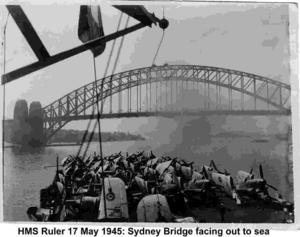
HMS Ruler May 1945 Sydney Harbour
A View from the Back: The Recollections of a Fleet Air Arm Observer 1941-1946 by Tony Inman Part 14 of 14 ( Sep-45-Mar 46)
Chapter 15: Oz Again
The days drifted by, the Aussies went home and eventually we were transported back to Australia - not to Sydney, but to an aerodrome at Maryborough, a small town some 50 or 60 miles north of Brisbane. Only 3 of us were now together and we joined another naval outfit, a MONAB, mobile naval air base.
My recollection of the move is vague. As there is no entry in my log-book we must have travelled by sea and I faintly remember that the Brisbane River is twisty. We disembarked at Brisbane and went by train to Maryborough, a nondescript sort of place shared with the RAAF. If I had known of the Australian side of the Sims' family I could have visited them and perhaps met some of those curious names. We did not seem to do much there and I see from my log that I flew down to Brisbane returning some 2 weeks later. That seems like a leave period and I certainly remember spending time with various families, though their names are long forgotten. From the snaps in the album I spent the leave with Noel Rolfe, another observer.
Some period we stayed in a bungalow which for coolness was built on stilts. I had bought myself some civilian clothes. Another time we stayed with a family that had three daughters who one afternoon suggested going to the beach in father’s car. They were not put off by the fact that the beach was 60 miles away. But usually we lounged round the garden by the pool. How the other half live!
There were trams in Brisbane at that time and as usual the tramlines ran down the centre of the road so that traffic overtook on the inside. There was a bye-law that when the tram halted at a stop the traffic had to stop as well as there was no undertaking of a stationary tram. This was to allow passengers to get on or off in safety.
We also went up country and stayed at a cattle station - a vast place that was prone to drought, so there was serious erosion when the wind blew hard. To retain what moisture in the ground that they could and to stop the soil blowing away, most of the trees were ring barked. That is, a ring was cut round the tree and poison put in so that the tree died. It therefore used no water and as the tree was not felled and removed the roots acted as an anchor to the soil. A cunning idea but all the dead trees were unappealing.
It was here that I had the encounter with the dreaded horse named Detective. I expect he was an amiable beast really, but I had never ridden a horse before. We were going out for the day on horseback, taking food with us. On the outward ride this horse was most reluctant to go any faster than a slow amble. I think I had to use a stick to get him up to a walk, never mind anything more than that. He had another nasty habit. Occasionally we came across trees or a small wood when he would deliberately walk under all the low branches in an attempt to scrape me off his back. We stopped for lunch among trees near to a stream. The horses had to be relieved of saddle and girth and hobbled so that they could graze. Nearby was a colony of what our hosts called flying foxes. They were actually large fruit bats, each about 2 feet tall that flew about in daylight. After the stop came the struggle to get my horse dressed again, humping the saddle on to his back, tucking his tail through that loop thing at the back, and tightening the girth, fearful that it was not tight enough and the saddle would slide of, taking me with it. But it didn't. Going back we had to stop and admire the stud bull and then it was suggested we might like to taste the fruit on this particular tree. The fruit was green and about as big as a plum. Unsuspecting, we bit into quinine, bitter enough to take the skin off your tongue. Very funny, Ha ha.
This blasted horse now showed another side to his, to me, evil character. As soon as it dawned on him that we were on the way home he started to take an interest in keeping up with the others and speeded up to the extent that he was soon in front, getting faster and faster and by the time we came in sight of the house he was going at a mad gallop, with me trying to stay on and at the same time get him to slow down. I ended up standing up and leaning back with all my might. All in vain. He slowed down and stopped when we were back. I hastily dismounted, probably fell off is more accurate. I then had to take off the tack and give him a rub down. Only then could I have a bath and nurse my aching legs and backside. Even that bath did not come quickly as there was quite a queue. I have not been on a horse since.
Around about this time I was promoted to Lieutenant (A). I hadn’t done anything to deserve this but the second stripe came along after 2½ years as a Sub. As I don't remember many Lieutenants (A), I sometimes think it was given as a reward for surviving 2½ years as a an operational flyer. This did not apply to me but I was promoted anyway, though I didn’t get anything from it except a bit more money.
********************
Then it was time to come home. The unit made its way to Sydney where we shed ourselves of all the equipment and waited at Warwick Farm racecourse, which was a transit camp. We had hoped to come home by the Grey Funnel Line, that is, a Navy ship, but we were eventually allocated to the Stratheden, a liner masquerading as a troopship. While waiting in Sydney I had taken the opportunity to send food parcels home and to buy some clothes for Betty, I remember a skirt and some blouses. She did not say if she approved of my taste, but no complaints.
The ship was crowded and it was a case of bunk beds in a huge cabin space. Not much to do unless you were unlucky enough to be allocated as officer responsible for several messdecks. These duties were given to sub-lieutenants so my second stripe came in useful. I had had no opportunity to buy new epaulettes but cadged a pair from a pusser 2 ringer. It took a while to cut away the white between the stripes. (Pussers, i.e., Supply Officers were not sea officers and had a white stripe between the gold rings, which indicated the branch they belonged to).
We came by way of Bombay where I purchased some more tinned food to boost stocks at home. One of the tins was of ghee which went down the same way as our butter. I think it was during the passage of the Arabian Gulf that we had the episode of the holes in the bath house wall. There were two big shower rooms, one for males, one for females, which had a common bulkhead, presumably done when the ship was converted to a trooper. One day several rude sailors were caught peeping at the naked females through holes that had been made in the bulkhead. There was hell to pay, punishment, reprimands and threats of future action before the engineers appointed to make the necessary repairs proved beyond doubt that the holes had been made from the female side.
Passage of the Red Sea was not the airless experience of going in the opposite direction and although the ship stopped at Port Said there was no shore leave. Not surprising, I suppose. Going through the Med we were overtaken by the Andes, a faster more modern ship than Stratheden. Andes had on board a large group of wives, Australian girls who had married our servicemen, who, ironically, were in Stratheden.
Chapter 16: Back to Blighty
We put into Southampton early in December, my second stripe again absolving me from being put in charge of drafts going to Lee on Solent, or Portsmouth or Plymouth. Shore passes were hard to come by but I was able to talk myself into one by pointing to a train and telling the chap in charge of the passes that it was my train home. His heart softened and I was home after about 15 months.
There was nothing the Navy could use all their aircrews for so it was a case of stay on leave until demob. After some weeks I was called to Lee on Solent to be demobbed. I stayed overnight at Lee, a very cold night, and in the morning I went through the formalities, obtained my discharge to the reserve, and my gratuity which the Navy put into a Post Office savings account for us. On investigation of the gratuity amount, (I don’t remember the total) it included some prize money. Prize money! What had I done to get prize money. It turned out that the old method of awarding prize money only to the ships actually involved had been abandoned and all prize money was lumped together and divided among all naval personnel, in what proportions I don’t know. It was said that in future there would be no prize money.
On going to the stores to get my demob clothing, (shoes, socks underwear, shirt, tie, suit, overcoat, and trilby hat) I received my parting insult from the Admiralty. The petty officer storeman looked me up and down and said "Bay 27, sir" I went to bay 27 where the clothing of my size was, to be greeted by a large sign - Long and Portly. I was quite affronted but as, at that time, I was 6'1" and weighed the best part of 16 stone, I suppose it was fair comment. Uncle Bill was to have the hat so I had to get the right size. I put the hat on when I arrived home which reduced your mother into hysterics, her usual reaction to me in a hat. I was now on demob leave at the end of which the great adventure would be officially over.
For 4½ years I had been proud to be part of the Royal Navy, particularly of its Air Arm and of my wings. I had enjoyed the traditions, the way of doing things, the jargon, the ships, and the seagoing. I had made some good friends, and been saddened by the loss of quite a few of them. I had formed a strong abiding and sentimental attachment to that proudest of all flags, the White Ensign
It was now time to get back to civvy street and earn some money to support what was soon to be obvious, the three of us. I had the job at the Post Office to go back to, but after 4½ years going half round the world and flying hither and yonder I was restless. I did not want to stop flying and would have loved the chance to carry on. Only one active anti-submarine squadron was being formed, and lack of enough experience ruled me out. In any case, it was based at Abbotsinch, near Glasgow. I thought of trying an airline, British European Airways had just been formed but they were deluged with applications from former members of RAF Transport Command who had already been flying to all the cities of Europe and they just changed uniform from RAF blue to dark airline blue. But again I did not have the experience. The airline navigated by radio and radar but my navigation was pen and paper stuff, just right for flying from a ship where there were no radio and radar aids. A friend of mine, who also worked at the GPO, had been an RAF wireless operator and he was in the same boat. We could have gone to a school in Southampton to learn what was required, but it was not cheap and it meant giving up the job we had without any guarantee that we would achieve our object. So I went back to my job and settled down to domestic life while the restlessness faded away. I was a civilian again and my glamorous life as a Naval officer was over.
© Copyright of content contributed to this Archive rests with the author. Find out how you can use this.


 Recommended story
 Story with photo