

- Contributed by
- Frank Yates
- People in story:
- Frank Yates, Walter Seyess Inguart, John Suffolk
- Location of story:
- Hamburg
- Background to story:
- Army
- Article ID:
- A7404725
- Contributed on:
- 29 November 2005
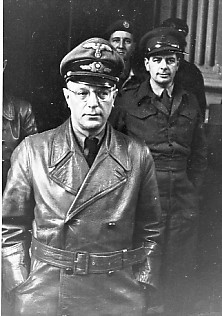
Arthur Seyss-Inquart the infamous Gauleiter of Holland. Captured by 53rd Welsh, John Suffolk and Glyn Davis behind.Photograph courtesy of Captain Tony Rutherford APIS 53rd Welsh Div.
Memories of Frank Yates Chapter 40
Next morning the 4th May 1945 we played host to Arthur Seyess Inquart, the notorious Gauleiter of Holland, who was one of the Nazi war criminals, tried and executed at Nuremburg. He was arrested, when his car was stopped by a young soldier on the outskirts of Hamburg. He was interrogated by John Suffolk in the Military police HQ and was found to have a knife strapped to one thigh and a tiny .25 pistol strapped to the other. We presented the pistol, which had two triggers, one for cocking the motion and the other for firing, to a WVS lady who felt she needed protection whilst doing her charitable work in the mess that was Hamburg. I suppose that the gun, nowadays, would be worth a lot of money, considering its history!
We found that there were 100.000 “Slave” workers in the city. These victims of the Germans were living in small camps set up on waste ground all over Hamburg. Some of these unfortunates, starved by the Germans, were kindly given tins of bully beef and Spam by sympathetic British soldiers, resulting in the death of some of them! One camp had its gates opened and a band of Poles roamed the streets, causing trouble. They found the train load of V2 rockets that we had noticed in a siding, as we drove into the city. They were more interested in the tanker wagons full of alcohol fuel, which they drank. The result was either death or blindness, the crude methyl alcohol being poisonous. The General put sentries on all these camps, to keep the inmates in, and then all the available officers were given pro formas and the address of a camp. We had to enter the details of the inmates, numbers, sex and the conditions in the camp, sanitation, food supply etc. I had a place containing about 40 Czech women, with a small sallow looking middle aged lady in charge. The food was a pile of loaves of black bread with mildew decorations. The sanitary arrangements were primitive concrete channels, washed down by a tap at the end. I filled in my form and was about to leave when the manageress lady, who spoke perfect English, told me that she was the wife of the ex Czech Ambassador to Egypt, who was, she believed, in the Czech Embassy in London, They had not seen each other since the German over running of Czechoslovakia and she knew that the husband did not even know of her location, or if she was alive. Could I please write a letter to him, she asked giving his name. I wrote to the diplomat, telling him of the details, care of the London Embassy. The news, out of the blue, must have been a tremendous shock, but a welcome one, to him. I got a letter from him, thanking me and asking me if I could let him know of her location as he had a promise of a flight to Hamburg. I went to the camp, which was in the process of being run down, ready for closure, to find that she had been transferred to the krankenhaus (hospital) at Altona. I went there, found the lady, in bed, suffering from a bad case of tuberculosis and, in my limited knowledge, not long for this world. I gave her the good news and then threw my weight around and told a nurse to fetch the “Herr Professor”. He confirmed my fears about her condition and I told him that I wanted a medical report that I could send to her husband. That is the last I heard of the matter and I do hope that he arrived in time.
It was patently obvious that these foreign workers, still kept in their camps, but looking forward to repatriation, had no idea of world news. The Germans had given them a diet of propaganda, to the extent that most of them did not even know that the Allies had landed in Normandy, until months after the event! Everything that we could do for these people was being done, In the turmoil of the aftermath of the war it was not going to be easy to arrange transportation to the many places in Europe and Asia, from which these unfortunates had been uprooted. G1 collared me and told me that I was to produce a newspaper in seven languages, to give the latest news to the camps. I asked him how to do it, and his ideas and my thoughts produced “Victory Herald”, a single foolscap sheet, in a different colour for each different language, with the Div sign at the top, before the title.
Before I had chance to open my publishing empire, the G1 had another small job for me:- to receive the surrender of a German Battalion, located on the Hamburg - Lubeck Autobahn. He gave me a sealed envelope and the map reference of the unit. He told me to find the CO., salute smartly, hand him the envelope, salute again and “B****r off”. With some trepidation, I set off on the road which crosses the base of the Schlezwick- Holstein peninsular, in search of the battalion. There was no difficulty because, parked on the side of the road, for hundreds of yards was the weirdest collection of military vehicles you can imagine, there were horse drawn vehicles, trucks with a gas bag on the roof, but most of the vehicles towed a gas producer trailer with a stovepipe chimney. The German soldiers were on parade in the courtyard of a large mansion, at the head of the motley column of vehicles. As I got out of the jeep, the parade was called to attention. I thought “Am I dreaming that Frank Yates is taking the surrender of a 500 strong enemy battalion?” Everything went as planned and I was careful to be as dignified as these defeated Germans were. Before finishing this bizarre story, may I say that 21 Army Group, having once missed the boat by not clearing the approaches to Antwerp, made no mistake and crossed the base of the Jutland Peninsular, thus preventing the Russians from adding Denmark to their prospective communist empire. In appreciation, the Danes fed our troops for a week. We had superb meals, great joints of pork and beef and unlimited eggs, ham and bacon!
The surrendered unit was given orders to proceed to a vast holding area in Hamburg where they would be disarmed and sent home as and when trains and transport became available. The tasks of the Army were heavy and complicated and not the kind of thing it was trained for. A Military Government body had been organised in England and they began to arrive, a motley collection of civil servants, local government officers and volunteers, happy for an interesting time lording it over a defeated enemy and dare I say it, enjoying the fruits of victory without the fighting! They were, perhaps, a bit like the “Carpet Baggers” after the American Civil War!
On the day after the end of the War a very swish and opulent banquet was held in the hotel, guests from Corps and brigades being invited. It was a very special evening and General Ross made an emotive speech of thanks to the officers and units who had helped him to lead the division from the Normandy beaches to the Atlantic hotel, without at any time, failing to achieve its objectives. We all retired to our posh bedrooms, replete with food and champagne!
© Copyright of content contributed to this Archive rests with the author. Find out how you can use this.


 Recommended story
 Story with photo