

- Contributed by
- judi-derby
- People in story:
- Wilfred George Bancroft
- Location of story:
- Middle East and Europe
- Background to story:
- Army
- Article ID:
- A5226725
- Contributed on:
- 20 August 2005
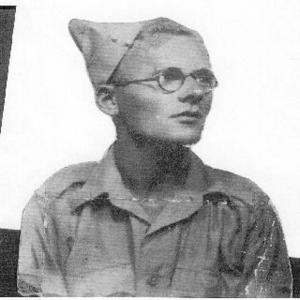
Bill Bancroft
THIS STORY WAS WRITTEN BY WILFRED GEORGE BANCROFT BEFORE HIS DEATH IN 2002
BILL BANCROFT A MEMORY OF WAR
During the Second World War and after serving in the Middle East for a couple of years in Egypt, Palestine, Syria and Libya, I was captured at Tobruk in June 1942.
Before being captured I really enjoyed my time there, apart from when I was blown out of the truck that I was driving landing on my face, smashing all my top teeth into my gums.
That was in Syria when the Vichy French were active, dive-bombing vehicle convoys.
However being only 20 years old at the time and following an operation to remove the teeth and having a new false top set I soon recovered.
Before being captured we were subjected to attacks by German tanks and aircraft.
The aircraft were Stuka dive-bombers that came in at about 20.000ft until directly on target (us) then dive straight down with sirens blazing and release the bombs at very little height, so they rarely missed.
The battery that I was in had 4 x 3-7 heavy Anti-aircraft guns on site and all 4 guns were knocked out by either the German tanks or aircraft and as Gunners were no good without guns, capture was inevitable.
We were captured by the German Panzer Corps, who at that time were the elite of the German army.
From Tobruk (after we were allowed to bury our dead) and there were plenty, we were transported in stages to Tripoli, and across to Sicily where the natives stoned us with brick ends etc as we were marched across the island. Then on to Italy to Brindisi my first POW camp.
From there we went to another camp further north at Bari. At this camp in 1943, the Italians gave up, and as a number of the guards had vanished in the night, four of us decided to escape and head south, hoping that we would be heading towards Allied troops. After a few weeks of heading south sleeping in barns and living off the land we stayed with a friendly Italian farmer and his family, before moving on again.
However the 4 of us were down to 3 as a navy chap called Ken decided to stay on, as he had grown very fond of the farmer’s daughter.
He asked me if I wanted to stay but I said no, as there was no way that I could be taken for an Italian, as at the time I had blonde hair, where Ken was dark and swarthy.
So the three of us headed south again but it wasn’t long before we were picked up by a German motorised unit. We were sleeping in a barn one night when they burst in, having been tipped off by some Italians.
I’ll break here to tell you a strange coincidence.
In 1950 I was standing in the doorway of our house in Derby, it was raining heavily and I shouted across to a chap who was standing in the porch of an empty house across the road, asking if he wanted to come in and shelter. He came in and then I realised that it was Ken who we left on the farm in Italy, waiting for his wife to come and bring the keys for the house. His wife came off the bus and came across to us and it was Elena the farmer’s daughter.
We were then firm friends for many years until we left Derby and then lost touch and I believe they split up.
So to carry on …
The Germans then moved us to Llamsdorf in Poland another stalag, where all the inmates were put to work down a coal mine, 6am to 6pm 7 days a week with a food ration of a bowl of thin soup and a small piece of bread with a cup of coffee (made from acorns) per day. This did not go down very well after sunny Italy I’ll tell you!
However winter was upon us and the Germans were getting very edgy as the Russian guns could be heard as they advanced on Poland, so they decided to move us to another camp in Czechoslovakia.
This meant all allied prisoners could then be housed in camps further away from the Russians. There was no transport so it was a case of walking, and it turned out to be about 250 miles in snow up to knees and freezing cold, with a stop in a schoolhouse etc in villages at night, when guards were changed for the next leg.
At night when we lay on the floor, sometimes the snow used to melt and we’d be lying in water, which froze on legs as soon as we set off next day. I don’t know how long it took us to do the journey, but I remember my boots dropped of my feet one night and the rest was done in bare feet, (I lost my little toe ends with frost bite then). During the march some men just fell and died in the snow and they had to be left, as everyone wanted to keep alive themselves, and were too weak to carry anyone. When we finally reached our destination, I would say that there were only half of us left, and funnily enough, it was mostly the big chaps who died. Eventually we arrived at the next Stalag, near Bruix in Czechoslovakia. Another pair of boots at last (they turned out to have wooden soles / heels).
We were put to work in a big factory nearby which was supposed to be turning out Benzine from coke and coal. The factory was run on slave labour of every nationality, including Ukraines, French, Dutch, English etc, not forgetting political prisoners (including women). Our main job was to mainly fill in bomb craters, and replace railway lines after the RAF and USA Air forces had bombed.
One day I managed to elude the guards that stood over you all the time, got into a compressor shed, and started putting sand in the piston sleeves. Unfortunately, I was missed and was caught by the guard, who decided he would beat me up with his rifle butt, before taking me back to camp. I didn’t like this, so gave him a good kick where it hurts most!
However, the guards soon surrounded me, each one hitting me with their rifle butt and then frogmarched me back to the camp.
The German commandant then sent me to a civilian prison near Dresden, (it was about 6 months before the Swiss Red Cross got me released from there.)
Whilst I was in there I was put in a small cell with the light burning all the time with
no windows to let any light in, so I didn’t know whether it was night or day. The only outings that I got from the cell were when the guards amused themselves by taking me into a yard and threatening to shoot me. Another source of amusement for them was to come into the cell with a large galvanised bucket, place it over my head, onto my shoulders and beat it with pick handles. These beatings became so frequent that after a while I didn’t know when the bucket was on or off my head, the banging went on in my head continually. I am afraid this treatment sent me a bit barmy, and in later years I suffered acute deafness. (I now wear a strong hearing aid).
Anyway, on Feb 16th, my 21st birthday, the Allied Air Forces bombed Dresden, reducing that beautiful city to ruins and afterwards the Germans herded most of the prisoners from the gaol into trucks, and we were transported to Dresden where my job was to go around picking up dead bodies, and parts of bodies and taking them to a point where they were loaded onto a truck and taken away. This job lasted about 24 hrs and in that time I was given nothing to eat or drink.
This made my mental state even worse.
After this we were taken back to the jail and within 3 or 4 days I was sent back to my stalag, where my mates who thought that I had been killed greeted me with great joy.
It was not long after this that the Russians advanced towards this area and the Germans in the camp became edgy, so after some thought four of us decided to take a chance, so one night during an air raid we escaped.
We decided to head for Germany and meet up with the allied forces and the next day we were surprised at the number of people who were heading in the same direction, fleeing from the Russians with all their belongings in trucks, carts etc and many walking.
This provided perfect cover for us as we mingled with them, with none of us wearing British uniforms, mine was a Hungarian outfit issued by the Germans it fit where it touched…very chic.
We’d been going for some days when we saw a German officer resting on the grass beside a staff car, he was also fleeing the Russians.
We all had the same thought “I want that car” so we went across to him and sat on the grass, he obviously refused to give us the car and while my companions kept him talking I went over to the car and lo and behold on the back seat was his belt and holster with a Luger pistol inside it.
I took the pistol out and saw that it was fully loaded, but by this time the German officer was aware of what I was doing and came towards me and when he was close to me I shot and killed him.
It was just as if I had no feelings or remorse at all.
None of the refugees took any notice or came across to interfere so we got in the car and headed towards Germany.
The only thing that I took from the car was the officer’s army issue pullover as I was cold (I was still wearing this when I arrived back in England)
We kept going in the car filling up with petrol and getting food at different American bases until we reached a town called Magdeburg in Germany where the American military police took us into custody, as we had no identification or papers at all.
At their headquarters we were interrogated and were held until they had been in touch with the British who identified us.
By this time I was very weak and suffering from Dysentery so I was sent to an American hospital where I was put on a drip for a few days until I recovered.
During this time my three mates came to see me and told me that they were being flown home, it was an emotional farewell. After leaving hospital I was taken to an American Airbase with a view to getting a flight home, I waited around the runways for a day or two waiting to no avail, then I was offered a flight to Rheims in France to another American air strip.
I got on the plane, there were no seats as it was a cargo plane and was very surprised when part way through the journey the crew gave me a parachute to put on, when I asked why the Americans said that they were not landing at Rheims but will be flying in low so you will be able to parachute out of the plane and land on the airstrip!
They reassured me that this would be no trouble as they were expecting me and would pick me up (literally?) when I landed. Having never parachuted before I was given basic instruction on what to do.
Needless to say I landed safely and the next day caught a flight home and was flown to a US Airbase near Swindon where I was handed over to the British army and home at last.
The army sent me straight into military hospital at Basingstoke for checkups.
After insisting that I wanted to go home the doctor gave me 6 weeks leave on condition that I went into hospital after the leave and I went to my brothers house arriving as a 6 stone man who had left Derby at the start of the war a healthy 11 stone young man.
My story ends when I finished up in the psychiatric wing of a military hospital in Northfield, Birmingham where I had to endure electric shock treatment and other treatments which was thought to help people forget the trauma and torture etc that I had suffered during my time in the camps but this was only partially successful as for a number of years afterwards I used to wake up shouting after I had terrible nightmares and I was left with permanent deafness due to the torture with the bucket.
I was discharged from the army on medical grounds and psychiatric disorders caused by the stress.
In 1991 (Yes 1991) I was awarded a 70% war disablement pension for the damage to my hearing and other associated disorders, I did not know that I qualified as no one approached me and it was only after seeing an article in a newspaper that led me to apply.
As a postscript to this story I must stress that there is no glory in wars …none at all
This story is dedicated to my brother John who was a tower of strength for me in the years after this story ended.
© Copyright of content contributed to this Archive rests with the author. Find out how you can use this.


 Recommended story
 Story with photo