

- Contributed by
- marchback
- People in story:
- James Badcock
- Location of story:
- Germany
- Background to story:
- Royal Air Force
- Article ID:
- A4521025
- Contributed on:
- 22 July 2005
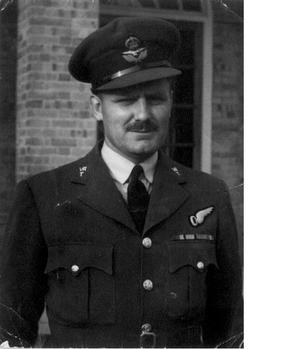
James Badcock
Chapter Seven
It was my job to decide who would stay - not a task I enjoyed. I consulted my Section Commanders and - as I expected - they all volunteered to stay behind but that didn’t make many. In the meantime the first Dakotas were away and in the finish the problem resolved itself by the mere fact that when the last aircraft was airborne there were 4 sections left standing there plus my working colleagues and myself. I was given the chance to fly back, by the Air Traffic Controller, as one of the aircraft was minus a navigator, so I could have come back as a member of the crew - talk about working your passage! I was sorely tempted, but I had accepted the task of getting everybody back so I figured it was my job to stay. Anyway, it was to be for a few hours only so why worry?
Our enforced stay, however, certainly caused problems. This place we had landed in was not a regular station - it was just an abandoned airfield - therefore there were no regular troops stationed there. This meant, of course, that there was no food available and no sleeping accommodation - and I had 117 men to find sleeping space for. Fortunately, we all had plentiful supplies of chocolate with us and some of us had brought some tinned food and coffee - so we would not starve. There were plenty of old buildings around the farm, I think it must have been a farm that had been hastily converted into an airstrip when the Nazis were getting desperate, so we would at least have a roof over our heads, but, of course, we had no blankets. The only 3rd Army men in evidence was a platoon of mechanised troops who had put into the field for a rest on their way to the front line. They sent a party down to the nearest village and came back with a truck full of blankets - I shrewdly suspect that some of the local Herren and Frauen slept rather cold that night.
We had nothing to do so some of us explored this so-called airfield. What treasure we discovered! Obviously the enemy had abandoned this area in a terrible hurry. There were lots of gorse bushes in the centre of the field and around the perimeter. In these bushes we found rifles which had been slung away and also several bombs. They were quite big bombs, I would estimate about 1,000 pounders. We couldn’t see any fuses and no tail fins were fixed on so I suppose they were comparatively safe, though I often wondered what might have happened if one of the Dakotas had veered off course on take off or landing and hit one of the bombs - I should think it would have been very interesting - but it might also have been tragic. I certainly felt very uncomfortable that night. I came across some of the 3rd Army platoon in a small hut having their supper - bacon and fried bread. They were mostly negroes and very nice chaps. I had a cup of coffee with them, but I refused any food because I guessed they wouldn’t have any spare rations until they caught up with their own Company. The young Lieutenant in charge of the platoon was an extremely nice chap - he came from Maryland and had joined the Army straight from college. Although so very young he was a veteran, where fighting was concerned. He told me his chaps were very bitter as things hadn't been too pretty during the advance. He said that a couple of days ago they had attacked near a small town and the white flags had gone up almost immediately. A party commanded by his best friend and consisting of this officer and 2 NCOs and 5 men had gone forward to accept the surrender of the town. Just as they got to the top of the main street machine guns opened up on them from both sides of the street. The whole party had been wiped out. So much for the white flag and Nazi integrity. Apparently they had stormed into the town after this - they smoked out the killers alright - not unnaturally there were the valiant SS - the Americans took no prisoners.
This Lieutenant told me he would be surprised if the RAF came back for us the next day owing to the difficulties they had experienced that evening. He said he had already radioed into his H/Q and reported the state of affairs and he promised to keep me posted.
I decided not to spread the news around about the aircraft difficulties - the chaps were feeling disappointed enough already, because they hadn't got off - anyway tomorrow would be another day. Sufficient unto the day is the evil thereof.
We spent a cold, miserable night. I think few got much sleep and daybreak came with quite a heavy mist hanging over the airfield. The RAF certainly couldn’t land or take off in this stuff. We ate what we had left of our food and had a drink and then there was nothing else to do but sit and wait. The waiting proved irksome. There was nothing to occupy our time and no more food to eat. Worse still there was no news and this was one occasion when no news was definitely NOT good news! Our host of the previous evening, the young lieutenant, did his best but could get no definite news other than that we were to await transportation to another airfield, some 50-60 kilometres away - as the RAF had decided it was too hazardous to try to use the field we were on - I couldn’t have agreed with them more.
Eventually, just after noon, the trucks arrived to take us to our final point of embarkation. It was with great relief that we piled up the borrowed blankets, tidied up the buildings and got away. This last road journey was quite uneventful. The aircraft were waiting for us - again Dakotas but flown by American crews this time. There were no problems this time as the airfield we had arrived at, Gelenhausen, certainly looked like an airfield and not like the shambles we were on the night before. Embarkation went quite smoothly and eventually the last 17 of us were safely aboard DC-3 292865 'R' for Robert, piloted by Capt. Tiedemann of the US Army Air Corps. At 15.03 hours we were airborne, heading for England.
The Dakota chugged steadily on and we were low enough for us to be able to see some of the ravages of war beneath us. Germany had certainly been knocked about a bit. We crossed the Rhine and settled down to enjoy the trip. However fate hadn't done with us yet.
The Quartermaster on the aircraft was sitting chatting to me when he got a signal from the skipper to go forward. He soon came back and told me he reckoned we might have to land in France. When I asked him what was wrong he said: 'nothing much, only I think she is dropping a few revs on the port motor - but she's all right - I reckon the skipper just wants to pick up his own aircraft, he doesn’t like this barrow very much.'
Oh! Oh! Here we go, I thought - its all going to happen again, the last time I flew we had a wonky port motor and that cost me over 2.5 years in Germany - and they say lightning never strikes twice. I told the Q/M this and that cheered him up no end. He went forward and saw the Skipper. After a moment or so the Captain came and sat down beside me. He told me that the Q/M had reported my remarks to him. I laughed and said I didn’t expect the trouble on this aircraft was anything like what happened to 'G' for George in July 1942
'No,' he replied 'I don’t suppose it is, and I have little doubt we could get to England alright, but brother, I'm taking no chances - I guess you’ve had enough trouble through dicey engines - for the sake of half an hour we are going to land in France and then we'll.pick up a real aircraft - but I'll have you back in blighty this evening - never fear - anyway I've got a heavy date in Oxford at 8pm and, buddy, she won't wait!
True to his word he brought the aircraft in to a perfect landing at a French airfield called St. Andre at 17.33 hours. They brought us out some drinks and told us our new aircraft would be ready in a few minutes. They also said that if anyone felt too tired to go on, or would like a night in Paris - here's the chance - but there were no takers - home was getting very near and we had had enough hold ups already. For the rest of my journey my log reads as follows:
18.07 hours Airborne St. Andre in DC-3 315140 'K' for Kitty.
Capt. Tiedemann set course England
18.58 hours Crossed English coast just below Brighton
(At this point cognac was served. This was the first time I had
ever had a drink, of spirits or beer, in the air but just as I
tipped my glass we hit an airpocket so I didn’t get a drink that
time either!) The excitement was now intense!
19.27 hours LANDED AT RAF OAKLEY, OXFORDSHIRE
So just 2 years - 8 months - 2 weeks - l day - 19 hours - 45 minutes after taking off in Wellington Mark III 'G' for George I was back in England - rather a long trip - one which, at times, I felt would never end.
As the aircraft taxied to dispersal point and stopped many willing hands were there to help us off the aircraft. I think they were expecting a gang of invalids (we were the first load of ex POWs to land there) and they were very surprised when they found 17 individuals of assorted Services and rank, all of whom were perfectly capable of looking after themselves. I said goodbye to my colleagues from the Army and I have never seen any of them since. I was taken over to the Mess where a little New Zealand w/o insisted on buying me a couple of pints - all the money I had got was 26 Deutschmarks, which I had acquired from somewhere. We had a meal, a lovely steak I remember, and then we were whisked off, by fast transport for an unknown destination - which turned out to be the Endsleigh Hotel, Euston, WCl. That night I slept in clean white sheets with a clean white pillow for the first time in nearly 2 years 9 months - HOME AT LAST!
This story may not read much like the release in the Colditz Story but I can vouch that this account, from Stalag IXC Ziegenhain is true because I WAS THERE
I cannot conclude this account without paying a small tribute to the 3rd US Army who looked after us after our release. They were magnificent! Although we were in the front line and, therefore, must have been an embarrassment to them - they did everything they could to ensure our welfare and bring us back to health. They fed us like princes and weighted us down with comforts and 'goodies'. The night I got back to London I still had over 1200 American cigarettes and two half-pound packets of excellent pipe tobacco. Thank you America!
Jim returned to live with his wife Doris in Hornchurch, Essex. They went on to have two children and four grand children. He became a popular senior lecturer in business studies and also worked counselling officers about to leave the RAF to start small businesses.
Jim’s health was compromised by his time in Germany (colitis). He died in 1985. He was a well respected man.
© Copyright of content contributed to this Archive rests with the author. Find out how you can use this.


 Recommended story
 Story with photo