

- Contributed by
- John Inman
- People in story:
- Anthony Inman Lt RNVR
- Location of story:
- Scotland
- Background to story:
- Royal Navy
- Article ID:
- A8108624
- Contributed on:
- 29 December 2005
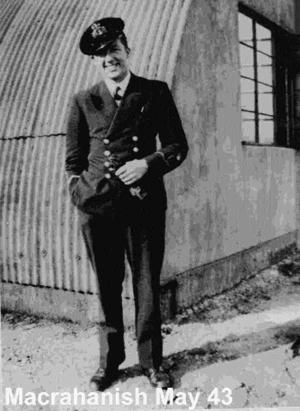
Sub Lt Tony Inman RNVR Macrihanish May 43
A View from the Back: The Recollections of a Fleet Air Arm Observer 1941-1946 by Tony Inman Part 5 of 13 (Mar-May 43)
Chapter 4: Machrihanish
Next stop was no 766 Squadron at Macrahanish, but more of that anon. This was goodbye to our days as jolly jack tars and I suppose it is fair to say that one of the things we missed most - certainly I did - was Saturday evenings in the canteen where there was always an impromptu concert. It wasn't a talent competition or any thing but anyone who wanted to sing or dance or play an instrument could get up and do it, probably be chi-iked a few times, but it always ended up with what was generally known as a "sods opera," usually performed by 2 rather ancient old sailors, probably reservists who had served at the battle of Jutland, and they would put on a little song and dance and cross talk show which always went down well. Risqué and rather rude and perhaps some of the jokes like the shut up jokes (“Dad why I am walking round in circles? Shut up or I’ll nail your other foot to the floor”) etc ending up with a cavorting dance when they would sing "Violate me in the violet time (the narrator is singing now) in the vilest way you know...” I won't go on any more it gets a bit ‘not for young ladies’ ears’ after that.
That was the end of non-commissioned time. There was a gap between leaving Arbroath on the 12 Mar and starting again at Macrahanish on the 26 Apr and I realised that we had a session at the Royal Naval College. Holders of the King's Commission are expected to be officers and gentlemen as John will know and while it was reasonably easy to make us officers by giving us a gold stripe, making us gentlemen was a bit more difficult. At Greenwich for 3 or 4 weeks, we were lectured on Naval history traditions and customs, learned some unarmed combat from an old naval commander who looking back now was probably about 50 but to a 20 year old he looked as if he was about 70. We ate in the Painted Hall. This is a beautiful long room with a high curved painted (by artists) ceiling with meals served on a big long table which stretched the whole length of the room with the instructors and permanent staff sitting across at the end. Most of us (all subbies) had to learn which knife to use, when to stand up and sit down when you were toasting the King, and what to drink and what not to drink. It was rather spoilt for us because we got rather poor service from the stewards who were all WRENs. Sadly sitting about 10 yards from us was a film star. Quite a few film stars joined the Services during the war and this one was here in the Navy. "Ian Hunter" was a well known face in the films before, during and even just after the war. But he was a very handsome young man and, although he had only one stripe like us and no wings, the WRENS fawned round him and neglected us - this was not the only time this happened, as I shall recount later. It was very enjoyable there - just a few air raids when we had to go and cower in the cellars. We found time to visit the Royal Naval museum and take walks out into Greenwich Park and up to see the observatory and the Meridian from which all longitudes are measured - the metal strip on the ground outside the observatory.
766 Squadron was an Operational Training Unit, which we had all expected. We were to go there, crew up and work up in the various arts required of the now operational types. The appointment came to 766 Squadron Macrahanish, but the question was where on earth was Macrahanish? Anyway we were told to go to Glasgow and Wemyss Bay or somewhere like that. We went up to Glasgow waited on St Enoch's station until it got light and then went to Wemyss Bay where we were met and taken to a ferry which took us to.......Rothesay was on the Kyles of Bute and then across to the Mull of Kintyre, which was far less well known than it is now. There we embarked on buses. They were wartime buses with wooden seats and we were driven the whole length of Mull of Kintyre as Macrahanish is nearly down at the tip, along these narrow steep sided roads where I swear the bus driver bounced us off the banks a few times. Well, we arrived at Macrahanish eventually. At that time we were originally lodged in Nissen huts away from the main buildings and this was known as Nissen City though there were so many holes in the roof that when it rained the rain came in and it was known as something else that rhymes with "Nissen".
We did all the usual Naval Fleet Air Arm things, night navigation exercises, day navigation exercises, torpedo bombing, dive-bombing but mainly anti submarine tactics. It seemed to be well known that at the end of our work up we should be joining one of the escort carriers on the Atlantic run, which rather pleased we naive young macho types who thought it would be splendid to spend 3 or 4 weeks at sea going across to New York, a couple of weeks in New York picking up all the goodies for the folks at home, food stockings etc, and then 3 weeks back followed by a week’s leave. Shuttling back and forth seemed to be a splendid idea.
We were only at Macrahanish a month but the weather was extremely changeable. There were some very sunny days but also times when it poured with rain or snow -I got lost in a snowstorm at night once - but just on the go all the time. On Naval Air Stations if the weather is fit for flying the "affirmative" flag is flown from the mast but if it is not fit the “negative" flag is flown. The negative flag was never flown, no matter what the weather was like, and it was strongly rumoured that the affirmative flag was nailed to the mast. Here we observers met a gang of pilots for the first time and we crewed up. I don't remember how this actually came about but I ended up with a pilot whose name was RJ Deacon, I don't remember what his Christian name was because he was called "Deke" and we had an air gunner whose name was Ashton. Never sure about him, he always looked as if he was one jump ahead of the police, but perhaps I am maligning him. Flying with your own crew is vastly different from training, I sometimes feel now it was like kids being let out of school. You knew how to do it so you thought, “Right let’s do it”.
The CO had taken part in the battle of Cape Matapan and was believed to have put a torpedo into one of the big ships there. He was a brilliant pilot and he used to do naughty things to us, or perhaps not. He would lead you out on an exercise somewhere and when the exercise was done - we observers being idle just followed him - he would not lead us back, he would either disappear or fly around and get on your tail so you could neither follow him nor shake him off - he was too good a pilot for that - so we soon learned that you had to keep a plot going when you were out with him so you knew how to get home again.
When we finished an exercise, on the way home the aircraft would get together and have a bit of fun. We would go to the top of the cloud and play follow the leader in and out and round the clouds. If you have flown on top of the clouds you know that they are not flat, it is all towers and pillars and lumps and bumps and you can have a fine time flying round this. Some sunny days we would fly along the beach and my chap was not averse to bouncing his wheels on the sand now and again, I hope he did it on purpose. One time he bounced them in the water, I was in an Albacore and suddenly there was water splashing all over the windows and then we were standing on our tail going straight up. He had come a bit too low and frightened himself as well as me. We flew several times a day, night flying as well. Night flying in May was vastly different from what it had been in December when we had started at 6 o'clock. This was Western Scotland and getting towards the longest day and I don't think it ever got properly dark. From twilight till dawn was about an hour and a half so we used to do our night flying from about midnight till one o'clock and then come back and have something to eat in the Mess before going back to our hut where we were allowed to sleep on later in the morning.
We used to practise formation flying and sometimes they would tuck their wings in so you would be flying along and the chap next to you would have his wings just 6 feet from your cockpit, and we could make hand signals and communicate with the other observer in the back. We generally had a pretty good time but it was not all fun and games. We were there about 4 weeks and we smashed about 7 aircraft and killed 5 people in that time, flying into the sea or the hills at night. But we seemed to take it all in our stride, I suppose you do at that age, and in those conditions.
The nearest town was Cambeltown, which was a little fishing port right on the tip of the Mull of Kintyre and we would occasionally go there, find a cafe, have a few eats and drinks, then make our way back. The flying was fairly continuous in all sorts of weather. On one night navigation exercise, we were out over the Irish Sea or in the Atlantic and it started to snow and my pilot had forgotten to switch the heater on the pitot tube. This was a hollow tube which stuck out from the front, and the wind and the air pressure gave you an indication of air speed and barometric pressure which controlled the altimeter. So it gave you both air speed and height. Unfortunately, without a heater on it soon clogged up with snow, so there we were in the dark out there over the ocean with no idea how fast we were going or what height we were. Without the airspeed indicator, I didn't really know where we were so we eventually had to get on the radio and ask for a bearing to come home which was very humiliating.
It was during this snowstorm that we saw St Elmo's fire. The whole arc of the propeller and all along the front of the wings were outlined in this static electricity and it was quite a sight. Another night we went out somewhere and we ended up over Londonderry Harbour which was full of the North Atlantic escort groups so we hastily let off recognition signals so they would not start firing at us because we were not flying very high - only about 1200-1500 feet. I don't know how we got there or why and it is probably better to draw a veil of that, it was probably my bad navigation again.
One of the chaps killed was one of my mates from Eastleigh - Ron Hamlet - one of those accidents that are unbelievable. We were doing some night anti submarine attacks. Floating in one of the bays they had a mock-up of a submarine conning tower and two or more aircraft would practice together in a combined attack on this submarine. One aircraft stayed high and dropped a flare while the other came in low, flying over the submarine towards the flare so that the sub would be silhouetted against the light. One of the things about flying low over the water is that if the water is calm it is extremely difficult to judge your height. This time the pilot came in too low and flew in. Now there was a rescue boat on hand and it was making towards him and the chap upstairs had seen what had happened and thought he would be helpful - quite a good idea - so he dropped a couple more flares so everybody could see. Unfortunately, one of these flares - it happened occasionally - caught light to the parachute so instead of swaying down gently this flare fell out of the sky. The aircraft on going in had split open the petrol tank and the water was covered in petrol and before the boat could get to the aircraft which was not in very deep water this rogue flare had dropped down in amongst the petrol and set light to it. So the rescue boat couldn't go to the rescue immediately and by the time it could get in and get the crew out the 2 in the back had been knocked unconscious by the impact with the water and had drowned before they could be pulled out. A bit of a shock for us all that was - it was such a silly accident.
A couple of nights later, we were doing a big mock torpedo attack on a convoy that was just leaving the Clyde. Again it was a very calm night and one of the aircraft went in and the pilot was lost. Life went on for the rest of us and towards the end of the course and after some night flying whilst we were having our usual sleep in, we were suddenly woken by someone who (apologising profusely for waking us) told us we all had to get up because we were on draft and would be leaving later that day. So here we were (or so we thought) rushing off for a bit of leave and then on to the Atlantic. In fact, although we had the leave, for me the Atlantic was a long, long way away.
© Copyright of content contributed to this Archive rests with the author. Find out how you can use this.


 Recommended story
 Story with photo