

- Contributed by
- John Constant
- Background to story:
- Army
- Article ID:
- A6951323
- Contributed on:
- 14 November 2005
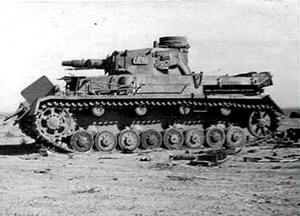
German Mk IV tank
The noose tightens.
The Division continued to withdraw on 3rd April, and the Field Park opened a water-point at Shelideemah. The Squadron passed them on their way to Rejima, as enemy patrols were by now entering Antelat, so the water-point there was closed after the Armoured Brigade had withdrawn. After their successful attack on Jarabub, and in spite of our signal to Cyrenaicka HQ to hold them at Abyar, the Third Troop had been sent by the Barche HQ to Antelat, which was by then already in enemy hands ! Attacked from the air as they approached their destination, they attempted to follow the usual practice of "baling out", but were then attacked from the ground and lost 6 killed. Also 6 were wounded, including the Troop Leader, Captain "Ark" Weston, as well as seven 15 cwt trucks being destroyed. Poor chap, like so many wounded in those days in the Desert, his evacuation to hospital surgery took so many days that gangrene set in and he lost his leg.
On their way North up the new Axis, Advanced Div crossed the Wadi Naggar with difficulty, as their Armoured Command Vehicles, in particular, were so unwieldy, and they pushed on northwards towards the Wadi Garridlah chasm. As we approached that obstacle, we were horrified to see about 1000 vehicles tightly packed and waiting to pass through the one very difficult track through it; they were reaching the far side at a pace of about one every 2 minutes. Almost all the remaining units of the Division, except for a few protective tanks, were now approaching, and were waiting to cross, as the total number of vehicles now rose towards 1500. The Squadron had crossed complete during the afternoon, but the Field Park quickly detailed a party under 2 Lt Harris to improve the track, enterprisingly using small explosive hand-charges to smooth off the worst of the jagged rocks, at the same time as we were all passing over them.. By the morning, the benefit of this risky action led to their being able to pass vehicles at some five times the original rate (latterly about 150 an hour). The difficulties encountered at this wadi did emphasize, if that were necessary, the reckless folly of changing the Divisional axis to an un-reconnoitered route at the last minute. If we had had wireless intercommunication between the Sapper units, it might still have been possible to make a reconnaissance in time to have improved the track before the main body arrived.
As events turned out, the enemy was concentrating on capturing the port of Bengazih, and thereby missed this opportunity, both from the ground and from the air, of ending the Cyrenaica campaign suddenly. Out of a total of nearly 2000 vehicles eventually crossing that Wadi, only 50 were lost, and these by overturning and comparable hazards; by daylight on 4th April all units had cleared that obstacle, and Advanced Div had reached Abyar, with Rear Div alongside. Some units of 9th Australian Division were in a defensive position on the escarpment near Beninah Airfield; as we were passing their flank, the German vanguard coming up the slope in the morning mist began to attack them with tanks and infantry. To my surprise, a random small arms bullet hit my car, penetrating the fuel tank.
We always carried some essential "self-help" items and, in this case, we were able to stop the leak with chewing-gum sealed over with adhesive plaster. In the very few minutes these precautions took us to complete, we were able to observe a troop of the 1st Royal Horse Artillery (on wheels) suddenly deployed for the courageous purpose of using their 25-pounder guns over open sights to destroy each of the German tanks. An even more impressive moment took place, when one of the 3.7 Heavy Anti-Aircraft guns, which had been defending the airfield, was turned onto one of the German tanks, absolutely shattering it. Unlike the bigger tanks we met later that year, these were mostly the Mk 2 with a 37-mm Anti-tank gun and a small arms machine-gun.
The Squadron had reached Rejima, and the Field Park were close to Abyar, when the Australian Sappers handling the demolitions suddenly blew up the water-supplies there. That water was still required by some units of our Division, which were already in Abyar and were queuing up for water, when the sudden explosion took place. Although acting under orders, and although the change of 2nd Armoured Division’s Axis may not have been coordinated with the Australians, it did seem essential that the junior Australian commanders should have been given powers of discretion on such occasions, as we had given to our own Troop leaders in similar circumstances.. Some units of our Division were now doomed to suffer immediate water shortage, as well as being already thirsty for fuel; Advanced Div HQ retired towards Barche covered by the Australians, whilst the Infantry Group moved to the area south of Marawah, now reinforced by the arrival of the (Regular) 1st Battalion of the 60th Rifles, and the Field Park joined them.
The Armoured Brigade retired from Abyar along the track eastwards towards Mekilih, accompanied by the 1st Royal Horse Artillery (on wheels) and the Squadron. Although the "Egyptian Gazette" of Monday 14th April published the "official" tale that Lieut General O’Connor was captured that night, when taking over from Lieut General Neame, it was in fact on the morning of 5th April, when they visited us for breakfast at Advanced Div, accompanied by Brigadier Kisch, their Chief Engineer. His staff officer, Bobby Phillimore, discussed reinforcements of men and vehicles with me, as well as the disposal of equipment not in use at this stage, and the possibility of getting a wireless truck attached to each of our Troops. We also discussed the water situation in the Mekilih area; however, as a result of the complete breakdown of the signal system, he confirmed that they had not received our reports of 26 & 29 March, and of 1st April, which had given details of all the engineer work done and still then in preparation.
Both Advanced Div and Rear Div moved south and east by difficult tracks in pleasant open-wooded country towards Gott Dervah, being dive-bombed and machine-gunned several times. On the way we met an Australian pilot, who said he had forced-landed; he made the surprising claim to have shot down four German aircraft that day, and went on to say that his Squadron had got a total of 18 ! Sadly we had seen nothing like that, which would have really cheered us up. Nevertheless, the petrol convoy for the Armoured Brigade was dive-bombed and 18,000 gallons of our vital petrol supply was destroyed. The Field Park moved from Marawah to Slontah, on their way towards Mekilih, and began a sweep of water supplies in the whole area south of the main road and north of the grid-line through Mesous, demolishing all they found and keeping contact with the Australians to the north of them.
Of the many of our small parties detached, three had temporarily been "lost" in the Ajedabiya area; however, one of these retired via Bengazih, and reached Tobrouk, whilst another under Sergeant Hurrell travelled across country direct towards Mekilih and reported to the Field Park on arrival near there, proudly holding 6 German prisoners. The third attached itself to the "B" echelon of the Armoured Brigade and travelled via Mesous to Dernah, where they were cut off by the enemy, so they wrecked their transport and equipment and walked to Tobrouk !. However, owing to the lack of any RASC 2nd line transport for Divisional Troops, there were no explosives nor mines on wheels and the amount scrounged locally was much too small to be effective..
This showed once more the vital necessity for second-line transport for engineer ammunition, especially in withdrawal. The Squadron was moving along the eastward track from Abyar towards Mekilih, but became dislocated on several occasions and was considerably delayed by dive-bombers, losing much demolition equipment. Although we did appreciate that the Royal Air Force strategy was to conduct their operations further towards the enemy, there is no doubt that it would have had a beneficial moral effect if they had occasionally engaged the enemy within sight of our troops. The view of even one enemy aircraft being shot down would have so heartened our men, dead-tired from being bombed and strafed by the enemy half a dozen times a day, while trying to achieve their objectives, as well as having to make the longer moves every night. By the morning of 6th April, 2Lt Graham and a Section had set up a water-point for the Armoured Brigade at the old Tackniss Fort, west of Marawah until such time as the petrol situation would allow them to retire along the Divisional Axis to Mekilih.
The Squadron, less its detachments, continued to move East, while aiding the Field Park’s destructive sweep of all vital resources south of the main road down to the tracks from Abyar to Mekilih. One exception to this was at Hackfett Gellgaff, where 2Lt Parker with a Section set up another water-point for the Armoured Brigade, in case they were able to continue to move eastwards. A major problem in any withdrawal is the lack of opportunity for the troops to receive hot food; I was impressed by the determination of the Squadron’s HQ Troop cook to take every opportunity to provide against any such failure, managing to sustain even the detachments from other Troops. Perhaps I should mention here that we had already adopted the practice of carrying 2 chameleons in each cook’s truck; they were wonderful at keeping the flies down. Div HQ continued to rumble on in the direction of Mekilih with its remaining collection of unsuitable vehicles on those very rough tracks, riven at frequent intervals by wadies; wireless contact with the air and with the Infantry Group had been lost, due to continuous operation for so many days without sufficient time for battery charging. As Advanced Div approached Mekilih, the awful lack of cohesion of our desert forces was demonstrated by the fact that Brigadier Vaughan’s Indian Motor Brigade, fired on us, and it took some 7 hours to reassure them.
Disaster.
By now almost all wireless contact had been lost, and Rear Div took up a position in the hills 10 miles West of Mekilih to avoid hanging about. Advanced Div was joined in the high ground between them and the Indian Motor Brigade by elements of various other units, including some of the Squadron. On 7th April, we could see enemy columns out in the desert to the South of us, and twelve German (Ju 52) supply aircraft were visible landing on the dry salt-pans about 7 miles in that direction, and later they took off again. We were still hoping that the Armoured Brigade had received its petrol supply and would be joining us along the track we had followed; however, our lack of wireless contact left us in ignorance. The Squadron organized patrols to scour west of us, in order to recover any worthwhile vehicles and stores abandoned in the withdrawal. They saw some Germen 8-wheeled armoured cars, but did have any weapons capable of engaging them, while enemy patrols in the hills North and East of us took up positions and began to fire at us with machine-guns and artillery.
When we finally heard that the Armour was not after all retiring towards us, Lieut Edwards took half his Troop as a fighting patrol, to extricate 2 Lt Parker’s party which, as they discovered, had already destroyed the well and had then withdrawn in the face of the enemy, taking 9 German prisoners on their way to reach Tobrouk safely. Lieut Edwards’ patrol had also engaged the enemy successfully in a brief fire-fight; 3 of the enemy were killed and the remainder escaped, with 2 wounded. If every Section of his Troop had been armed with a light machine-gun, they could have inflicted heavier casualties; afterwards, Edwards was awarded the Military Cross in recognition of his initiative and the gallant leadership he had exhibited throughout that engagement.
The Indian Motor Brigade was holding an extended defensive position centred on the old Mekilih Fort, a"Beau Geste" mud brick structure. There a water-point had been set up by their Sappers, who turned out to be 35 Field Squadron of the Bengal Sappers and Miners, commanded by Major Hayes, who briefly came under our CRE’s command. Hearing that they had a cobbler there, I decided to have my desert boots repaired as my others were in my kit with our Chief Clerk; while I was sitting there, a lone enemy field-gun started to range on the fort and I felt irrationally vulnerable because my feet were bare.
Both parts of Div HQ had now joined up on high ground NW of Mekilih, together with 901st Company RASC, 3rd Light Ambulance and some Light Anti Aircraft gunners,. We had no field guns and only one tank, but the General decided to break through to El Adem, near Tobrouk, at dawn the next day. During the night, the Squadron, less detachments, occupied a defensive position as a "keep" and all the other vehicles closed up ready for the dawn move, while the enemy’s field guns were being registered intermittently on various targets, or they were they just making sure we did not get much sleep ?
As first light dawned on 8th April, there was no sign of the Indian Motor Brigade, when our "charge" eastward began, using the 40-mm Light Anti Aircraft guns as field artillery to break a way out of our position, but it all failed under withering enemy machine-gun and sporadic field artillery fire. The General decided to withdraw 3 miles West, but the enemy immediately occupied the hills to the North, overlooking us and firing down with machine guns. Enemy tanks located hull-down in the dead ground to the South closed that direction as a possible line of dispersal. Using his Armoured Command Vehicle as a shield against the machine-gun fire, the General decided that the enemy remaining in our way must now have thinned, owing to the numbers moving to North and South of us. Once more, he ordered a "charge" eastwards with the ACVs leading, but it soon came to an end, in face of the accurate machine-gun fire on the "soft" vehicles.
© Copyright of content contributed to this Archive rests with the author. Find out how you can use this.


 Recommended story
 Story with photo