

- Contributed by
- Pamela Fox-Russell
- People in story:
- Lieut Commander Thomas Fox-Russell and Wren Pam Fox-Russell
- Location of story:
- Scotland and England
- Background to story:
- Royal Navy
- Article ID:
- A8477922
- Contributed on:
- 12 January 2006
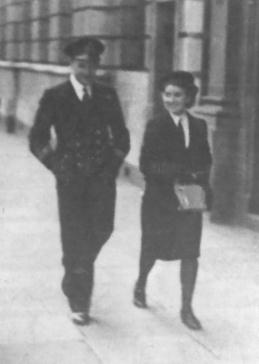
My father and I walking down Whitehall 1943
MY MEMORIES OF THE WAR
During the First World War my father served as a midshipman in the Royal Navy, on convoys in the North Sea. His ship was sunk at the battle of Jutland but he survived. On another occasion he was under a gun when it was fired, making him totally blind and deaf. At Greenwich hospital he recovered his sight and hearing in one ear and he met his brother Henry (RFC) who had an arm injury. My father and his family were devastated by the loss of his eldest brother Capt John Fox Russell, VC, MC, RAMC in Palestine in 1917.
In 1939 when the Second World War was declared my father volunteered for the Navy, the Army and RAF seven times but always failed the medicals as he had a very bad heart. He offered his services to the Admiralty and was taken into the Brown House, an extension of the Admiralty, organizing convoys in 1940. He had a medical but the Admiral Surgeon, who gave him the medical, told him all the things that were wrong with him. However he had to be in uniform to sign his own signals so he was passed with the proviso that he did not volunteer for anything other than his work in the Admiralty.
In 1938, just before the Second World War, we lived on Essex/Suffolk boarder where the German planes used to fly over us. They flew so low that we could see the pilot’s faces. Lamarsh, the little village in which we lived, was preparing for war. My parents were organising, and practising with others, First Aid and emergency arrangements in the ARP.
When war was declared my father said “we are not staying here” so my mother, me and the dog were bundeled into the car. It was a lovely little pale blue car, the back seat had to be blown up and it also had a dickey seat. We went up to Criccieth, my mother’s parents’ home. My father then returned to Lamarsh, sold the car and put our furniture into store and volunteered for the services. He was turned down seven times because his heart was so bad. On his return to Criccieth, he joined the Home Guard and took an allotment to grow vegetables. When he was missing my mother told me had gone down to London. When my father returned I heard he had volunteered to help get our soldiers back from Dunkirk. He remained in the Home Guard until he was called to the Admiralty. He then went down to London, found a flat and my mother joined him.
I was at boarding school at this time and coming up to seventeen. During the holidays I went to the WRN’s recruiting office and signed on to be called up when I became seventeen and a half. I did not tell my parents but the recruiting office were punctilious and sent a request, as I became the magic age. My father recognised the envelope and contacted WRN headquarters to postpone my medical examination until I had completed my exams and finished school. On returning home my parents asked me if that was what I really wished to do and as I said yes they agreed. For a short period I worked in the Naval War Library in Portland Place.
*Millhill, North London, the WRN training camp had been bombed just before I was called up. We gathered on Euston Station after dark, allocated to carriages and off to an unknown destination. There were no lights and the journey, with many halts, through the night with darkened countryside was quite eerie. During the journey we became acquainted with each other, where we lived and the schools we had just left. Among us, one was from Roedean, two from Whycome Abbey, three from convents including Sacred Heart, Richmond, and two from local grammar schools. From Glasgow station we were escorted to a small local line to the training camp of Nissan huts below Tullihuon castle. The following day we were kitted up with Bluettes, equivalent to the sailors’ uniform, but with skirts not trousers. Then there were heavy seamans’ socks and clogs, waterproofs and sou’westers. The sizes and state of the clothing caused much hilarity. My sou’wester was so big it came down to my shoulders, the waterproof was within inches of the ground, so by bending my knees and withdrawing my hands the outfit was a self-supporting uninhabited outfit!
During the fortnight we were there we had lectures on the Royal Navy, recognition of ships and our planes and those of the enemy. We slept in bunks where rats very frequently ran over those in bottom bunks. We were woken each morning by “reveille” which could not be ignored as the bugle was blown inside the half door of the huts! Early morning was spent cleaning, scrubbing floors cleaning the ablution blocks or whatever one was assigned to. I was taken off scrubbing flagstone floors in the castle because I put too much soap on and a Petty Officer slipped and I was very pleased to get a posting to Sick Bay polishing the floors. Drill and marching were a daily routine, first up the road to the Castle to the parade ground (known as the foredeck) for the whole ship’s personnel. There was much giggling and laughter on the way up and down to the Castle, any girl who happened to have a title was always more severely reprimanded than others which was so unfair. Not long before leaving we were given our uniforms, two navy suites, black shoes, white shirts and stiff white collars and the well known black bloomers (the famous blackouts.)
Just days before leaving we were given our typhoid and Tetanus injections and a half day off. We all rushed for transport to the station and a train to Glasgow where many were seen to faint and collapse!
After some little tests and an interview we were told which category we would be in and the work we would do. Then sadly we parted and I went to Portsmouth. We worked in the barracks during the day as well as more marching practice in South Sea. Our accommodation was in an old primary school among the ruins of South Sea. Clothes were hung on a rail and if you were foolish enough to leave a segment of chocolate in your pocket the mice got it, it was a little safer if it was slept on. The bombing continued, one of the WRN establishments received a direct hit, killing 80 Wrens. The terrible devastation of Portsmouth and South Sea was appalling and I shall never forget what I saw there.
Parkston Quay was my next destination and the destination of Doodle Bugs constantly flying over, which were shot at by a mobile gun to bring them away from the docks and dwelling area. Day and night we singularly went down to take secret messages to the ships, moored outside each other; our defence was a wooden truncheon. We had to climb up ladders and over from one ship to another in our skirts and “blackouts” much to the amusement of sailors who cheered us on. In the early hours of the morning great enamel mugs of tea, terribly sweet and hot, were passed down from the ships galley. There was a cinema on the Quay for sailors who could not go ashore. One night when the lights went up I was the only female present and the sailors cheered.
On a hot night, with the window wide open, I was woken by a doodlebug. Looking out of the window I could see it was coming straight for me, I leapt off my top bunk straight under the bottom bunk. It passed over and the others girls who were so used to this laughed at me. There were endless arguments as to whether these bugs came down when the engine cut out, or whether they went on after the engine cut out before coming down.
I was thankfully sent to London so that I could pursue further education. I was sent to Vintry House on Southwark Bridge, which was the Headquarters of the Reserve Fleet. The Wrens were quartered in houses on the Chelsea embankment. The Canadian Army drivers were housed behind us. In the evenings I attended the Chelsea Polytechnic. All the WRNS in the London area were moved to Englands Lane near Chalk Farm, which was the Charring Cross Hospital Nurses home who had been evacuated. This was real luxury with many bathrooms and only two girls to a room. I moved to Oxford Street Polytechnic where the tuition was superb.
My parents were now back together in London and my mother was expecting a long awaited baby. A lovely baby brother was born in Queen Charlotte Hospital and we returned to St. Peter’s Square, Chiswick. The bombing in London was heavy at that time so my mother and brother went to various temporary homes. As often as I could I went over to St. Peter’s Square to prepare a meal for my father. We slept in the basement and when the Square received a direct hit the windows were blown in and the shutter housing fell on my back. Luckily I was not hurt and we closed the shutters on the broken glass.
The Allies were doing well and the need for skilled women in engineering and radio sections meant a redirection of labour would be required, which took place in Holding Depots. I was sent to Reading, a pleasant encampment where I met Ann who became a life long friend. We were both sent to Lee-on-Sea to HMS Daedalus and housed in a large house in Fareham and the name of the house was Heathfield (now a hotel). It was a home of an elderly lady who lived on the top floor and could often be seen looking at us down the stairwell. Daily transport from house to Lee was by lorry, I was told off for jumping on with a marmalade sandwich held high!
Ann worked in the Pay office and I worked with a charming Third Officer in the Officers’ Clothing Store, right on the runway and it was interesting watching the planes. I was fortunate to go on an educational course in Crewe before being demobbed, then back to Lee before leaving the Wrens. We had interviews to help us to decide on our futures. I had decided at sixteen that I wished to become a doctor. It was thought improbable at school and the Wrens advised me that I should think of another occupation and tried to dissuade me. I did become a Doctor of Medicine.
© Copyright of content contributed to this Archive rests with the author. Find out how you can use this.


 Recommended story
 Story with photo