

- Contributed by
- John Constant
- Background to story:
- Army
- Article ID:
- A6951422
- Contributed on:
- 14 November 2005
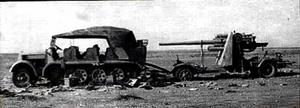
German 88mm Atk gun & tower
Near Despair.
Years of professional training as a Regular Army officer had not prepared me for the sight of a General waving his handkerchief out of the ACV’s roof-hatch, to betoken the white flag of surrender. I felt a burst of fury, as I went to my "office-truck" nearby to burn all the remaining Operation Orders, etc, and discovered that the wire in- and out-trays had a useful incineration role. I felt almost sick with anger as I saw the well-mannered German aide-de-camp, perfectly uniformed, coming to lead the General away, poor chap: dead tired, given an impossible task, and hopelessly ill-equipped, one could only feel sorry for him. I felt great sympathy for all our more senior officers, who had fought in the Great War a generation earlier, many of them decorated for bravery, and each should now have been at the peak of his career. I had hardly got to know our General in those few busy days we had been attached to HQ 2nd Armoured Division — a high-sounding name for an untrained shambles.
Ever more resentful, I watched the other senior officers, including our CRE, being escorted away as Prisoners-of-War, while I removed my badges of rank and packed a small pack with spare under-clothes and washing-gear; I hesitated to join the bedraggled lines of dispirited men being ushered away to sit on the desert about a mile from our vehicles, but there appeared at that stage to be no option. To add to my misery, the sky revealed a lone RAF aircraft overhead; the first we had seen for weeks. Dead-tired myself, I was thinking how unrealistic it seemed actually to have taken part in a surrender, and I was cogitating on whether the General had had any viable alternatives, as it was clear that the German artillery and machine-gun fire-power, including their tanks, was so decisive. Now I was with them, and about a mile away, I could see the bulk of the Div HQ vehicles, and those of the attached, all packed together neatly by our captors, but apparently useless to us; meanwhile we were idle prisoners, but unconfined. Fortunately, I realized, the majority of the Squadron and the Field Park were still on detachment and had not been caught in the net, although both the Officers Commanding those units were with me as prisoners. Still furious with the hopeless situation, I was so tired that I fell asleep there on the ground, and must have slept for well over an hour. When I woke, I found the sight of the enemy soldiers bossing our men around was a further irritant, but I began to feel the calls of nature.
Escapes
A little breeze had got up, and the well churned desert was being fanned into a mild dust "storm"; I decided to have a pee and, as I walked a decent distance away from the other prisoners for that purpose, I guessed that this might be my lucky opportunity, so I kept walking. The enemy soldiers guarding us were spaced about 25 yards apart, and I was in full view of them, but I had left my little kit-bag where I had been lying and may already have been undoing my flies. Nevertheless, I still had "un mauvais quart d’heure" wondering whether a guttural German voice would suddenly yell out at me !
Surely they would not shoot an escaping Prisoner-of-War without at least a warning ? Nothing happened.
Unlike the excitement typically experienced in the heat of battle, the very quietness of that moment just engendered a spine-chilling fear.
Just occasionally a blast of dust was swept by the wind, as I walked on, glad that I had had my boots mended by the cobbler.
Then, was it perhaps some sort of telepathy ? I became aware that John Bond was also walking, and on a convergent course. He was soon beside me, as we continued -- on and on — until we were near a group of the abandoned vehicles. Trying not to look conspicuous, we were about to mount a suitable looking truck, when suddenly we saw some German mechanics close to us. For a moment we froze, but fortunately their technical interests took priority and they stopped to examine the next vehicle to us, as they must have thought that we were some of their own fellows. Nothing happened and, in great trepidation, we got into a likely looking truck and I gingerly tried the starter; what a relief that it worked ! With John in the passenger-seat, I drove slowly westward, as if I was a mechanic unused to the vehicle, and still nothing happened. The expected rifle-shot did not ring out, and I kept going for about 5 miles, then bearing South-west, for a few more miles, until we saw a dozen of the big German 3-engined J.52 transport aircraft landing on the salt-pan, as they had done the previous day. Still in our battle-dress, it was becoming hot, as noon had come, so we lay in the shade under our truck, with it looking as if it had been abandoned.
After about a couple of hours, they had unloaded the aircraft and all was clear, so I took the wheel again to drive South. Gradually, in the distance, a motor-cycle and side-car appeared with a German soldier riding it, and I altered course towards him, accelerating as much as I could on the rocky surface of the desert. Unsuspecting, he turned in our direction and was all trusting until the last minute, when he suddenly realized that I had evil intentions - indeed, my pent-up anger now had an outlet, indeed a blood-lust. Panicking, as he tried to turn his front-wheel, he fell off, and I did not stop until my front-wheel was actually touching his shoulder; John leapt out and menaced the poor wretch, as I went round behind and grabbed the rifle from his side-car. He was obviously terrified, but we were then faced by awful doubts: did International Law permit one to tie up a Prisoner-of-War ? Did we have any rope ? NO. Taking the wheel in turns, how could we guard a prisoner ? 65 years later, I am still seeking a satisfactory answer to such questions! What we did was to take his boots and all his clothing, except for his uniform-shorts; we took his rifle and ammunition, his watch and water-bottle, and kept them all in the driver’s cab. We bashed his motor-cycle with a pick-axe to render it useless.
Although there was a big packing-case in the covered back of the truck, there was plenty of room there for our prisoner, as well as for the novel German Army 20-litre water-can. Keeping about 20 miles South of Mekilih, we then drove generally Eastward, taking the best of the "going" as far as we could judge. After a couple of hours or so, taking our hourly turns at the steering-wheel, the pangs of hunger proved powerful so, when we changed over at 1600, we looked for sustenance in the truck and found a tin of Pineapple Chunks. Sitting down on the ground with our prisoner, we each dipped our fingers into the can to grab the pieces, in order to assuage both hunger and thirst. My ability with the German language was fairly fluent, so I did my best to quiz the man, who gave his name as "Schulz", of Three Company, First Brandenburg Regiment; he tried to be careful with his statements, but admitted that he had not enjoyed his 6 weeks in Libya. While we sat there, we saw a Fieseler Storch light aircraft flying Eastwards about 10 miles North of us, so we judged there must, therefore, be more enemy troops ahead; we also wondered whether it was carrying their Commander, whom we later heard was called Rommel. About 2 hours later, when dusk had fallen, we crossed a series of tank-tracks; we recognized these to be from the Mk 2 and Mk 3 Germans, moving in a North-Easterly direction, and up to a hundred in number, accompanied by a similar number of heavy lorries. We concluded that they must be concentrating in a position to cut the road between Gazalah and Tobrouk.
Having previously noted there were spare petrol-cans in the back of the truck and that the tank was fairly full, we resolved to keep well South of Tobrouk and to aim for the Egyptian Frontier, which the Italians had delineated by a huge wire-fence with occasional passages through it. The moon was clear and we could keep direction without difficulty, but there were many small escarpments to be crossed; they were mostly descents, over each of which we fell with a considerable bump and the risk of breaking a spring. Every hour on the hour we changed over driving, and also checked the back of the truck but, at 0100, now 9th April, we were shocked to find that our prisoner was no longer there. Also absent was the big crate; it must have bumped out, when we "jumped" down one of the scarps. We were worried about our German guest, so lightly clothed and perhaps wounded by a fall, lying in the desert until the Senoussi picked him up; his future, then, would have varied according whether it was our long Range Desert Group to whom he would be handed by the Beduin, or whether similar patrols were already being mounted by the Germans. Mussolini’s cruelty towards the Senoussi had led them to retaliate by slaughtering lonely Italians, unless the price was good; but what did they feel about Germans, we wondered ?
It was no good going back, so we continued to the Frontier Wire about 0730 and soon found a gap to cross into Egypt, then driving North we were relieved to discover a petrol dump, guarded by a single Egyptian soldier. If Schulz had still been with us, his presence might have caused a problem; however, sadly being now without him, even our few words of Arabic were sufficient to charm the guard into giving us a fill of petrol for our fuel-tank. Following the well worn Trigh-el-Abd — "the slave route"— we made for Matrouh, and reported to the local Garrison HQ, where Brigadier Lomax gave us a hot meal. After interrogating us while we ate, he emphasized the need to avoid any delay; without further ado, he then called a driver and dispatched him, with John Bond as his passenger, up the road to Tobrouk to give the garrison there the benefit of our observations. Meanwhile, his own driver had checked over our truck, and prepared it ready to drive me, almost non-stop, all the way to Cairo with the gear from the prisoner, including the "Jerrican" -- the first one ever seen by our staff there.
As I was later able to piece together the whole "jig-saw" of information, it transpired that several parties totalling some 200 all ranks from the Squadron and the Field Park, including Lieut Weir and 2Lts Parker and Harris, had succesfully escaped the German net near Mekilih, and had reached Tobrouk, where they gathered together briefly with Major Hayes, the Indian Sappers & Miners’ Commander. Also, Lieut Terrell had reached Tobrouk with 90 of our men, mostly from the Field Park. When he had been some distance away to the West of Mekilih, he had been able to see in the clear dawn light that a debacle was about to occur, as Div HQ was trying to charge the German arms and armour. He had decided to lead the dozen vehicles with him into a wadi, where they had hidden for a while, before joining up with a (2-pounder, portee) Anti-tank Battery under Major Teddie Mitford. On the way across the desert to Tobrouk, this combined force managed to capture about a hundred prisoners Such was the situation found there by Lieut John Bond, after leaving me at Matrouh to be driven Westward to Tobrouk, which had not then been totally encircled by the enemy.
He reported to Brigadier Kisch, the Chief Engineer at Cyrenaika Command HQ, which had withdrawn there from Barche. John then regaled the General Staff with all he could remember of the experiences he had shared with me since our capture. Then, granted the temporary rank of Captain, he took command of those members of the Squadron and of the Field Park, as they trickled in. Many had had equally interesting adventures, including those with our heavy vehicles under the Field Park’s Sergeant-Major "Claude" Cumper; they had been following the main road through Barche towards Tobrouk, when they found that the route up the mountain escarpment at Dernah had already been damaged by some other retreating Sappers (later identified as 551 Army Troops Company, acting under orders of the local Garrison Commander). With some 300 vehicles of various units waiting behind him, and in danger of being captured by the advancing enemy, Cumper had led those Sappers with him (mostly Drivers by trade) for 6½ hours to make the road sufficiently passable to enable the whole column to pass, and they all reached Tobrouk before the Germans, coming across the desert from Mekilih, had cut that road..
© Copyright of content contributed to this Archive rests with the author. Find out how you can use this.


 Recommended story
 Story with photo