

- Contributed by
- actiondesksheffield
- People in story:
- Arthur Ward, Bill Turner, AI White, Eva, Ken Maureen, Cavill, Winnie, Bill and George Fazackerly, BC Maj Mansell.
- Location of story:
- Faugils, Milan, Dodomozola, Italy, Switzerland, Villach, Austria, Dover, Sheffield, England.
- Background to story:
- Army
- Article ID:
- A4770722
- Contributed on:
- 04 August 2005
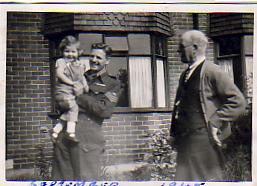
September 1945 - Photograph taken whilst on 28-day leave. Arthur Ward
This story was submitted to the People’s War site by Roger Marsh of the ‘Action Desk — Sheffield’ Team on behalf of Arthur Ward, and has been added to the site with his permission. The author fully understands the site's terms and conditions.
Refer to Chapter 1-- A4345544 -for links to other chapters.
LIFE IN THE ARMY
by
ARTHUR WARD
Chapter 29 — Home Leave and Demobilisation
Overseas mail was usually a long time in arriving and we were limited in the numbers we could send. An air graph was quick to arrive both ways, but we could only have one in a fortnight, air letters had more room but were very scarce and sea mail was as many pages as we wanted, but they took a very very long time to travel and they were all censored by an officer, so we had to be careful what we wrote. My Aunt Frances sent me every night's Star in a parcel every week, but many times they did not arrive. Parcels were sometimes tampered with as if someone had looked to see what was in them.
Mail from home was one of our main joys of life, a quiet night and plenty of food were next in line.
We were lucky at times to see some good shows with first class artists, sometimes they were not so good, we usually found the local picture houses where we saw all kinds of films.
We saw many extremes of weather, but had plenty of warm sunshine and blue skies.
We visited many places where we would never in our lives have had chance to see without paying very high holiday prices.
Places which stand out were Venice, Rome, South Africa (Cape Town), The Pyramids in Cairo, Tunis, The Casbah in Algiers, London, Edinburgh and one of our favourite places Peebles. Others were Norwich and Scarborough.
Then the main thing in the Army - Comradeship. Right from the start, we soon picked out mates and in most cases, a comrade would give their last cigarette or do anything possible to help a mate.
An instance of this is when I met Bill Turner from Maltby on Sheffield (Victoria) Station, and we clung together like leeches the first day. We stayed together until 1942 when we were both posted abroad to 11th (HAC) RHA but he was placed in ‘B’ Battery when I was in ‘A’ Battery, but we still kept in touch.
Unfortunately we have only met once since the war finished.
I had many very good mates but in the army we kept being transferred to other units, so then we had to start again.
After the war I, kept in touch with Al White, as he only lived 15 miles away at Thurlstone near Penistone. I would very often spend a weekend with his family and he very often came to my home. When he died suddenly from a heart attack in 1966, I was very upset and it took a very long time to get over his death.
August 28, 1945
The Journey Home for 28 Days Leave
The great day arrived (Python) leave that is 28 days in England.
I left Fauglis by truck to Udine, to 211 Transit Camp, arriving at noon and at 07:10 hours the next day, we boarded a train via Padua to Milan, to 310 Transit Camp. We were able to visit Milan, 3 miles away where we saw the marvellous cathedral, although we did not go inside. We saw the actual spot where Mussolini had been hung upside-down after he had been shot. The area round it was roped off as a view point for visitors. Spots of blood were still on the pavement.
We had 4 days in this camp; we learned that we would be travelling by train to Bologne in France, then by Ferry to Blighty. At this time of year, the channel was very rough so the troops were held in Milan until a ferry was available, so that the docks at Bologne would not be too overcrowded as troops were arriving there from all parts of Europe.
Whilst in the camp, we had an upsetting experience as it was reported that a woman had been murdered in Milan by a soldier. We all had to line up for an identity parade and the girl’s friend walked round rows and rows of soldiers. We never heard if anyone had been picked out, as it must have been just about impossible to sort us out, as we must have all looked pretty much alike.
We had a pretty easy time in the camp as there was a mixture of all regiments, so we only knew our immediate mates, although we did make a few special mates. We boarded trucks to the main station at Milan and marvelled at the size of it. There was a half round roof which was a terrific size. We boarded the train in a Second Class compartment, which was pretty uncomfortable for the long journey we had in front of us. We were travelling through the mountains and lake district of North Italy, and the scenery was outstanding.
We stopped at Dodomozola, which is the last train station in Italy.
We had a hot meal brought to us on the train which we all enjoyed.
We moved off again and soon arrived at the Simplon Tunnel, which is 12 miles long. During the darkness in the tunnel (the dim train lights were on) the Italian and Swiss border guards made a rough inspection looking for contraband etc., but they did not search very keenly. Most of the troops had various souvenirs, but I did not see anything confiscated.
After the tunnel we were travelling through, came the beautiful country of Switzerland. We passed Montreaux which was on a blue placid lake. Along the route were many Union Jacks hung from the bedroom windows of various buildings. I remember seeing a flag as big as a blanket, of the Union Jack being waved by a man dressed in a Scotch kilt. We followed the Rhone valley and we were soon being shunted onto the docks at Bologne. There we went into a temporary transit camp where all the documentation was completed at 2200 hours. We drew tokens to use in the NAAFI canteen and English money. We stayed one night.
Next morning at 09:15 hours we boarded the ferry, Princess Maud and set off across the channel. On board we were able to send telegrams home to say we would soon be home.
We were all on dock looking excitedly forward, when a shout went up that the White Cliffs of Dover were in sight. What a marvellous feeling the first time we had seen England for 3 years and 2 months.
We had been warned that the customs men would be waiting for us and that a lot of the loot would be confiscated. Many men panicked and overboard went many bayonets, German binoculars etc. I had a German camera (AGFA) but I decided I would take it through with me. We eventually docked and there were all the customs men, and all they did was to wave us through as quickly as possible and did not even look for anything. We were ushered onto a waiting train at Southampton, at 11:15 hours, and on the platform were tables full of sandwiches, tongue and ham etc.
The troop train was packed with soldiers all singing and cheering in a cheerful mood. We arrived at Victoria station, and red double decker buses took us to St Pancras. The train left at 1500 hours and arrived in Sheffield LMS station at 19:40 hours. I had to wait until 20:45 hours for a bus, and finally arrived home at 21:15 hours.
My mother and dad were waiting for me at the front door at 135 Worksop Road, Swallownest. This was the first time I had seen this house, as my mother and dad had moved whilst I was away.
At home were my mother and dad, Eva and Ken, with baby Maureen and my granddad (Cavill).
They all lived together in a three bedroom house. Whilst on leave my granddad had to move out as he had the third bedroom which I had to have. Maureen (my first niece) was 2 years and 2 months old and Ken insisted that he fetched her down for me to see, as she was fast asleep in bed.
What excitement!! And we stayed up talking until the early hours.
My 28 days leave started on Sunday morning 3 September 1945, 6 years from the day war started.
This leave was spent mostly visiting friends and relations. I also went to quite a few dances and plenty of visits to cinemas. I had one disappointment at the beginning of my leave. I had been writing to Nessie (from Lockerbie), although she had been living in Birmingham for 4 years, as she worked in Munitions. Our friendship had mostly been through letter writing and when she knew I was coming home, she said she would come to see me. She couldn't stay overnight as we were short of room and she couldn't get the time off work (she was now in lodgings).
However we decided, and it was mostly her decision, that owing to the distance between us, we had better end our friendship, so in Sheffield station we said goodbye for the last time.
One day I went hiking with Winnie and George Fazackerly and George's brother Bill (Navy) and his army pal. It was a very hot day and at George's mother's house near Bramall Lane, I took off my battledress tunic and went out without it. Whilst waiting for a bus, we were approached by Military Police and they checked our passes which were OK, but put all three of us on a charge for not wearing my stripes and they said we were all improperly dressed, because we had no tunics on.
Later I heard that they had both been punished by their Commanding Officers, but when the charge against me was forwarded to my Regt, the BC Major Mansell just laughed and threw it in the waste paper basket.
September 30, 1945
Return Journey To Austria
On 30 September, I left home for Sheffield Station. The return was not too bad this time, as we knew that it would not be long before I was home for good.
I travelled by train to London, to Bologne by ferry, then the same journey back to Milan.
Whilst I was at home, I had received a letter from the Regt. saying that they had moved to Villach in Austria.
I reported back to the Regt. But it was all upsetting news, the 11th (HAC) Regt had been broken up, as many men had been sent home after 4 years abroad and we had been amalgamated with 12th (HAC) RHA. The Sergeants were billeted in a large house in the main street, but more bad news for me when told that all kit I had left behind had gone missing, including my favourite belongings, my camp bed and some German souvenirs.
We had our meals in a large Hotel which was in the main square.
We started playing football, and there was a very good pitch in Villach. We did not have much work to do, it was a waste of time learning any more gunnery, we had no Sextons or guns to maintain, so mostly it was lectures to prepare us for Civvy Street.
One day, I had a visit to RHQ and had a brush with the RSM over a small problem which he made out to be the end of the world, so I thought.
If this is the army in peace time, I hope my demob comes through soon.
After a couple of weeks, our Battery Commander who was still Major Mansell, sent for me and said that he had received a letter from the War Office that my name had been put forward to be demobbed under Class ‘B’ release, which meant that I could be demobbed, providing I went back to my job as a bricklayer.
He gave me a few hours to think it over and he said that he hoped I would stay, as he did not want to lose any of his men who had served under him during the fighting.
I soon made up my mind. Several things that happened helped me in this. I thought about the RSM with whom I had crossed paths, we knew some of the 12th (HAC) NCOS resented us being in their Regt, so I knew we would get no favours from them. I had lost the job I had, being in charge of sports in the Battery and being on the dance committee.
We were a bit bored as there was not much work we could get our teeth into. Quite a few of my mates had been transferred to other units or gone home after 4 years abroad.
Mainly, I was still homesick after the 28 days leave. After such a long leave, it took some getting used to the army life and the extra Bulls**t since, the war had finished.
Major Mansell wrote out a personal Testimonial for me in case I needed it for work or anything in later life.
I had a medical inspection which was mostly the MO asking me if I was OK, and I said yes to everything, as I did not want any delay in going home. I realised afterwards that already over the last few months, I had been having upset stomachs and I wasn't hearing quite as well as usual, but I did not mention this to the MO. I was to find out later that my hearing became worse and in the late 80's I was awarded £3,265.00 from the War Office, as the hearing specialist at St James' Hospital in Leeds said that I had hearing loss in my left ear, due to the noise of 25 pounder guns and the bombing and shelling by the enemy.
My stomach has given me trouble all my life since the army, but it could not be proved that it was due to stress.
In the hotel in Villach, I had befriended the rather buxom middle aged cook, and when I said I was travelling home, she specially made for me a beautiful apple pie, but whilst waiting at Villach Station, I had to leave my kit for a short time and someone stole my pie!!!
On the station we saw some Russian Officers, and in sign language they told us that they were trying to commandeer a train to take them to Vienna, but they were not having much luck. They made us understand that they were hungry and had had no food, so we gave them some apples which they appreciated.
Eventually I boarded a train to Milan and this time, I stayed outside the city at Navarra where I was able to visit Milan again for a short visit.
I boarded a train at Milan and travelled on the same route as before to Bologne and across to Dover, then by train to London, and to Woolwich Arsenal, which is the peacetime HQ of the Royal Artillery.
I did not like this place at all - all that everyone was concerned with was `spit and polish', so we were pleased one day to travel to Olympia by truck, where we were fitted out with civilian clothing and we had to hand in our battledress for the last time. Although I was on army reserve, but with no pay for a long time, I was now officially finished with HM Forces. The day was 30 November 1945.
That concludes the dairy of my army service, so now my life picks up again as a bricklayer in civvy life.
My service days were from December 12, 1939 to November 30, 1945. That is 6 years except for 12 days, if I had not been demobbed on Class ‘B’ (i.e. return as bricklayer) I would have been demobbed in April 1946, which would have been 6 years and 5 months.
Pr-BR
© Copyright of content contributed to this Archive rests with the author. Find out how you can use this.


 Recommended story
 Story with photo