

- Contributed by
- actiondesksheffield
- People in story:
- Leonard Charles Eades
- Location of story:
- Crete
- Background to story:
- Royal Navy
- Article ID:
- A6450220
- Contributed on:
- 27 October 2005
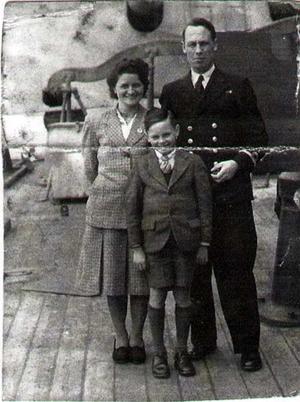
Commissioned Warrant Officer Leonard Charles Eadse. This photograph was taken at a later date, with his mother and younger brother, on HMS Rodney
This story was submitted to the People’s War site by Michael Maw of the ‘Action Desk — Sheffield’ Team on behalf of Mrs Sheila Russell and has been added to the site with the authors permission. The author fully understands the site's terms and conditions.
If you look at a map you will see the island of Crete is a long strip of land lying across the Southern end of the Aegean Sea and 300 miles from Alexandria. Bomber aircraft based on Crete could control all shipping in the Aegean; therefore after the fall of Greece it was essential to the Germans to take the island. It is a rugged mountainous country with one good airfield at Maleme and a place that could be used in an emergency at Heraklion. After the fall of Greece it was decided that air defence of the island was not practicable for a number of reasons. Firstly there were no good harbours or transport for large supplies, secondly there was only one airfield which was bound to be the object of the enemy's attack and if that fell, they must fly to Alexandria 300 miles away. Thirdly there were very few fighters and they could not be replaced in time to defend Alexandria itself. So the fighter force was withdrawn. The anti-aircraft defences were also scanty. At that time, we were expecting an invasion of England and rightly or wrongly, we kept most of our men and material at home. Added to that we had lost a lot of material in Greece, and with the Libyan air bases in enemy hands, it was too dangerous to run convoys through the Mediterranean. It is true, one did come through, as we came with it, but that is another story. So, though woefully short of equipment and lacking air protection, the army decided to stay and fight it out, with the assurance that the Navy would prevent an invasion by sea.
It was dawn on May 21st that HMS Fiji, in company with the majority of Med. Fleet left Alexandria. For the last fortnight, units of the fleet had patrolled the waters around Crete waiting for the German assault. Each night cruisers had been busy ferrying supplies of men and material to the island in a hurried preparation. At last news had come from reconnaissance aircraft that convoys were stealing down the Greek coast and we knew the attack was imminent.
On arrival off Crete, at about 2100, the fleet split up into 5 separate units. Two striking forces of cruisers and destroyers entered the Aegean itself, one force patrolled the north eastern entrance to the Aegean; one patrolled the NW entrance, while the main battle fleet cruised to the south'ard as a covering force, just in case the Italian fleet came on the scene. The Fiji, only 4 months in commission again after being repaired from a torpedo attack, was detailed to accompany the war hardened Gloucester, who had come successfully through all the actions in the med, the two being escorted by the destroyers Kandahar and Kingston. We were closed up at action stations all night but nothing happened and dawn saw all units withdrawing on to the main battle-fleet off the Western end of Crete. On board the Fiji we were just changing from action to A.A. Defence when R/Df reported "aircraft Green 100, large formation 15 miles." All that day formations attacked the fleet, but we kept together and put up a massed barrage that deterred them from pressing home their attacks. Some of the daring spirits however, sometimes broke through and one registered a hit on Warspite, which wiped out her starboard 4-in. battery, but did not decrease her speed.
We were attacked at regular intervals throughout the day, but no more casualties occurred. With darkness, we once more split up into our separate units and went in searching for convoys. During the night one of the striking forces in the Aegean ran into a German convoy of several transports and 20 or 30 caciques, which are fishing craft's little smaller than our drifters. Our force got in the middle of them blazing away with everything they had, and a few thousand Jerries met a watery end that night. Unfortunately, in the melee, the Carlisle was torpedoed by an e-boat and Naiad took her in tow, reducing the speed of withdrawal to 6 knots. With dawn, aircraft were sighted and Naiad asked for assistance. Meanwhile the remaining forces had withdrawn and were just rejoining the battle fleet. Fiji had just reported only 350 rounds of 4-in. H.A. Ammunition remaining, but before that could have got through, a signal came from Warspite "Force Z to proceed with all despatch to cover the withdrawal of force Y." I was in the 6-in. T.S. At that moment, the Gunnery Officer's voice came through, "Our big moment has come. We are going in. Warn all quarters to be prepared both for surface and air attack." Almost immediately, came the warning from R/DF, "Large formation approaching from Green 15; 12 miles." Shortly afterwards from the Gunnery Officer came, "I can see them, they are passing ahead to attack the fleet." Then came a medley of voices, through which broke the Gunnery Officer's, "With C.P.B.C load, load, load." "Surely you mean H.E sire?" I queried. "No," he answered, "there is a lot of smoke on the horizon and it looks as if we shall get our teeth into something at last." The log now showed 34 knots and it seemed the ship herself was quivering with excitement. The low angle R!DF gave a cut at 2400 yards and then from the R.A.set, "Aircraft approaching from ahead 12 miles." From the Gunnery Officer came, "Repel aircraft, turrets follow director, stand by to clear guns." I waited for no more, as my repel aircraft station was the 4 in. T.S and I had to husband that ammunition.
I arrived just as the ship shook under the discharge of the 12-6-in., and I watched the R/DF pricker creeping along the range plot. 13,000 - 12,000 - 10,000 "Open Fire." They began a confused medley of sound through my phones. The crack crack of the 4-in., the whoosh and shake of the 6 in., the roar of diving bomber engines; the pom-pom and chatter of close range weapons; the whistle of falling bombs the tilt of the deck as the helm went over, followed by the concussion as the bombs exploded near, and a clang-clang as pieces hit the ship's side. Often the ship seemed to leap and then drop back again. Above all this, I could hear the 4-in., Control Officer commenting, "That was close, I'm drenched to the skin." "I believe they've got the Gloucester; no, she's coming out of the spray; Yes we are all here still." Occasionally he would say, "That's one so-and-so less," or, "Did you see the pieces fall from that one? I don't think he'll get far."
During the first lull, I checked the ammunition and was forced to order the director to wait until the target commenced his dive before firing. Then came a blow as the 4-in. control officer said, "God, they've got the Gloucester this time; Yes, she's stopped and on fire." Over the broadcast system came, "All available hands stand-by to let go c Carley rafts." We zig-zagged a bit more and then turned towards where the Gloucester was slowly settling in the water and men were already taking to the water. A stick of three bombs had caught her amidships. We could not stop as once more came the warning, "Aircraft ahead." So as we passed, we dropped the Carley rafts which hung from the sides of our hangars and went on to draw the attack away from her. We fired the last of our I-I.E. and I ordered, "Carry on with practice and target smoke-shell." Long before this, the 6-in, had finished their H.E and were firing low angle armour piercing shells. I went on deck to go to the after 4-in. T.S., just as a terrific explosion seemed to lift the ship right out of the water. We heeled right over, but came back upright and with a sigh of relief, I saw we were still going at full speed. I went over to the side of the explosion and found the triple torpedo tubes had been lifted bodily inboard. Then I went on the 4-in. gun deck and found the deck under the foremost mounting had been rolled up like a piece of cardboard, and the gun thrown over backwards. Looking over the ship's side, I saw a sheet of armour about 20 feet long hanging by two bolts and flapping in the rust of the water. I think that near miss must have been a small one, say about 2,000 lbs. But there was not time to think about it, as back they came again; 1-leinkels this time, 9 of them. As I looked up at them I remember thinking, "How beautiful they look, just like a flight of swallows with the sun shining on them." But that idea was soon dispelled when they all released their bombs in a pattern.
Pr-BR
© Copyright of content contributed to this Archive rests with the author. Find out how you can use this.


 Recommended story
 Story with photo