

- Contributed by
- John Inman
- People in story:
- Anthony Inman Lt RNVR
- Location of story:
- India and the Pacific
- Background to story:
- Royal Navy
- Article ID:
- A8109119
- Contributed on:
- 29 December 2005
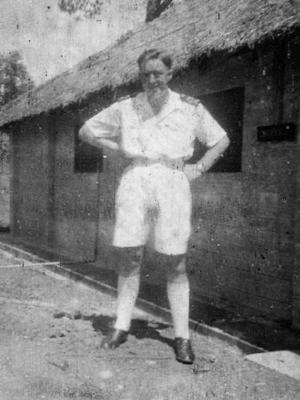
Tony Inman Katakurunda 1944
A View from the Back: The Recollections of a Fleet Air Arm Observer 1941-1946 by Tony Inman Part 9 of 14 (Sep 44 — Nov 44)
Chapter 9: Going Foreign
So off on leave to await posting, which came towards the end of September. It was at the time of the Arnhem battle for I remember listening to Stanley Maxted, the BBC correspondent, who was broadcasting from in Arnhem itself where he was with the Airborne Division. Norman and I wrote to each other to confirm we both had the same posting to Ceylon. Writing, for only posh people had phones. We met in Liverpool with most of the rest of the course where we embarked in the trooper Orontes, one of the P&O boats. By luck we were given a cabin, though most were in bunks in the holds. It seemed a biggish convoy of troopers for there were several other liners and a fair number of escorts. The convoy stopped at Gibraltar and then proceeded through the Mediterranean. By this time of the war the Med was open and next stop was Port Said at the start of the Suez Canal, Here we were ejected from our cabin which was taken over by some nurses who had been with the Australian forces in the desert and were now going home. We joined the less fortunate in the crowded holds where there were rows of bunks up to six layers in height. There was no air, just dozens of sweaty bodies, who could not wait to get
up on deck or into the big saloons where it was a bit cooler.
The canal is just a large straight ditch with steep sandy walls. From the upper deck you could see over the top across a sandy waste. Occasionally there were groups of Arabs who shouted and pointed and when the nurses were seen, exposed themselves and made obscene gestures. The nurses thought this a huge joke and replied with derogatory signals about the exposed manhood. The canal is not wide enough for two large ships to pass so a one way system is used, with stops at the end of each stretch. The canal is not continuous but leads to a succession of lakes until it reaches the Red Sea. I seem to remember we stayed overnight in the Great Bitter Lake; presumably to let a north bound convoy through. Eventually into the Red Sea where the heat became even more oppressive as we were unfortunate to have a following wind so the was no draught whatsoever.
At the end of the Red Sea we anchored in the harbour at Aden. Aden is in the crater of an extinct volcano and was, and probably still is, an unattractive place. Dark grey lava rocks all round, quite high, with the town on a shore of some sort with dock facilities. We did not stay long, probably only to fill up with fresh water and to rearrange the convoy for the dash across the Arabian Sea to Bombay. After the comparative safety of the Mediterranean and the Red Seas, we were back in an active war zone.
During the voyage we had not done very much and spent a lot of time playing cards. After a couple of weeks playing Solo, we thought to try something different and taught ourselves Bridge. I don't think we reached anything but a very low standard but, as we were all the same, it did not matter. We also became involved in a tug of war competition, entering a team from the naval aircrew to compete against the mostly Army and RAF teams. Among the naval personnel on the voyage was an old Warrant Officer who had been recalled from retirement. I don't know what his actual trade was but he was a fireman, both in the Navy and in Civvy Street. He had served in the London Fire brigade after his discharge from the Navy and had been in the Brigade tug of war team which won the AAA championship 3 years running in the early Thirties. He became our trainer. He showed us the techniques of how and when to pull, never bend your legs or your back and the proper way for anchor to wrap the rope round himself. He thought we needed toughening up so made us do exercises. (The fact that we did all this shows how bored we were.) One of the games you can play on the deck of a ship at sea is hand football which has the benefit of keeping the ball on the deck so it is less likely to go over the side. He made us play this but with a medicine ball! As well as scrambling around on all fours we had to knock this cumbersome heavy ball with our hands. It was to strengthen our backs and wrists, he said - nearly broke mine. We persevered and did quite well, though I don't think we actually won the competition. To compensate for the roll of the ship the pulling rope was led through two blocks so that both teams pulled in the same direction.
The passage of the Arabian Sea was uneventful and after about a week we arrived in Bombay. The harbour still bore some traces of the devastation caused when the ammunition ship had blown up some time previously. We disembarked and were quartered in, I think, the Bombay Cricket Club. I expect this first contact with India was a shock to those of us who had never been outside the UK. The heat, the smells, the teeming people, the beggars, the betel juice on the pavements which looked like blood, the bazaars and the ‘pukka sahib’ attitude of the white residents. These were the days of Empire and the Raj, no Race Relations Board or political correctness and I suspect we would soon have adopted the same attitudes if we had stayed long enough. For the few days we were there we did the tourist bit. We admired the big arch, the Gateway to India, we dined at the Taj Mahal hotel, drank iced tea in a cafe and bought sandals in a bazaar. Then we embarked in a small troopship 'Nevassa', for the weeklong voyage to Colombo. Nevassa was so old that only the outbreak of war in 1939 had saved her from the breaker's yard. She was running alive with cockroaches and little red ants, which luckily were not the biting kind. We slept in hammocks and, apart from the livestock, conditions were not too bad. I am not too clear about where we first stayed on arrival in Colombo but I expect it was at the Racecourse. The Racecourse, being large, level and straight had been turned into a temporary aerodrome, a grass field with no cross runways, just one - probably east-west.
Chapter 10: Katakurunda
After landing in Colombo I think we must have stayed there for a few days because I have memories of the shops and a wide thoroughfare past a fort of some sort with the usual assortment of beggars. I remember also bathing from a broad, sandy beach though this might be a later memory. We eventually went down the coast about 20 or 30 miles to the aerodrome at Katakurunda. The living accommodation was not at the aerodrome but a mile or two away on a small hill. On the top of this hill was the wardroom which had a large anteroom with walls about 3 feet high and from there to the ceiling was open, though there were shutters for when the weather was bad. The dining place was at one end. The building was surrounded by a covered veranda where at night the lights attracted myriads of flying insects of all sizes. These inevitably scorched themselves and fell to the ground where they were eaten by numbers of frogs that came out of the surrounding undergrowth. Living accommodation was in huts a bit down the hill in a ring round the main buildings. These huts were on a similar design to the wardroom, with palm thatch roofs and storm shutters. Each hut contained three largish rooms which held three of us. Our hut was looked after by a young Tamil named Vel. In the thatch were one or two snakes. They were harmless and called rat snakes, for that is what they did - ate any rats. The food was very good, especially on Sunday, which was curry. There was a great selection of ingredients in big dishes from which you helped yourself. This was always followed by fruit salad and then either a siesta or a lorry ride to the beach with big rollers and palm trees.
The airfield itself was the usual temporary strip of rolled metal carpeting, not very wide and not as flat as it might have been, but quite adequate for our purposes. Here we were introduced to the Avenger, an ugly 8-ton monster. The Royal Navy version of the Avenger differed from the original American version by being converted from a two to a three seater to make room for the observer. A cockpit had been made in the fuselage immediately behind the pilot. You entered from the top though a tunnel from the back of this cockpit that led to the tail where, in times of dire necessity, a .303 machine gun could be fired. On top of the fuselage was a twin .5 ball turret. The usual things had been put in the observer’s cockpit, chart board holder, compasses, radio, ASV (radar) parachute rack etc.
As well as our squadron, the strip was used by carrier squadrons, usually from passing escort carriers, to do some working up. On the first or second day there, one of these squadrons was doing stream landings, that is landing very quickly one after another, rather more quickly than was allowed usually on land but very useful for getting all aircraft down on a deck as soon as possible. One of these rather overdid it and was caught by the preceding one’s slipstream just as he was a bout to touch down. He was too close to the ground to do much about it and crashed turning over on to its back just off the end of the runway into a paddy field. It was quite close to the crew hut so we all dashed over to help where we found that the observer was trapped in his cockpit upside down. Luckily for the observer one of the wings had broken off and there were soon enough people there to rock the plane over towards the broken wing when the cockpit lid could be opened and the poor bloke dragged out of the liquid mud of the paddy field in time to prevent him from drowning. The mud was cleared from his face so he could breathe but I think he broke a couple of ribs. A lesson to us all not to get too close when landing!
Training went on apace. Day flying, night flying, navigation exercises, radio exercises (RT. had now taken over from WT and we had to learn the phonetic alphabet. This alphabet changed a bit when we started to work with or near the Americans). One night when we had been on a night navigation exercise we returned to aerodrome to find that a squadron had flown from a carrier (I think it was Rajah) to do night deck landings and so landing control had been passed to the squadron's batsman and he could not distinguish our aircraft from his own with the result that we were kept swanning around for what seemed ages. I got fed up with this and was letting my feelings be known to my crew when I was interrupted by an acid voice in my earphones ‘Unknown aircraft, you are broadcasting intercom.’ I had knocked the switch and it was a good job it was 'unknown'. Eventually we came into land. Norman made his normal immaculate approach and landing only to get the grudging comment from the batsman "Not bad, just try another one, to which I replied "Not bloody likely"
Soon after we arrived at Katakurunda an enquiry was made for anyone who had had experience of Swordfish. Only one observer, me, and one pilot, Peter Watson, had, and we were sent to Trincomalee, the main naval base which is in the northeast of the island. There had been a sub scare in the Bay of Bengal and it was decided that an air escort was needed for Victorious and 4 destroyers until such time they were clear of the coast and Victorious could operate her own aircraft. She had been in Trincomalee for repairs to her rudder and before finally departing had to carry out rudder trials. I am not sure why Avengers were not used but believe the right sort of depth charges were not available. Or perhaps the fittings were wrong. We took off laden with 4 depth charges and as soon as we were clear of the ground the wings on one side dropped and we flew along lopsided. It looked as if the aeroplane was banking but it flew quite straight. Peter tried all sorts of tricks to get the wing to stay up but it wouldn't and he concluded that the riggers had adjusted the flying wires incorrectly. That was not the last of our troubles. Victorious had left from the dockyard but we had taken off from the aerodrome which was a bit inland so we had a few miles to go to catch up. Victorious worked up to full speed about 30 knots to give the repaired rudder a real test so she was sailing away from us at high speed. Unfortunately this direction was straight into a fairly strong wind and with our ancient aeroplane only capable of about 65 knots we did not make very rapid progress. We did catch up, eventually, thanks to the fact that she did not continue in a straight line but zigzagged to test the rudder controls. Once we were able to get in front all was well. We didn't see anything.
My logbook shows that I did no flying during the last 2 or 3 weeks of November 1944 so we must have been doing a lot of groundwork and this must have been when we went on an escape and evasion exercise. Three or four crews went up into the jungle with an instructor, known, of course, as Jungle Jim. He was a rubber planter who had escaped with his family from Malaysia and it was rumoured that he and his wife liked the jungle so much that they spent eekends camping out. Anyway we were deposited at some remote spot in the jungle where he told us the ways to make use of things that grew there and also what things to avoid. Under his guidance we built a hut of palm fronds guaranteed to keep the rain out but luckily it was not put to the test. Food, my memory says, was mostly corned beef fried in palm oil, which is as revolting as it sounds. It was difficult to sleep what with monkeys howling, other creatures grunting, squeaking, snorting and shrieking. We stayed awake and played cards, which did not please Jim, who eventually got up and went outside. He called us out to show us, he said, something we should beware of at night. He would not allow a torch so we could see a luminous snake and sure enough there was this luminous thing. We should be careful, he said, as this type of snake tended to jump at its prey. The words were hardly out of his mouth before the thing jumped up in the air. I fell over backwards and down a filthy muddy bank and there was a general thrashing about as we all tried to escape from this leaping object. Jim then turned on his torch so we could see the 'snake’. It was a dead branch that had become covered in a fungus that glowed in the dark and it 'jumped' at us when Jim picked it up, unseen in the darkness. I think he won that round.
Next day each crew went off at intervals to make our own way to a map reference where, in theory, we would all meet up in a couple of hours. Hacking our way through jungle, coming occasionally on an animal track that might take us in the right direction was not the easiest of tasks. We learnt afterwards that if you did do it correctly then it was a reasonably straightforward journey, but none of us did. My compass reading was apparently no worse than anyone else’s. After some hours we came to a log slide. Trees were being felled and elephants were used to drag the logs to this slide where they slid down to the bottom of the hill. This log slide was near our destination which we reached shortly afterwards. It was close to a village and while we waited for later arrivals we were given fresh coconuts cut open so that we could drink the milk and scoop out the flesh which was soft. At last everyone was accounted for and we were led through the jungle to where transport would be available to take us back to camp. The rendezvous for the transport was next to a native refreshment stall where we had the most refreshing snack I have ever had in my life. Fresh bananas straight off the tree and dishes of tea, (Ceylon, naturally,) no milk, but sugar and lime. My mouth waters at the memory.
© Copyright of content contributed to this Archive rests with the author. Find out how you can use this.


 Recommended story
 Story with photo