

- Contributed by
- Frank Yates
- People in story:
- Frank Yates, Tich Williams, Donald Phelps
- Location of story:
- Hilden Barracks
- Background to story:
- Army
- Article ID:
- A7406219
- Contributed on:
- 29 November 2005
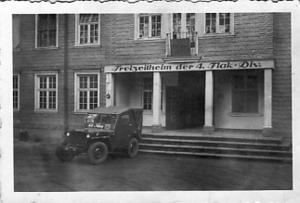
Hilden Barracks. The Fircombe Hall sign is on the balcony.
Memories of Frank Yates CHAPTER 43
So, in the early days of June, 1945, we said goodbye to Hamburg, handing over our palatial hotel to the Military Government and setting off on a long day’s journey, this time uninterrupted by enemy action, to the Rhineland and the Ruhr, to take over from the Americans. The Yanks moved down to southern Germany and Bavaria.
We took over a modern German barracks, in Hilden, a small town a few miles to the S.E. of the big city of Düsseldorf. The barracks, the HQ of a Flak Battalion, was superb, with every facility. Our first task was to take over from the Yanks. Our Recce Regiment were famous for its ceremonial efforts, even having articles printed about it in the press. They even had a special and unique colour of “Blanco”, manufactured to their own specification, in Britain. Their turnout and drill were impeccable, and spectacular to watch. The change over ceremony, involving the lowering and raising of\the Stars and Stripes and the Union Flag, was emotive and the Americans made a workmanlike job of it, we were pleased to see. For the next few months, until the Division began to break up, the recce lads proudly provided a Guard at the main HQ block.
As one leaves Hilden, on a steadily rising road which goes to Barmen- Elberfelt, a tramway runs at the side of the road, in no way interfering with road traffic. On the right is the entrance to the barracks, modern and well designed. As you enter, on the right was a special building divided into small rooms, used by the German soldiers to entertain wives. We used it as officer accommodation. The building was made of straw blocks, lightly bonded with cement. The blocks provided good insulation. Some bright spark got the Provost department to paint a large sign proudly displayed on the front, bearing the tasteful legend, “Fircombe Hall”. When Monty was due to give out medals, the general told us to remove it although it was restored to its place afterwards.
We occupants of the building were getting troubled by insect bites at night. A chance visit to the cellar, during the day, disclosed an astonishing sight. Comatose mosquitoes lined the walls to a depth of about a centimetre. They were little Draculas, sleeping by day and bloodletting at night! The R E’s decontamination squad was sent for and they donned a sort of sub aqua suit and goggles and sprayed them with the newly concocted insecticide called “DTD”. They shovelled the dead bodies out!
After leaving “Fircombe Hall,” on the right and carrying straight on, one came to the huge gymnasium, in which we played a lot of badminton. A road off to the right led down to the workshops and the storage areas and garages. I drooled over the two metre diameter parabolic glass mirrors as fitted to their searchlights. Some vandal, obviously drunk, smashed them all.
In the opposite direction, a broad boulevard ran up to the steps of the HQ Office block. The AQ Staff occupied the upper floors, G staff taking over the ground floor.
On the right hand side of the main road was a large block containing officers’ messes and hotel accommodation for the senior staff. Opposite was barrack accommodation for other ranks. All the blocks were built in rustic red brick and the whole place was brilliantly designed. In the toilets of our “B” mess were receptacles, like high level urinals, with two handles screwed to the wall above. Believe it or not, they were what one could call, a “Vomitorium” as there were three of them I suppose that makes a “Vomitoria”! If the original occupants got drunk after a mess party, they held the handles and spewed their hearts out! On the other side of the main road was a heavily forested area, containing a sort of Country Club, taken over as the NCO’s mess and accommodation. They had a large outdoor swimming pool and some tennis courts in bad repair. This then was the very nice accommodation in which we all finished our wartime adventure.
Here was an interesting situation, a large number of young men were at a loose end, no more hostilities, and, no regimental troops to supervise, so thoughts turned to leisure and alternative interests. Firstly, it was a priority to establish a place of entertainment and we took over a large club on the banks of the Rhine, converting it to an Officers’ Club and, for some unknown reason, calling it the “Yacht Club”. We attended this Mecca frequently and especially on Sunday evenings when a magnificent cabaret was staged, often featuring the principals of the Düsseldorf Opera Company singing duets from the German operettas. There would be acrobats, jugglers, conjurers and the like, all of a very high standard. All free and drinks flowing at ridiculously cheap rates! What a life! A popular drink was a “Princess Elizabeth”, a concoction of cognac brandy and evaporated milk. Nowadays they have rehashed and refined it and called it “Baileys”! there was an unpleasant incident when a young lady contortionist, very scantily dressed for those far away times, was assaulted by a drunken Mil Government bloke, who, unable to control his libido, was thrown into the Rhine by irate members, leaving him to be rescued by his pals.
Demobilisation was beginning, on a points system, governed by age and length of service. I personally, was at the end of the scheme, serving, from Sept 2nd. 1939, to the end of my demob leave, in Sept 1946, seven years to the day! I would be lying if I said that they were unpleasant years. Those war years were horrible and terrifying for millions of people, but, for me, they were a rich mix of interest and excitement, for which I am grateful for not missing.
Tich Williams, although a Rugby man, hit upon a scheme for entertaining the troops and keeping some of us busy at the same time. Football was the name of the game! Donald Phelps, our G3 (Int.) who was a Cambridge soccer Blue, teamed up with Tich and I was conscripted to help. We circulated a letter to all units in the Division for returns of the names and particulars of all professional footballers. A surprisingly large number were revealed. I cannot remember the all, but we had Arsenal’s goalkeeper George Swindin, who being a PT sergeant major, was put in charge of training and supervising the team. In the Normandy days, when 59 Div. was dismantled we inherited their Heavy AA regiment, recruited in Stoke on Trent. There were about half of the First Division Stoke City team. There was Grimsby Town’s England Goalkeeper, Tweedy, who refused to join us , saying that he did not want to jeopardise his England career by getting crocked in an army match. (I don’t think he played for very long after returning home). We had QPR’s centre half, Smith, three Welsh Internationals, from Cardiff City and Swansea Town and the remarkable “Ma Ball” Peter McKenna, late of Glasgow Rangers. He was a company sergeant major in an infantry regiment and refused to come into our set up, but kept fit and played for us. “Ma Ball Pete”, as he was known in Scotland, was a hard man, in the style of the modern day Roy Keene of Man. Utd.
These gladiators were brought into Div HQ, in charge of George Swindin, where they lived a comfortable existence, free of regimental duties and playing the game they loved and to which they looked to return after demobilisation. The reader will recall that I mentioned, in the last chapter, the “Non Fraternisation” policy of Rhine Army, but this was almost impossible to uphold, because the Army had to deal with the Germans for many reasons.
Very shortly, we had a German visitor, bearing the usual imitation leather briefcase and an invitation to play FC Barmen on Sunday, Tich agreed and we got word about so that there would be plenty of our troops at the match. We won easily, our players had not suffered the privations that the Germans had and this played no small a part in the many matches we won against teams like Cologne, Leverkusen, Essen and Munchen Gladbach.
On the Monday morning, after our first match against a German team, we were surprised when the manager appeared with his briefcase full of money, about 20,000 marks, our share of the gate money. This happened every time we played a German team. Tich put the money in a large safe in our office and it was used to buy sports goods for distribution. NAFFI had a sports goods catalogue, quoting prices in German marks, so rugby shirts were bought and all kinds of sports goods such as table tennis balls, tennis and badminton racquets, footballs, hockey balls and, later on, souvenirs for visiting English teams. There was a school exercise book in the safe, with the money. On the left hand page were recorded the income from matches and the opposite page had the details of expenditure. I shall, later on, refer back to this rudimentary accounting system.
© Copyright of content contributed to this Archive rests with the author. Find out how you can use this.


 Recommended story
 Story with photo