

- Contributed by
- Frank Yates
- People in story:
- Frank Yates, General Ross, Tony Rutherford
- Location of story:
- Baelen, Reet
- Background to story:
- Army
- Article ID:
- A7402619
- Contributed on:
- 29 November 2005
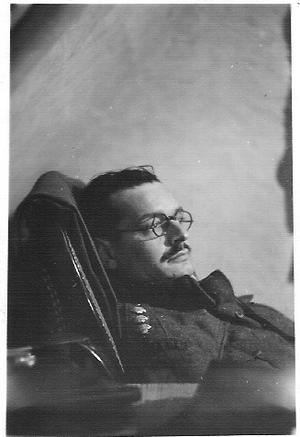
Tony Rutherford Army Photographic Interpretation Service
Memories of Frank Yates CHAPTER 33
After a week’s pleasant stay in Antwerp, we set off in a south easterly direction to a location near the small town of Diest, the date being Sept. 16th. We quickly moved further east to Baelen, as part of 12 Corps, our “proper” Corps. It was commanded by Lt. Gen “Neil” Ritchie, who had been replaced by Montgomery in the N. Africa campaign. He was very well liked and, as well as our Division, commanded 15th Scottish and 7th Armoured Divisions.
Our role was to protect the left flank of the advance of 30 corps up the vital road leading to the crossings over the three great river barriers, the Maas (Meuse), the Waal and the Neider Rijn. These two rivers are the lower Rhine and pass through Nijmegen and Arnhem respectively. This hectic advance up a single road caused much opposition from the enemy, who cut across the road several times. 8 Corps were deployed on the right flank, to stop these attacks. We had to cross the Meuse Escaut canal, collaborating, as usual, with 15 (Scottish). Our advance was halted at the Wilhelmina canal, on 20th Sept, as we were needed in the consolidation of the main push to the north.
To return to the beginning of our progress, up the left flank, where our infantry was meeting heavy opposition. Out of the blue arrived Jacques Hannebique, whose name I remember so well because in his 2 days with us, he made a lasting impression. He was 20 years old, a French Army officer in a resplendent uniform, complete with sky blue kepi. He had left Madagascar, his home, and made his way to Capetown and got a lift on a homeward bound convoy. His hatred of the Germans was pathological. I don’t know why the authorities chose us as his guardians but, although he was such a charismatic character and we would have enjoyed his company, he could not rest and kept imploring the G1 to let him get at les “Salles Boches”. He was sent to 71 Brigade who put him in an infantry battalion. He was captured by the “Salles Boches” on his first night at the front!
Whilst in Baelen, at about midday on Sunday, Sept. 17th, we stood, open mouthed, watching the biggest air drop ever seen. The sky was full of Dakotas, carrying paratroops, Dakotas, Stirlings and Liberators towing Hengist and Horsa gliders. We could see that, as they approached the dropping zones, the German AA was very active and we saw many planes going down in flames. Then, ten minutes later, the whole armada, returned, empty, over our heads. We little realised that we had been watching a very important episode in history.
Leaving our progress, on the left flank, we were sent up the main highway, following the Guards Armoured Div up the chaotic road. On three places, on the road, were the blackened hulls of convoys of vehicles, destroyed by German sallies across the route. On our way northwards we learned hat the Arnhem Bridge had proved to be a “Bridge too far”, and the Guards halted their advance on the road from Nijmegen, just south of Arnhem.
When Graves, with its bridge over the Maas, was reached, we were surprised that several American officers were still hanging about, busily occupied in wheeling and dealing, the lieutenant with whom I had a chat, had started off with his issued Colt pistol and finished up with a Luger, a Leica camera and a British Webley revolver. He, like all the Yanks we met, was from the crack 82nd and 101st. Airborne Divs. The Nijmegen bridge, together with the Graves bridge had been captured virtually intact by these American parachutists.
We passed straight over the great rivers, through to the “Island”, the land bounded to the north and south by the two branches of the Rhine. Across this low lying area ran the main road to Arnhem, now a dead end, with our Div, preventing any chance of an enemy attacking down the Arnhem Road. HQ was established in a large farm at a place called Reet, about a mile west of the bridge and a few hundred yards from the north bank of the river This was one of the few large buildings on the “Island " and a welcome shelter from the dampness and mist that were features of this water bound landscape, much of it below the river levels. It was October the 8th, with the nights drawing in, and from then until the spring we found buildings to live in, rather than tented accommodation. The occupants of the farm were missing, probably having left during the battle for the bridge. The main crop had only partly been harvested- Cox’s Orange Pippin apples, the largest and best we had ever seen or tasted and there were tens of thousands of them! We filled a 3 ton lorry with fruit to save for Xmas. Otherwise they would have rotted!
On the second day at Reet, I was told, by the General, that I was to go to an address in Nijmegen where he had arranged for the CO’s of the Div LAA Regt, and the Corps searchlight unit to attend at 10.00 hrs, and to pass on his orders. Feeling very important, they went something like this:- “Good morning gentlemen, Since the bridge was captured, several unsuccessful and two successful attempts have been made by the enemy to damage it by floating rafts of explosives down the river, On one occasion a midget submarine was suspected. General Ross would like you to ensure that nothing comes up or down the river, by deploying Bofors guns and by illuminating the area east and west of the bridge by night”. One of the CO’s asked for how long were they to maintain the guard and I said “Until further orders”, (General Yates!!), smartly saluted, and drove back to the apples!
Nine days at Reet was pretty boring, and we passed the time, after dinner, playing Lie dice and listening to stories from our motley company. A character was Tony Rutherford, the APIS. In the period before the war, he had turned his hand to chicken farming and, one evening, he regaled us with the problems that he had experienced, and before he had finished, we were rolling about! There is, it seems, a distressing complaint peculiar to chickens, called “Vent Gleet”. He reckoned that the smell was the worst ever experienced, he told us of burly red faced farmers who went ashen and fainted. He told us of church services that had to be abandoned and of milkers who fell off their stools!
On October 16Th our Div, having had a week or so to regroup and rest, we received orders to take the town of ‘s Hertogenbosch, a strong point opposing our efforts to open a corridor to the mouth of the Scheldt to open up the great port of Antwerp. There was disappointment that, after more than four months, the only working port was Cherbourg and war material was still being landed on the Normandy beaches. We trundled back over the Nijmegen Bridge and had a look at the unfortunate southern suburbs, bombed by the American Air Force, who clearly did not read the newspapers! After two one night stops, we arrived at Oss, the springboard for our assault on Den Bosch.
© Copyright of content contributed to this Archive rests with the author. Find out how you can use this.


 Recommended story
 Story with photo