

- Contributed by
- Frank Yates
- People in story:
- Frank Yates, John Simons, Bob Currie
- Location of story:
- Knighton, Clacton
- Background to story:
- Army
- Article ID:
- A7376718
- Contributed on:
- 28 November 2005
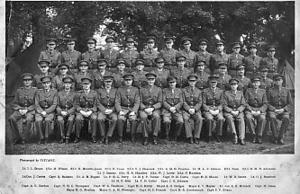
Officers of the 50th LAA Regiment Royal Artillery. Frank Yates is fourth from the left back row.
Memories of Frank Yates CHAPTER 21
Off I went, on my journey from Plymouth, North Road, to Knighton, in Radnorshire, on the borders of Wales. This involved a change at Bristol, then again at Hereford, where I took a local to Craven Arms, finally finishing at Knighton after a picturesque journey, through the beautiful and isolated countryside, pulled by a GWR saddletank loco.
When I unloaded my luggage, the station attendant told me that a vehicle was waiting for me. When I showed astonishment, he told me that Craven Arms had telephoned that an artillery officer was on the train and, as my new unit was the only artillery unit in the area, they knew who to contact. They knew how to run a railway in those days!
My final destination was a large mansion, approached by a long avenue of trees, in New Radnor. The first impression was rather spoiled by finding the house completely surrounded by bell tents and marquees. I was warmly welcomed by my new Battery commander, Major Boulton, who had been, I later discovered, a bank manager. From him I learned that the regiment was on a month’s “field training,” a euphemism for behaving like the Infantry!
My troop officers were a captain Bob Currie and a Lieut. John Simons. . Bob Currie was older than most of us, probably in his mid thirties, and had a slightly wizened look! They organised a shared batman to set up my bed in a quarter of a bell tent As I unpacked my things, I thought that, after two months of being my own master, and being responsible for the air defence of two towns, and, incidentally, having civilised living conditions, here I was, the junior of three officers doing the job I had been doing on my own. Bob and John then collected me, for dinner in the Officers’ mess, a large Marquee. I was introduced to the CO., a sizeable Lieut. colonel called Mitchell, who welcomed me and bought me a drink.
During dinner, I was very much feeling my way. I was now the most junior in a mess of the 39 officers in the 50th L.A.A. Regiment, living in a tent, eating in a marquee and, as I found out later, having to go to the monastery, at Presteigne, for a bath!
I noticed a grand piano at the end of the marquee, standing on four wooden blocks, and wondered why such an instrument should be in such an incongruous place. After coffee, I found out why. My fellow troop officer, John Simons, an Australian, was a concert pianist. After playing a Chopin Etude, he played “The Warsaw Concerto,” the theme music, by Richard Addinsell, from the film “Dangerous Moonlight”, both film and music being sensationally popular at the time. I was spellbound and joined in the generous applause. I discovered that the piano had been hired from Hereford and that it was common practice to hire an instrument, paid for from mess funds. I little realised that I would have the job, in the future, of hiring pianos!
John was a protégé of Dame Myra Hess, a fellow Australian, who was noted for giving lunchtime recitals at St. Martins in the Fields, throughout the war.
We were at New Radnor, for a month’s “Battle Practice” This meant aping the infantry and cavorting about in wet grass and doing strenuous and fairly pointless exercises in the Black Mountains and the Breckon Beacons, whilst living in tents, miles from anywhere. I cannot say that I much relished the prospect, my doubts being confirmed by events.
One disastrous night sticks in my memory. All the subalterns were given a party of about 25 gunners, a map and a compass, shown a starting point on the map and instructed to cross the high moorland to a rendezvous point some miles away, What we were not told, until evening, was that the exercise would start at dusk and continue to the meeting place at 0800 hrs!
There was a slight snag, the night was extremely dark, no landmarks could be seen and the compass could only be used to get a general direction, using the luminous N. mark on the card. Very soon we were one of the lost tribes of Israel, wandering aimlessly about the plateau. Occasionally w were diverted from our preferred route by a high wire fence, and so I took my 25 charges wandering in the dark, trying to read the O.S. map by striking matches, which promptly blew out. So the night passed. Once we stumbled into a flock of sleeping sheep, which immediately became bleating sheep! During this miserable night we came upon a little gully, which contained the bizarre sight of a group of men sitting round a little campfire, having decided that they had enough of pointless wandering. I carried on, thinking that we would keep warmer that way.
When dawn broke, I looked around for landmarks, to fix our position, and down below and far away, I could see a road. On checking the map I found that I had no idea which road, so we headed down the mile or so to the mysterious byway. War time road signs had been removed since 1940. Then succour arrived in the shape of a postman driving a little red van. He confirmed what I was already realising, that we were diametrically opposite, on the other side of the mountain, from our rendezvous point. Then for a brisk five mile march until we arrived where everyone else had been for ages, to be greeted with rude remarks, even from the colonel who thought it all very funny. They gave us tea, which was very welcome, before our return to New Radnor and a rest!
Although I was feeling a bit disgruntled about life in general, I could not grumble about my new colleagues. I was invited to a very nice night out, in the best inn in Hereford where we had a splendid meal and a most convivial evening. There seemed to be plenty of food in the lush grasslands of Herefordshire! I was of course, finding out more about my new friends, I happened to be visiting Bob Currie’s tent when I noticed some very nasty red scars down the leg of Capt. Thompson. They were very deep and must have made him medically borderline for military service. He had been in the ill- starred demonstration, in 1940, when the RAF demonstrated the fire power of the eight gun fighters, using a group of tailor’s dummies, dressed in military uniforms, as a target. Unfortunately, one of the Spitfire pilots mistook a group of spectators for the target, with catastrophic results. Thompson was one of the few survivors.
My Troop Commander, Bob Currie, was what is usually referred to as “character” He was a composer of cabaret-type songs and sketches and had, in fact, written and produced a revue called “Rumours”, which had, because of its security theme, been widely performed. I must confess that, with Bob and John as my fellow troop officers, I felt very humble!
Bob had worked in the City, for his uncle, who was a broker on the Baltic Exchange, and in the mid thirties, uncle was elected President of this British/ Scandinavian Association. They had an Operatic Society which presented a show, annually, at a west end theatre. A lottery was traditionally held for occupation of the Royal Box, but the winner was expected to offer it to the President!
Bob decided to break the mould and, having won the raffle, kept the box, turning up in it with a girl friend and braving his uncle’s glares from the stalls!
A week later, Bob was summoned to the Presence and told to report to Moss Bros., where he would collect a mourning outfit, complete with top hat, festooned with black ribbons. The Norwegian Ambassador to St. James had had a heart attack and his body was to be collected at Tilbury by a Norwegian destroyer for carriage home. Bob was to stand, on deck during daylight hours, as a mark of respect, by the Baltic Exchange
We endured a weekend exercise in the Breckon Beacons, involving several units. I was a little put out when some thoughtless twit pointed a rifle at me, at close range, and fired a blank cartridge, peppering my face with the debris from the wadding. I did not see the necessity to use blanks, surely, it would be cheaper and safer, just to point the gun and shout “Bang!”
One day, on part 2 orders appeared an announcement that the Army was looking for RA Officers to volunteer to train as AOP officers (Air Observation Post officers.). The idea of learning to fly attracted me and, defying the golden rule never to volunteer, I submitted my name.
Eventually we learned that our stay at New Radnor was to come to an end, and better still, that we were all to be given a week’s leave. A special train from Knighton took the whole regiment to Crewe, where our warrants could be exchanged for tickets to our home stations.
Peggy was, of course, delighted to see me, and the feeling was mutual. We enjoyed an all too short week, during which, Gladys and Walter, who were going to London for a few days arranged for me to meet them at the Regent Palace, on my last day. I was due to meet the regiment at Liverpool St. Station at 23.00 hrs, so they had time to entertain me with a meal and a visit to the theatre to see “The Merry Widow”, before I got the tube to the station.
The train took us to a place, in Essex, called Braintree, where we were taken , in lorries at about one o’clock in the morning, to a camp, where we were glad to lie down and sleep’ Next morning we discovered that we were in the “Mushroom Camp”. Whatever the history of the camp, it proved very comfortable, with good toilet facilities and we were given breakfast and lunch before moving on again to Clacton on Sea.
Clacton, in wartime, was a no go area for the public and the beach was defended by barbed wire and strong points. As were all seaside resorts, thousands of military personnel were stationed there, because of the many hotels, guest houses and holiday camps available for accommodating troops. We took over several large red brick hotels close to the sea, the Regimental Officers’ mess being the elegant dining room of the best of them.
© Copyright of content contributed to this Archive rests with the author. Find out how you can use this.


 Recommended story
 Story with photo