

- Contributed by
- krhudson
- Location of story:
- London
- Background to story:
- Civilian Force
- Article ID:
- A8956317
- Contributed on:
- 29 January 2006
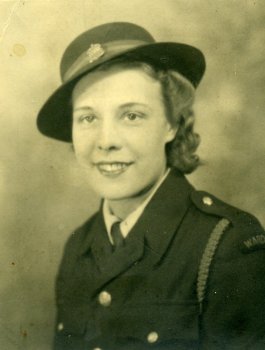
The picture shows Connie in her Air Raid Warden’s uniform 1943
The war was responsible to altering our lives completely. When war broke out I was working for a firm of wholesale and manufacturing opticians in Mount Pleasant WC1. I was Secretary to the chief accountant. After a year or two the firm was reorganised and the Chief Accountant’s office was moved to Hatton Garden and I was working there on the outbreak of war. My younger sister Hetty was also working for the same firm. My other sister Frances was a nurse.
People had been talking about war all summer and some precautions had been taken and although I suspect the politicians and the people in power knew it was inevitable, the ordinary person did not really believe it would happen. But happen it did, on that sunny Sunday morning. Many people had had corrugated iron shelters delivered to their homes and some had already been erected in the back garden. Not that we ever expected to actually sleep in them! They were called Anderson shelters after Sir John Anderson. Other households who had no garden, had an indoor shelter provided, which was fixed up in a downstairs room away from windows. These were called Morrison shelters.
Some months before, everyone was issued with an identity card. Babies when they were born had to get a card issued. And everyone had to have a gas mask. These were issued from church halls and school halls. They were carried about in a square cardboard box, slung over the shoulder. For the first few months everyone did carry them. To work or even going out in the evening to the cinema or a dance. You women going dancing in the evening, dressed in their best dresses, quite often ankle length, as long dresses were then quite fashionable, still carrying their gas masks. After a little while, a few months, as things were quiet, people became rather lax about it and stopped carrying them about quite so much.
Lights in the streets were put out and the blackout began. All windows had to be blacked out. This was mostly done with a curtain made of black material to start with, but as the war progressed, a lot of householders made a wooden frame to fit the windows and nailed black paper or material on to it, and as soon as the time came to light up indoors, these black out frames were fitted over the windows. After a time we got used to the blackout, fumbling about in the dark outside, with our small battery torches with the light shining downwards, finding our way home. Buses and trams were only allowed a minimum of light and the windows were darkened, with just a tiny diamond shape space left on the window. It was really a very trying time, travelling and walking about the streets to get home in the dark, but on the whole a lot safer than today with the lights on. We never heard of muggings or rape attacks.
Almost as soon as the last note of eleven o’clock had struck on September 3rd the air raid siren sounded. We couldn’t believe it, surely we were not going to be bombed so soon; but no — it was, fortunately, a false alarm, just an unidentified plane. We were to experience the real thing often enough later on.
Life had to go on at home. People like myself had to go to work. Although there was of coursed a great turn round of work. Men were called up for active service. Those who were engaged in essential jobs were in a ‘reserved occupation’ and were exempt, at least in the beginning. Of course owing to all these men having to leave their jobs and join the forces, their places in civilian life had to be filled by women. We saw women bus and tram drivers and conductresses for the first time and later women worked in the arms factories. Later there was a call up for women between the ages of fourteen and forty without children to join the forces or the land army, to release more men for active service.
I was still working for the firm of wholesale and manufacturing opticians and the firm was put on war work, supplying spectacles and equipment for the forces. The men working for the firm were ‘reserved’, and office staff were still needed, so I stayed there throughout the war. Sometimes I wonder what my life would have been like if I had been in the WRAF or the army or even a bus conductress. Even if you were not actually in the services, you were expected to volunteer for some kind of Civil Defence work. There were the ARP (Aid Raid Precautions) wardens, Auxiliary Firemen and women, special police, first aid workers and fire watchers. They were all voluntary, unpaid jobs. I enrolled as a part time Air Raid Warden and we worked on a rota shift system. I did evening and night shifts as I was working full time. To start with it was just a case of reporting to the Civil Defence Post, which was a hut in the school playground and just being available. After September 1940 it was a different story. When the Blitz started the wardens used to patrol the streets in pairs and check the communal air raid shelters to see if everyone was all right, and to be on duty at the post in case an incident was reported by telephone. Then we had to make contact with the Fire Service, first aid, heavy rescue etc. The worst part was when you had been in bed for few hours and the air raid warning siren sounded. You would have to get up and get your uniform on — trousers over pyjamas, tin hat of top of your curlers and report for duty.
Sometimes the ‘All Clear’ would not sound for hours and then it would be home to bed for an hour or two and then up for your days work. The strain of action and loss of sleep could be seen on lots of faces in the morning as people wearily made their way to work. In spite of it people remained cheerful and ready for a joke. Often you would find roads closed as buses could go no further and you would have to pick your way over rubble and fire hoses and past buildings that were there yesterday but now were just ruins, to your place of work. One day after a very bad night and a similar journey to work I found the building I worked in was no longer there, just an empty shell having suffered a direct hit with a high explosive bomb the night before. The employees were all standing around stunned. It seemed unbelievable. We were all sent home for the day, but back again the next day and somehow within a few days it was business as usual in temporary office nearby, having somehow acquired all sorts of office machines and furniture. We remained in these offices for a few months and then the accounts office transferred to a small building in Wembley Park and I travelled there and back by Underground until we eventually came back to Hatton Garden towards the end of the war.
Another wartime job I did was as a National Savings Collector. Every Sunday morning I called at several houses in the street where I lived* and the residents paid me a certain sum each week in exchange for savings stamps. I think they were sixpence, two shillings and sixpence and five shillings. When they had collected fifteen shillings I exchanged the stamps for a National Savings certificate. The money I collected was banked and this helped the war effort. These collectors worked all over the country. I did the job for seven years, carrying on after the war until it was phased out.
My friend Gladys and her young man, Gordon, joined the Auxiliary Fire Service, part time before the war and at the outbreak of war Gordon volunteered to go into the fire service full time and spent the whole of the war there. Although firemen did not go abroad as some of the services did, they worked incredibly hard and saw some serious action and some horrendous incident, especially during the Blitz. Gladys and Gordon married in December 1939. I was their only bridesmaid.
Gordon’s brother Richard volunteered for the army. Alan, slightly younger than Gordon, who became my husband after the war, also volunteered for the army**. Their youngest brother Kenneth joined the RAF. These volunteers were not motivated by a great sense of patriotism I am sure, but they knew they would be called up sooner or later and they would be given more of a choice of job in the forces by volunteering. Fortunately they all came back unharmed at the end of the war.
My own brother Frank although very young, joined the Navy and worked as a cook in the galley on a ship in the convoys patrolling the Norwegian coast. Being young I think at first he regarded it as an adventure, But I am sure he must have found it quite frightening most of the time. I don’t think he could even swim.
My sister Frances was working as a hospital nurse and was courting a bus conductor who later joined the army. They married quite early in the war. Her husband Charles was a few years older than her and a widower with three young children. With this ready made family, she gave up her nursing job and was evacuated with the children to Halstead in Essex, where she spent most of the war. Sometimes I would spend the weekend with her, travelling down on Friday night and getting up incredibly early on Monday morning to get to the office. What a journey it would be on Friday night, in the dark in a blacked out train crowded mostly with troops going who knows where. Sometimes we would be stopped in the dark for anything up to an hour if there was an air raid warning. I would arrive cold and hungry and find my way from the station to where she lived. I can remember that I used to have to go through a churchyard to get to her house. This was frightening in itself, especially in the dark.
After the Battle of Britain, the night bombing began over London and other large cities. People were very frightened of these nightly raids. They began as soon as it got dark and continued till the early hours. Many families had no shelters and even those who did began to go to the tube stations, not only for safety but for relief from the sound of gunfire and bombs. At first this was quite chaotic, but after a time some sort of order emerged. Shelter marshals were introduced, bunks fitted up and proper sanitation installed. Entertainment was introduced by the ‘campers’. Amateur singing groups and anyone who could play any sort of instrument, banjo, guitar, mouth organ, was very popular. People felt much safer underground and on the whole they were; but of course some stations suffered direct hits and then the damage and loss of life was considerable.
Rationing started in January 1940 with the rationing of bacon and ham to 4 ounces per week, sugar 12 oz and butter 4 oz. By July, cooking fat meat and tea were rationed. Tea was only 2 oz per person and by 1941 cheese was also rationed. We were only allowed three eggs a month. After a time dried egg appeared in the shops. We used this for a sort of scrambled egg, or if we managed to make a cake. Expectant mothers were allowed extra mil and eggs. Every person was issued with a ration book which we had to take to the butcher, the grocer and register with them and we were only allowed to buy rations fro the shops where we were registered. Sweets were also rationed, but there was a different procedure here. Everyone was allowed a certain number of points per month and sweets and chocolate (when we could get them) were sold on points. Clothes were also on a different set of points and were very difficult to get hold of. We had to make do and mend and alter our clothes. For a special occasion like a wedding we would beg or borrow coupons fro friends and relatives.
Luxury eating in restaurants was discouraged and in 1942 a maximum price of 5 shillings was fixed for a restaurant meal. At the same time communal restaurants approved by the Ministry of Food were developed and flourished in towns, where a meal of roast beef, potatoes and pas would cost about one shilling with a cup of tea for one penny. These were called British restaurants and proved quite popular and helped out with rationing.
Towards the end of the war, I think it was in 1944, the Germans started releasing unmanned missiles called V1s and later on there were larger ones called V2s. WE could see them coming over very fast , noisy and with flames spurting out of the tail. Then the noise would stop suddenly and we would wait a minute or so in silence and then a great big bang and we knew it had dropped somewhere causing a lot of damage. One afternoon while I was at work one dropped on Gladstone Avenue on houses on the opposite side of the road from us. It demolished several houses. Fortunately as it was as sunny afternoon most of the residents were out, but the houses were demolished. The houses opposite, including ours, suffered blast damage. All our windows were blown out, window frames and the front door were damaged. The curtains were in shreds and, ceilings were down and the beds covered in plaster. My mother was in the house alone, but although shaken and frightened, she was unhurt. We soon had the windows boarded up and cleared up the plaster and made some tea. For all the rationing there was always tea on hand in a crisis. It was weeks before the house was properly repaired. I remember my sister and I went to some friends to sleep as our bedroom had no windows and came home each morning for breakfast and to get ready for work. This went on for several weeks.
During the war I met several young men and had even become engaged, but after a year or so we realised we were not really suited and the engagement was broken off by mutual consent.
When the war ended in 1945 there was such a feeling of relief. Great crowds went to the West End, to Trafalgar Square and Piccadilly Circus and there was singing and dancing in the streets. Street parties were organised locally for the children. Streets were decorated with bunting and flags. Chairs and tables were brought out and someone would drag out a piano. A jolly time was had by all.
The return to civilian life was difficult. Firms were supposed to take back the men who had been called up but in lots of cases even with the best of intentions, this was impossible as the firm had changed completely to special sar work and the pre-war jobs were not available.
Lots of men who had been content with a humdrum job before the war after having acquired special skills in the services could not settle down to a civilian life easily. Young men who had held a position of authority in the forces found that when they were out of uniform and back in their ill fitting demob suit they were not really trained for any job in civilian life and they became very disillusioned.
All the Bullock boys returned from overseas and the services at home were disbanded. By this time Gladys and Gordon had two children a boy Stephen and girl, Anne. When Anne was christened I was godmother and Alan was godfather. A few weeks after the christening Alan rang me up at work and asked me out. We went to the cinema and that was the start of our courtship. It was years after that Alan told me that he had already seen the film earlier in the week. We were married on December 4th 1948 at St Marks Church Noel Park Wood Green.
*Connie Harvey lived at 51 Gladstone Avenue, Wood Green.
with her mum and dad, two sisters and brother. It was on the Noel Park Estate, which was owned by a trust which rented the houses out, mainly to transport workers. Connie’s dad Horace, worked on the Underground.
** Alan spent the war in the 8th Army in North Africa and Italy and was at Monte Cassino.
© Copyright of content contributed to this Archive rests with the author. Find out how you can use this.


 Recommended story
 Story with photo