

- Contributed by
- John Constant
- Location of story:
- Burma
- Background to story:
- Army
- Article ID:
- A7881816
- Contributed on:
- 19 December 2005
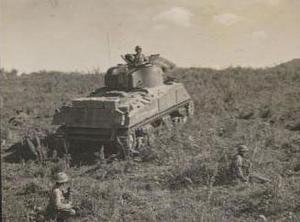
Tank O P for infantry
Chapter 3
I shall never forget the appearance of Kohima, when I saw it for the first time. The severity of the battle, with its continuous shelling and mortar fire, had stripped all the leaves and the twigs from the trees, leaving only the short tree trunks and occasional boughs, in all their nakedness. Nor was the jungle itself safe, being infested in many places with ticks, carrying typhus, from which many of our brave companions died, weak and emaciated so they were from the long drawn out struggle. However, when I joined them in the summer of 1944, the Division had just moved into reserve, securing Kohima’s important position, but also resting and refitting after months of fighting in the Arakan, whence they had flown up to Assam, mules (five kicking creatures to a Dakota) and all.
Our Brigade, camped out strategically in case of the Japanese resurgence, consisted of the usual Indian Army's ethnic mixture: British (2 Kings Own Scottish Borderers (KOSB)), Indian (1/11 Sikh) and Gurkha (4/8 GR), but we also had an additional one, 7/2 Punjab, at least for the time being. As well as our service units, including 400 mules, close by, there were both a British Field Artillery regiment and an Indian Mountain one; the personnel for brigade HQ were found by 8 Gurkha Regiment (8 GR) and the signal section were Sikhs. Our defence company came from the Maharajah of Baroda's State Forces; there were no Sappers, as they were all keeping the airfields servicable in spite of enemy or weather.
The Brigadier was British, but 100 per cent Indian Army in the Dogra Regiment. A fine figure of a man, but somewhat shy, nevertheless we got on very well, and he very rarely even criticised me. He was a great believer in staff officers getting out and about, and welcomed my willingness in this respect, so it became my habit, whenever possible, to eat lunch with the soldiers, as they messed by companies whenever they could do so, so they knew me by sight For the first few months, the principal task was to get everybody away on leave, in instalments, since it could take as much as three weeks for many of the soldiers to reach their homes. I felt sorry for the British ranks, for whom "leave" meant just a different part of Asia, and many of them, like myself, had not at that time seen their families for four years. By chance, I knew something of the 8GR, because their depot was in Quetta, and I had met many of them when I was at the Staff College there. In contrast, I knew little about the 11th Regiment of the Indian Army, who were all Sikhs, unlike the Punjab regiments which had companies of different religions. Ours was their 1st Battalion, and very proud of it. Their senior Sikh officer, the Subedar Major, a real "father figure", was old enough to have been my father, and this was epitomized by the fact that he had been fighting on the Dardanelles just before I was born.
By the time most of the troops had come back from leave, and reinforcements had replaced our casualties, the deficiencies in our equipment had been replaced, so training started in earnest, with just one weekend break, when the nearby British 2nd Div held a joint sports gathering with ours. Among the highlights of the occasion, we all enjoyed the magnificent sight of the combined pipe bands of both divisions beating retreat, with all the Scots wearing the kilt. Preparing for this, great efforts had taken place, not all being welcome to me, as all four of the infantry battalions surrounding brigade HQ had pipers, and each chose to practise on our side of their camp; a cacophony ensued!
Another brief respite from training occurred when Admiral Mountbatten, the Supreme Commander of the Allied Forces in Southeast Asia, presented medals won by members of our division, at a parade on the light aircraft landing strip cleared out of the jungle near us. The spit and polish was commendable and all ranks were elated to witness the display, which included a gallantry medal for one of our 4/8 Gurkha soldiers. I had met the Admiral some months earlier at Cocanada, and was much impressed by him.
One of the objects of our operational exercises was to increase our endurance on night marches in the jungle, where the bamboo grew so fast that paths cut through the bamboo one week had grown up again if we returned a week later. The leeches were merciless, penetrating the folds of our puttees, to feast off the blood of our legs, sometimes leaving their fangs in the flesh to fester; even after medical care this usually left a scar for life (I still have 2 of these scars). There were many other insects and reptiles, but some of the most dangerous were the malaria carrying mosquitoes, so we all had to take our dose of Mepacrin daily; this required good discipline and, in the hope of discouraging the Indian and Gurkha soldiers from taking theirs, the Japanese spread false propaganda that the Mepacrin pill destroyed a man's virility.
I should, perhaps, mention that this part of Assam was sparsely populated, with thick bamboo jungle occasionally interspersed with small open areas of primitive huts and vegetable plots for the Naga families, who wear little or no clothing, and keep dogs for 2 purposes: (1) as pets and (2)as a source of meat to eat. They have a habit, which terrified a detachment of three RAF men, manning an early warning radar on a spur some way to the east of us. One morning they woke to see seven Nagas, in single file, with upright spears, on each of which was the head of a man from the next village, raided by them in the night; apparently an annual occurrence.
© Copyright of content contributed to this Archive rests with the author. Find out how you can use this.


 Recommended story
 Story with photo