

- Contributed by
- John Constant
- Location of story:
- Burma
- Background to story:
- Army
- Article ID:
- A7881915
- Contributed on:
- 19 December 2005
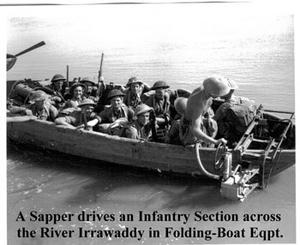
Crossing the River Irrawaddy
Chapter 5.
Driving back in the dark towards Kalemyo again, I had to stop to allow a convoy to pass, and who should be sitting in the leading vehicle, but (then Major) Bill Adams, my great friend and batch member, whom I had last seen in Poona a year earlier. Our warm greetings held up both tracks for a few minutes.
Later that evening, returning to Brigade HQ in the jeep with my driver, batman and gunman, all three Gurkhas, the two latter were sitting on our bedding, etc, with their weapons held high to engage any possible snipers in the trees on either side; I had the Bren-gun pointing over the flattened windscreen down the empty track ahead. We suddenly saw a pile of "footballs". Deeply suspicious, we stopped and realized that an elephant had just passed that way. The Gurkhas had an earthy sense of humour, and there were many occasions thereafter, when these three would remember that incident and laugh about it. Back in my HQ again, I found the Brigadier most interested in my account of the Chindwin bridging, and he admitted he would have loved to be a Sapper himself.
The next day we said goodbye to our vehicles and just before we started marching, along the Gangaw valley, we enjoyed a surprise visit by the Army Commander, General "Bill Slim". It was quite informal; no parades, no spit and polish. I had not previously met him and now found him to be rather dour, but he had a wonderful reputation as a fighting man, and we all appreciated his making time to see us off. The brigade was to go ahead of the division, dividing into three battalion groups, moving in parallel columns on forest paths, still almost due south through the Ponnyadaung, later Pondaung, Hill features towards Pakokku.
The Gurkha Battalion Group was on the left, and the Sikhs on our right, while brigade HQ was in the centre column with the KOSB. That night happened to be 31 December 1944, and, in the moonlit open forest, the Scots celebrated Hogmanay as best they could, without noise and lights, but with a limited supply of liquor. At the Brigadier’s suggestion some of us moved independently among the soldiers, who were a model of good behaviour, chatting quietly about their homes and their families. We had acquired an intelligence platoon of Anglo-Burmese, a pleasant hybrid, who served an additional purpose by providing an occasional source of good toddy, when they knew of a tree in the right condition. Although we never saw any women as we advanced, these Anglo-Burmese used to collect any of the supply parachutes, deemed to be unserviceable, to swap them with the village girls in exchange for information about the Japs.
These days were spent in extreme simplicity, with a lack of any creature comforts, so that our only means of transport, the mules, could be almost entirely laden with ammunition; only just one was allotted for all the administrative requirements of Brigade HQ. Not even a spare pair of boots was carried, but replacements of specific sizes could be demanded in the daily airdrop. We each carried a pack, with a change of underclothes, our wash bag, one blanket, a poncho/groundsheet, and two days’ hard ration, as well as a kukri, two grenades, 15 rounds of ammunition and our personal weapon --- in my case a USA .300 semi-auto Remington carbine.
Getting up well before the stand-to at first light, so that we were all ready to move, as soon as the cooks had produced breakfast and distributed a packed lunch to each man, we marched in tactical formation for six hours; each column being ready for ambushes and snipers, but with the imperative of reaching its chosen dropping zone by 1400, when the Dakotas were expected and the supply-drop had to be gathered before our starving Japanese enemy could grab it. As an "all drinking" Brigade, the occasional loss of the rum ration was felt deeply, and the mail drop often seemed to go astray. The meat ration was fresh, but frozen, and had to be thawed in time for cooking and eating before evening stand-to. Fodder for the mules was dropped free and hit the ground with an almighty wallop.
On the second day of our jungle-march, just as we were approaching our dropping zones a Japanese Zero fighter appeared very low over us; no doubt hoping to intercept a heavily laden Dakota. We had no anti-aircraft guns, but engaged him with every available Bren light machine gun and drove him off, but not before he had made a couple of strafing runs in our midst. Few, if any, were hit by bullets, but several suffered terrible pain from bamboo splinters, which appeared to land from every direction onto their hapless victims and were tiresome to extract.
Although we observed wireless silence, our signallers kept watch all night, for the three or four encrypted messages usually expected; since most referred to the day ahead, when we would be on the move and could not erect the tall aerial. As soon as they were deciphered, I was woken to check whether they demanded immediate action; this was always a problem, when thus wakened, to concentrate one's bleary eyes, with a minute electric torch under the blanket, and decide whether to disturb the Brigadier, who was 15 years older than me, and I felt he had to be cossetted. So I hesitated ever to wake him, and usually took whatever action appeared appropriate; there was only one occasion when I was reproved for not waking him, and even then he agreed with the action I had taken.
© Copyright of content contributed to this Archive rests with the author. Find out how you can use this.


 Recommended story
 Story with photo