

- Contributed by
- TORRANCE Duncan Leitch
- People in story:
- Duncan Torrance
- Location of story:
- Egypt, return U,K.
- Background to story:
- Army
- Article ID:
- A7594815
- Contributed on:
- 07 December 2005
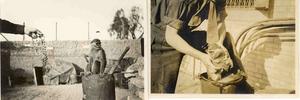
Resus monkey called 'Gypo'. He was taken off a troopship from India in Port Said. Continuing to U.K. would have crated a quarentine problem for rabies. Kept on a chain, he spent a lot of time in my office. Driver Harvey used to bath him.
CHAPTER X1V - Part Two - A BASE WALLAH
On Xmas morning at seven o'clock, a corporal from the neighbouring welfare unit woke the sergeant that slept in the compound and told him there was a hole in the outer compound wall.
Quite naturally, the sergeant thought his leg was being pulled. When the corporal came back at 8.30, with the same story, the sergeant thought it was worth investigating. To his horror, he found it was true. He sent a truck up for me, and the telephone orderly, who also slept on the compound premises, down to the billets to raise some checkers.
I arrived on the scene by ten. By this time, the bay where the hole was, had been checked. It was found short of one item only.
Everybody was full of Xmas spirit. So, after we had informed the Military Police, it was unanimously voted that two crates of Stella be obtained from the local NAAFI. At 11.00, there was still no sign of the Military Police. We blocked up the hole in the wall and backed a truck up on it.
We left the poor duty clerk in charge and went off to the football match, officers and sergeants versus other ranks. When the Military Police came, they seemed to feel the same way as we did. They viewed the hole, and said they would make a second visit after the holiday. Nobody did anything more 'till Friday.
On Friday, we made a complete check of everything in the yard. We found that we were twenty pieces short. Although the hole had been made in the UK bay, stuff had been taken from the CMF and Tripoli bays. My first valuation of the loss, was at least £200. (I later learnt that one officer had claimed £271 from his insurance). In the end, a lot of what was taken was old clothing being returned to an Ordnace Depot for accounting purposes.
Imagine my horror when people started talking of Courts of Inquiry, and finding someone on whom they could pin the loss. I had previously taken the precaution of writing to the Garrison Engineer, asked for more barbed wire and a proper brick wall, pointing out that the present protection was useless. It was this, and one or two cleverly framed statements which absolved us from blame when the final inquiry came.
The day of that inquiry was long and tedious. It also heralded my next disaster. Wearied, I was passed a pile of signals to sign. They had to go out immediately. Given to me by a reliable corporal,
I just signed the lot. The first and last time I will ever do this without reading them.
The signals were all the same. They asked the receiver to collect the goods consigned to them within fourteen days, or they would be returned.
One of these signals was for a box, the personal property of the Major General Administration. Lieutenants weren't supposed to address generals in his way. His P.A. read the notice, not even the General. But the P.A. issued a rocket to my senior officer in GHQ. This duly descended to my boss, with a few additions. The damage was done. Every Movements Officer in the Middle East knew about it. Those senior added their criticism, my equals pulled my leg. Never again.
I was told that a planned promotion to Captain was also finished. Pity, Captains were well paid.
The motor transport situation. Tyres were still a problem. We reckoned our three tonners were still averaging a blowout every 1.000 miles. It took six months to get a tyre through the proper channels. In December we may have established an MFO record. Of our seven three tonners, four were off the road. A truck took at least four weeks for a small repair in a REME workshops. The longest was nine weeks.
We contrived to move some 460 tons by road, mainly on long distance journeys to Alex and Port Said, which took two days. On paper this beat our previous record by 80 tons. Really we were moving more. What we were showing as three tons often proved to be four when lorries were put over a weighbridge.
During this period, the organisation was changing and the evacuation of Cairo was really beginning to move. Originally, MFO was directed by a Major, the DAQMG of QM3(F). Under the new arrangements, we came under the direct control of a Major in British Troops Egypt, who, in turn, received his instructions from another Major in GHQ. Neither of them knew anything about the job, which had just been tacked onto them as an after thought.
I decided to make as much use of their ignorance as I could. So, I began to travel about on what were officially liaison visits. In particular, I could visit the British Troops Egypt headquarters at Moascar, and the occasional jaunt to GHQ at Fayid. These were a good chance to get out and enjoy myself.
Our old boss had a large number of friends for whom he would do anything. It was easy for him just to lift the phone. He did not have to divert vehicles, scrounge wood for crating (unobtainable through normal channels) The crating system was terrible. A workshop had agreed to do crating on a charges recoverable basis. But this workshop had been one of the first units in the area to be disbanded. This left us high and dry.
Every time I got onto the new British Troops Egypt, their answer was always the same. 'Tell them its their responsibility'. He had not to stand in the office, as a lieutenant, telling about four colonels and twenty majors, this story.
They had to find a civilian to do it. It would then cost them about a pound a crate - more than my days pay. At that stage, every item had to be crated before we could accept it.
This was the most trying period I had in the job. It made me particularly angry when they asked me for my opinion. I told them to whom they should complain, but very few of them did.
One Major was particularly awkward. After a good deal of argument, asked to borrow the phone to try and get someone to make a crate. While he was in the other room, a Brigadier came into the office to see about his kit. The Major blundered in, still mumbling and grumbling. Then he saw the Brigadier. The surprised expression on the Major's face was a scream. Then he collected himself, saluted, and departed somewhat tamed.
As Egypt packed up, I pondered my future. Should I just wait. Perhaps something more constructive might be a good idea.
The old ADGRE for the Middle East Graves Service, had left in the summer to take over Graves in BAOR (British Army of the Rhine). I had discreetly sought to make to Sure- my name was not forgotten.
On Thursday 28th February I returned from Suez. There on my desk was a signal.
TO MFO MIDEAST
FROM OOA MIDEAST
360466 LT D L TORRANCE A AND SHS SOLL ON DEPARTURE MELF ON POSTING TO BAOR RPT LT TORRANCE
I started to try and decipher it. What did it all mean? 'COA' was the pay office in Jerusalem, so, apparently, I should have left already. 'SOLL' was a ticklish one. 'SO' was obviously 'struck off'. I thought 'LL' must be a mistake for 'S' strength. But eventually it turned 'LL' was lodging list. Thus, struck off lodging list.
In the morning I tore down to see the Major. He phoned GHQ and found I was on a War Office posting to Germany. But I would not be released until I had closed down the MFO depot. This would be completed in about a fortnight.
It seemed only a matter of hours before I stepped into my little pickup truck outside the flat and was on the road to Port Said for the last time. A transit camp is at best a bleak place. It was a sad moment when I said good bye to my driver for the last time.
I was thirty six hours in the camp waiting for my ship. I thought of all my many friends in the Middle East.
But now I was really leaving. When I had arrived it was the 'Middle East Forces'. When I left it was the 'Middle East Land Forces'. It was said that 'Land' was added to stop the troops dubbing the initials MEF, as, The Men England Forgot.
The ship was to be the 'Empire Battleaxe', the same ship that had brought me to the Middle East over a year ago. I was looking forward to the journey. When we were herded onto a Landing Craft Infantry, and herded up the gangway, I realised how much I would miss my former position of comfort and authority. We had excellent weather. I had a camera with which to amuse myself.
I happened, one morning, to be chatting to a civilian. He turned out to be a senior official of the Imperial War Graves Commission. Completed Cemeteries were handed over to the Imperial War Graves Commission who looked after them long term and arranged access for
visitors. My friend was out here making a preparatory recconaisance of some of the cemeteries including Benghazi.
He was at great pains to explain the plans made in London and the changes he was proposing as a result of his visit.
The final plan certainly seemed to achieve something both beautiful and blend with the local scenery. All the trees were to be left.
Also grass and flowers were to be planted. The place was to become a veritable garden in the wilderness.
I also took the opportunity of informing him of the four Germans lying beside the former grave of Col Keyes V.C. He promised to attend to the matter which cleared my conscience. The Wermacht,
Rommel, had buried Keyes alongside his four victims. There had been honour and chivalry. My instinct was that the five were a special case and should always have been together. Were we less chivalrous than Rommel?
At Toulon, I had to wait for 36 hours. As before, I was appointed baggage officer for the train. Didn't mind, as I hoped to get a bed out of the job. While the train was loading, I had a chat with the train conducting officer, a sergeant. He seemed a good sort and we were soon pals.
Once the train got going, he invited me into the staff wagon which had a kitchen. We sat there 'till midnight, yarning and drinking tea. When I got up to go, he said it was too late to prowl round the train and gave me the vacant berth in the ambulance compartment.
I was able to get up leisurely in the morning. At the meal halt, I got out just in time to get breakfast. The other passengers had all been up before me for a shave in cold water. It was later, in the warmth of the kitchen and with a bowl of hot water, that I performed the daily ritual.
We drank tea without end. There was always a quart jug lying in the compartment. It was with mixed feelings that I stepped out onto the cold Calais siding at ten o'clock on a stormy night. But we first went to a Transit Camp.
We were wakened at 5.30. Then filled in forms, received various chits, and hung around for an endless time. At ten o'clock we moved off to a small cross Channel ferry. We were soon battling our way across to those cliffs which seem to impart such a romantic feeling to great numbers of nostalgic wanderers. To-day they looked grey and forebiding.
It was midday. A cold and wet Saturday when we dissembarked at Dover. We passed through the customs shed quickly. Customs were much more thorough with troops returning from the continent. Middle East troops weren't regularly crossing the border.
Then we were all taken up to the Transit Camp which was on the side of a hill about a mile from the docks. Actually, we were supposed to walk there. The truck was for kit only. The men had to climb up with their kitbags.
At the transit camp we were given a good meal. But, we were told we could not go on leave. We must first go to our Regimental Depot. A clerk would come down during the afternoon to make out our warrants for rail travel.
The Movements Officer was, I suppose, a little afraid of what might be said to hmm by some of the more senior officers. So he sent down an unfortunate clerk who suffered from a stutter. He could only try
to explain to the irate colonels what his orders were. That we must have warrants to our depots. What we did with them was our own affair. That was a useful hint.
About six in the evening, a three tonner came to collect us and take us to the station for the London train. On the train we were in high spirits.
We still had a problem. Do we go to our Regimental Depots, or home. We all decided we were going home. We would take a chance on difficulties with our rail warrants.
We had trouble in opening and closing the carriage window. Smoke from the engine blew in as we passed through tunnels. Something ought to be done. We decided to repair it. We unscrewed all the paneling, but unfortunately some civilians got in before we had finished.
Unlucky in London. Had a long wait for a taxi. Arrived at Kings Cross just in time to see the train pulling out. Caught the next train. Eventually arrived home after three in the morning. What tolerant parents.
I spent the whole day at home in Nottingham and thoroughly enjoyed myself. At midnight on the Sunday, I got on the train and began to make my way to the Regimental Depot at Stirling. This was my third night out of four on a train.
This train was very slow. It fell two hours behind schedule. By the time I reached Stirling Castle, everybody had gone to lunch.
After lunch, I went across to an office and filled in a very large form asking for all the usual particulars. Age, how many children I had, revolver serial number of the revolver I hadn't had since the Cairo riots. By three o'clock, I was walking back to the station with food ration cards for twenty eight days. After a terribly cold journey, arrived home again the following morning. This was the fourth night out of the last five I'd spent the night on a train.
© Copyright of content contributed to this Archive rests with the author. Find out how you can use this.


 Recommended story
 Story with photo