

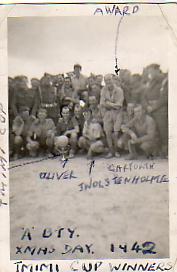
Chrismas Day 1942 — ‘A’ Battery, 11th H.A.C Reg. V R.H.A., M.E.F. winners of the Tmimi Cup, The Western Desert Football Cup Team L/Bdr Ward, Gnr. Hodgson, L/Bdr Hodgson, Dvr. Vincent, Sig. Adams, Sig. Oliver, Sgt. Powell, L/Bdr Rosie, Gnr. Ebdon, Dvr. McLaghlane, Gnr. Wolstenholme.
- Contributed by
- actiondesksheffield
- People in story:
- Arthur Ward
- Location of story:
- North Africa Mersa Matruh, Sidi Barrani, Fort Cappuzzo, Bardia,El Addem, Gambut, Tobruck, Derna
- Background to story:
- Army
- Article ID:
- A4514915
- Contributed on:
- 22 July 2005
This story was submitted to the People’s War site by Roger Marsh of the ‘Action Desk — Sheffield’ Team on behalf of Arthur Ward, and has been added to the site with his permission. The author fully understands the site's terms and conditions.
Refer to Chapter 1-- A4345544 -for links to other chapters.
LIFE IN THE ARMY
by
ARTHUR WARD
Chapter 13 — ‘Hygiene in the Field’
November 06, 1942
We stopped 15 miles from Mersa Matruh as all the brigade was short of petrol and ammunition.
Then it started to rain. We could not understand this in the desert, but it churned up all the tracks, so that movement was impossible except on the asphalt coast road. This meant that we could not get our supplies, as the coast road was jammed with traffic which was a pity, as our forward observation officers could see hundreds of enemy guns which were in range but retreating fast. Most of them got away!!!
We stayed for 4 days, then our Priest which had been damaged, had to be taken on a tank transporter to Mersa Matruh, to the Depot. We went with it and were issued with a new one, then all the Regt loaded up on to transporters (1st Transport Coy), so on November 11, 12, 13, 14, 15 and 16, we continued the chase through Sollum, Halfayia, this was a very steep escarpment with 'S' bends on which we were travelling down hill. We could see for miles across the level desert at the bottom, and had a hair raising ride down the pass, as we were perched high up on the transporters. There were many trucks burnt out at the side of the roads from both sides, as they had been machine gunned by planes when negotiating the many bends in the road. Also a burnt out Messerschmidt fighter had crashed near the road. It was named by troops as 'Hell Fire Pass'. Then on the coast road again, past Sidi Barrani, Fort Cappuzzo, Bardia, El Addem and Gambut. All these were 'Wog' villages where the Italians had built forts when they took over this part of North Africa. We by-passed Tobruck by going down the Axis road and finally stopped South east of Derna, which was a town on the coast, and from the road high up overlooking it, we could see the flames as the Germans had set, fire to the large buildings before they fled.
November 19, 1942
We stopped at Tmimi on 19 November. We dug slip trenches and erected our biwies as we were told we were to have 14 days rest, and intensive training and a “fittening up period", which had been ordered by Montgomery, ready to make a final push to El Ageila and then the 8th army objective Tripoli.
We levelled out a hard area of sand and marked out a football pitch. I played in goal for ‘A’ Battery.
Results ‘A’ Bty 2 v ‘B’ Bty 0
No. 1 team 0 v No. 2 team 2 (inter Battery)
We received some mail which was the first for a long time and I had an airgraph from mother and dad, which said that they had moved from 114 Worksop Road to 135 Worksop Road which was a larger house.
I wrote a letter to Wally Walton's mother at Tune Street, Barnsley, telling her how her son had died. I corresponded with her several times afterwards, although I never went to see her, this I have always regretted.
December 12, 1942
This day completed for me 3 years service in the army, so I received 3d (approximately 1p) a day extra pay.
I played football ‘A’ Bty 2 v ‘I’ Bty 2nd RHA 1. At the match I saw Chris Harrison who was in this Regt. (ex 70th ).
We were then told that plans had changed and we were staying at Tmimi for 6 weeks. The actual spot was RAS Chechiban which was 12 miles from Tmimi. Tmimi was one house on the coast road with an air field and a well for water (very few in the desert).
December 14, 1942
I gained back my first stripe, as I was promoted to A/L/Bdr (Acting Lance Bombardier).
Many football matches were arranged:
‘A’ Bty 1 v RHQ 0
‘A’ Bty 4 v ‘B’ Bty,
‘A’ Bty 2 v ‘E’ Bty 0
‘A’ Bty 2 v ‘B’ Bty 0
‘A’ Bty 4 v Queens Bays 0.
December 25, 1942
On Xmas day, we went to RHQ and had a big church parade. Then I took part in a football match at RHQ ground which was a very good game and result:
‘A’ Bty 2 v RHQ 1
This was the final of the Tmimi Cup and the CO Lt/ Col Goodbody presented the cup to our Captain Gnr Adams.
We had a snapshot taken of all the team.
The Regt. Engineers had made this cup out of shiny metal so we were the first winners of it.
The cup was inscribed 'A' Bty 11th (HAC) Regt. RHA Western Desert Cup Winners Xmas 1942.
In triumph, we went back to the battery and had Xmas dinner. All the usual good food, turkey, vegetables, pork, Xmas pudding, rum and coffee and 2 bottles of beer per man. As was the army custom, the Sergeants acted as waiters.
At night, the football team were entertained in the Sergeants' Mess and we had a good time drinking out of the cup mixed drinks of rum, whisky, beer, gin, cherry cider. Most of the lads passed out, I was very merry but managed to climb into bed before I had had too much to drink.
I forgot to mention that on Xmas Eve, ‘C’ Troop had a sing song and we had 2 bottles of beer each.
December 26, 1942
Boxing Day, it rained all day and the bivvies were flooded. It must have been a bad day as a rum ration was issued.
We heard the good news that the 8th army forward troops had moved passed El Agelia. This meant a lot as this was the farthest that the 8th army had been in previous advances. Also the first army were progressing well.
We were now on another training programme and for 6 weeks I was on a wireless course on a No.19 set under Bdr (Bobby) Boulton.
1943
January 06, 1943
I went on leave to the 8th Army Rest Camp at Derna. We travelled 60 miles across desert tracks in a truck.
We were billeted in white washed bungalows, right on the sea front. These had been built for Italian civilians to have a holiday before the war. This was a real treat for us to live in a proper building. The first night we had supper in the NAAFI canteen and saw 'The Nomads Concert Party', which was very good.
January 07, 1943
Visited a Wog market and I bought a fountain pen for 20 pts. Blue Gillette (German made) razor blades 10 pts.
Had a haircut (5 pts), bought some eggs at 2pts each, Brown loaves (1 pt each).
In the NAAFI Canteen I bought several tins of fruit, 2 eggs and 2 sausages, which we ate back in the holiday villa.
From the villa, we had an excellent view of the dangerous winding pass which overlooked the town linking it to the desert.
Various shows that we saw during the week were 'Boom Town' at the Regal Cinema, Abbott & Costello in 'Ride 'em Cowboy' and 'The Rascals' Concert Party in the NAAFI canteen.
Another visit to the market and I bought some presents to send home, a table centre (45 pts), 1 cushion cover (35 pts), 2 silk scarves (20 pts each), 5 handkerchiefs (2pts each), 1 leather wallet (25 pts), 2 combs (5 pts), 1 pipe (20 pts) and 2 pen nibs (2 pts each). Pts was short for Piastres which was the money used in Lybia, I cannot remember how much it would be worth in English money.
January 12, 1943
I played football for our leave party against Derna Royal Engineers, but we lost 3-1 (this team had been called Sunderland when in the Cairo league) and included some well known players.
January 13, 1943
The well enjoyed leave was over and we travelled back to camp to more discomfort, and we did not know what to expect. I then had a bad head cold!!!
We learnt that ‘C’ Troop was now been changed to ‘A’ Troop.
Football: ‘A’ Troop 3 v ‘B’ Troop 0
Scored 1 goal playing at centre half.
‘A’ Bty 1 v ‘F’ Bty 4th RHA 0.
I played for the Regiment
11th (HAC) RHA 8 v 310 Bty (76 A/T) 3
January 19, 1943
I started on a Nos. 1 (Sergeants) and NCO's course at RHQ under the CO and Major Richmond (2nd in Command).
Wireless News. Heard that Tripoli had been captured by 8th Army.
February 08, 1943
The course lasted until 08 February 1943 when we all had to give a lecturette to the Colonel and quite a few of the senior officers of the Regt.
My subject was ‘Hygiene in the Field’, which I passed Grade ‘A’, which meant I was the top of the class so I beat 4 Sgts.
February 09, 1943
I think this course helped my army career because on 9 February 1943, I was promoted to A/Bdr, so that meant I had a second stripe. I will mention here some of the ‘hazards of the desert’. I learnt much about the hygiene during the course. The main trouble was the flies. They were everywhere, even when eating or drinking, when we opened our mouth we had to be careful that no flies slipped in. We could not keep food covered all the time so sometimes we could not see it for flies. Most of us suffered from Desert sores - just a small knock or cut in our skin would form a scab which the flies enjoyed. I had sores on both arms and the MO covered them with a purple liquid, as it was almost impossible to keep bandages on, and sometimes they were covered with flies whilst not being good for us, as they made us itch nearly to distraction.
It was a well known fact that flies empty their stomachs before eating, so any disease they carried could easily be transferred to someone else. Very few of us had sunglasses so we were inclined to squint a lot, especially as practically at all times, we had to be on the lookout for enemy planes.
The dust was a problem as when any vehicle moved it left a stream of dust just like a smoke screen behind it, so it paid if possible to be the first in the convoy. The trouble was, the first vehicle was first to hit any mines if they were not expected.
Also the dust storms came up at times and then everything had to stop.
There were quite a few lizards and chameleons about. Although they were harmless, it was a shock to find one in our kit, clothing or blankets.
Then there were black evil looking scorpions with a terrible sting. The favourite trick of anyone who saw one was to put a ring of petrol round it, light it and the scorpion in panic would sting itself to death as it would not cross the flames.
During the daytime, usually under the cloudless blue sky, it would be extremely hot, but after dark in the winter part of the year it would be bitterly cold, although during the hot part of the year the nights would be balmy and warm.
I suppose the desert was an ideal place for fighting, as there were very few civilians or buildings involved. If any side had a vantage point like a ridge or the top of a pass or escarpment, one could see for miles over the flat country. Also planes were useful for spotting. The other trouble for everyone was that there was no cover at all, so the only protection was slit trench if the sand was not too soft or the rocks underneath were not too near the surface for digging.
We also at times had a very hot wind called the ‘Khamsene’ which was very sticky, made us sweat and was very uncomfortable.
Water was very scarce it had to be brought up in water wagons; it was always warm and never tasted very good.
Sometimes little red 'weevils' were swimming about in the water, but we just had to grin and bear it.
Usually our ration was one gallon each per day, which had to make do for drinking, making tea, washing, shaving and baths (in a bucket) when possible.
One great pleasure, if near the blue Mediterranean, was a dip in the sea. Although this was hazardous if the Luttewaffe gleefully saw the men in the water (usually in the nude), and opened up with machine guns which caused a rush to shore.
Our food was not helped with the heat, as the most common food was bully beef, and when we opened a tin, it sometimes ran out nearly like water, as we were not able to keep it cool. We sometimes had tinned fruit which was smashing, but at times the juice had dried up and it was not unknown for tins to arrive, where someone in the delivery line had made a hole and then drunk the juice, which meant that the fruit had gone bad.
Biscuits were usually very hard, its a good job that we had our own teeth.
We sometimes managed to obtain fresh eggs from some of the wogs who travelled round in the desert. They were keen to swap eggs for tea, and it was not unknown for soldiers to use tea, then dry it out, put it back in the packets and let the wogs have it. This sometimes worked the other way when bad eggs were given in return. The wogs also had their version of brown bread which we purchased at times. If we came across a village, they would stand outside huts shouting, "Eggs and bread," (but it sounded like eggs a bread).
Pr-BR
© Copyright of content contributed to this Archive rests with the author. Find out how you can use this.


 Recommended story
 Story with photo