

- Contributed by
- buxeycooper
- Location of story:
- Brighton and Hove
- Background to story:
- Royal Navy
- Article ID:
- A7379913
- Contributed on:
- 28 November 2005
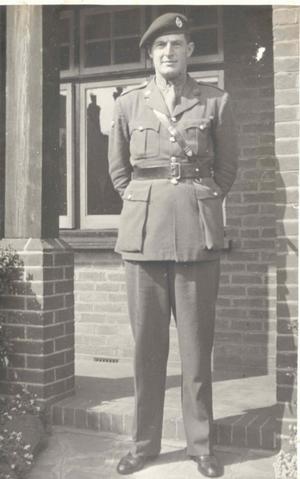
Major Desmond Bonham-Carter outside his headquarters in Hove
EPILOGUE
In July 1945 H.M.S. Vernon left Roedean School, St. Dunstan’s and the Grand Hotel and Dreadnought garages in Brighton and returned to her old home, Gunwharf, in Portsmouth, to continue training Naval Personnel.
H.M.S. Lizard had no such future — she just disappeared. The lovely houses she had occupied were returned to their owners only, as the years went by, to be demolished to make room for modern blocks of flats.
In 1986 H.M.S. Vernon herself was closed down and the land that she had occupied for so many years was cleared to provide space for new housing and business estates.
No trace remains of these land based Ships during their years in Brighton and Hove except in Archives and Libraries and, perhaps more importantly, in the memories of those of us who served in them.
APPENDICES
OTHER PEOPLES MEMORIES
The end of the war meant a lot to all of us and we celebrated in different ways, as in the following tale:
DENNIS CHRISTIAN then a young Commando from the Royal Sussex Regiment writes: "The dropping of the great bombs on Japan meant that we (6 Commando) did not have to battle there and tens of thousands of young men were given a life. V.J. night (Victory in Japan night) found me halfway up the Clock Tower, my 18 years old body aflame with an unaccustomed glass of Shandy". He goes on to describe an unusual arrangement for billeting Commandos: "We had no depot or barracks other than our basic training grounds in Scotland and Wales, so we were given an allowance to rent private accommodation which we called 'civvy billets'. This was a unique privilege for service personnel in those days. It was a strange existence, leaving one's house like a commuter in the mornings and taking a Tommy gun on the bus instead of a briefcase. We had formal parade on Saturday mornings on the Sussex County cricket ground -a sacrilege today - and danced at the Dome in the evenings with those ladies who were nor otherwise drawn to Sherrys in West Street where the (very) Free French frolicked”.
Dennis Christian served with the Royal Sussex Regiment for several years after the war, but rather wistfully ends his memoirs thus: “many of us made careers in uniform, but the days in ‘civvy billets’ in Brighton and Hove were the best ever”. His happy memories of ‘civvy billets’ is reflected in the wishes of some troops of 6 Commando who, when one of their officers married, chose not to celebrate in the pub, but to have tea in the officer’s home.
To the thousands of service personnel who came to Hove between 1939 and 1945, it must have seemed that the town resembled a ghost town. Although the local population was not wholly evacuated, many left the area in 1940 when danger of invasion by Germany became imminent after the evacuation of our troops from Dunkirk. Many empty houses were requisitioned and ‘danger’ areas such as the houses called Seaside Villas, with their private beaches, were vacated and anti-invasion defences erected there.
CAPTAIN ROBERT EDGLEY then serving with the 46th Light Ack Ack Regiment remembers going to Seaside Villas in 1942. Accompanied by his Sergeant he looked over the empty houses with a view to selecting one or more as being suitable for billeting his troops. On entering one house he was surprised to find a group photograph of his old school’s Cricket First XI dated 1938, and which included himself, still hanging up on a wall.
DAVID WINDELER a Commissioned Officer serving with the 45th Royal Tank Regiment in Hove in 1941/2 writes: “the 45th were deployed along the seafront of the seaside resort of Hove. Many of the civilian population had been evacuated and it was more or less a ghost town. We did troop squadron and regimental exercises with Valentines (tanks) on the South Downs. Our battle positions in the event of an invasion were, in battle line, on the beach. Little did the good people of Hove realise that up to 50% of the tanks were unserviceable, with broken tracks or awaiting parts for ‘stuffed’ engines. To compound our problems the tracks had a limited life of several hundred miles, so we were ordered to conserve our movements! Despite everything morale was high and we made ourselves comfortable in the many empty houses in roads and avenues between Kingsway and New Church Road. The local people were extremely kind and hospitable and we were to spend a comfortable winter in this pleasant coastal town. At night the pubs were full and likewise the cinemas and theatres”. He goes on to say: The final act of the 45th prior to leaving for North Africa was a Church Parade at the Parish Church (All Saints) in the Drive which was filled with Hove people who had come to wish us God Speed. We sailed to the Middle East via the Cape. We were decimated at El Alamein”.
The 45th Royal Tank Regiment arrived in Hove in late 1941 together with a large number of tanks which they parked in the roads in Hove and Hove Park. The officer in charge of the squadron in our road was Major Desmond Bonham Carter, the nephew of Lady Violet Bonham Carter, the famous Liberal politician and grandmother of Helena Bonham Carter
© Copyright of content contributed to this Archive rests with the author. Find out how you can use this.


 Recommended story
 Story with photo