

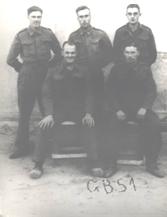
Sid Harland Front Row left
- Contributed by
- warnford
- People in story:
- Sidney Harland
- Location of story:
- Poland
- Background to story:
- Army
- Article ID:
- A7867812
- Contributed on:
- 18 December 2005
P O W Stalag X X A , Stalag X X B and Stalag IIA
Guardsman number 2735109 Prisoner number 7592
I was captured at Dunkirk on 25th May 1940. A large group of P.O.Ws were assembled and we began the long weary march through France. On arrival at Givet station near the Belgium border, everyone boarded a train and travelled via Luxembourg to Trier in Germany. On arrival at Trier our group was surrounded by jeering Germans. Defiantly we sang “Were going to hang out the washing on the Seigfried Line“. They spat at us and threw empty bottles: full ones would have been o.k.That evening we slept in the open at a large P.O.W. camp.The next day 600 of us were herded onto cattle trucks (75 English swine per truck) and travelled in appalling conditions to Torun in Poland. I ended up at Stalag X XA Fort 17. The accommodation was very primitive, our barrack room was a tunnel shaped hut.We slept on the straw covered floor. The starvation rations mainly consisted of barley soup, rotten potatoes and bread.
On the 12th July 1940 I received my first Red Cross parcel. We had one parcel between 28 men. My share was half a bar of chocolate.
On the 5th September 1940 I received my first letters from home, one from my wife Mary and one from my mother.
Whilst at Stalag XXA, I was sent out on working parties. I had various manual jobs, one of which was working at a bombed out Polish cavalry barracks reclaiming bricks from the earth closets: the stench was terrible.
On the 13th September 1940 I collapsed on the job and began to bleed from my nose and throat.
I was sent to hospital and had to walk to the station then catch a train to the LuftWaffe Isolation hospital at Bromberg.
On arrival at the hospital the German doctor was less than welcoming and kicked me out of the room. I was rescued by a German nurse called Hilda Yung. She bathed me and put me to bed in an isolation ward. The next Doctor I saw could speak English; he told me I had diphtheria. Anything I tried to swallow would come back down my nose. The only way I could swallow anything was to pinch my nose. My weight had dropped from thirteen and a half stone in May 1940 to nine and a half stone in September 1940.
I began to lose the feeling in my hands. Unfortunately at this time the doctor decided to transfer me as I was occupying a whole ward.
On 8th November 1940 I was transferred to Torun PO hospital Fort 13. Again I had to walk and travel by train. By the time I arrived I was verging on collapse. Despite being spotlessly clean I had to be deloused and take a shower: this nearly finished me off. Fort 13 was a dump, an underground fort with artificial light.
By December 1940 I was paralysed, deaf and dumb. I could hardly see and the doctor would inject me with a stimulant to keep my heart beating. We lived in sub-zero temperatures. It was so cold the water would freeze in the mug at the side of my bed. Our Polish doctor had an arrangement with the undertaker. When a P.O.W. died the undertaker would bring a coffin into the Fort filled with food which he unloaded in the mortuary. He then placed the body in the coffin and proceeded to the cemetery. The Polish doctor would barter the food for anything of value.
On the 17 February 1941 I received a Red Cross parcel all to myself. My condition had begun to improve and I was the learning to walk again. The slightest touch, however. and I would topple over. By March 1941 I had resumed light work, some spud bashing and turnip picking: our staple diet.
On the 31st March 1941 some of the fit P.O.Ws put on a play “The Dover Road” quite good considering.
In April 1941, I was transferred to Stalag X X B at Marienburg nicknamed the” Vagabond Stalag”. One of the favourite punishments in the camp was solitary confinement in a place called a Herd hut. The hut, (just like a cave) was inserted into a raised bank, with wooden shutters leaving the prisoner in complete darkness. Another punishment was to make you stand naked, in the cold, at the camp gates all very degrading.
On the 6th April 1941 fifty of us were detached to a labour camp at Langfhur Danzig Adolph Hitler Strasse. The firm we were to work for was Alfred Hahn Timber Merchant's. We were employed unloading timber wagons and were paid in Marks (Lager Geld) which was worthless as you couldn’t buy anything with it.
I changed jobs in the June this was when I met Alf True from Deptford. We soon became good friends.
Our job entailed levelling a piece of ground using skips. Moving a minimum of 20 skips of earth a day. I made the job easier by putting a false bottom in the skip. We got away with it for some time until the foreman nicknamed “Lugs” told us to tip a load whilst he was watching, we refused, so he tipped it himself and our secret was out.
On the 30th December 1941 I was transferred to a fresh job at Gdynia. This was the worst job I ever had as a P.O.W. The job consisted of digging holes with pickaxes in frozen ground exposed to the wind from the frozen Baltic. The holes were for wooden piles on which the Germans were going to construct more huts, the ground was like concrete: it was slave labour. To get round this we decided to shorten the wooden piles whenever possible. The guards spent their time huddled around blazing braziers so we were able to do this and remain undetected. The weather was getting worse and worse, and to top it all the Red Cross parcels stopped. These parcels were the only things keeping us alive.
In the end they had to transport us by train from Oliva station as everyone was suffering from frostbite. Unfortunately for the Germans, we were building on a marsh and when the ground thawed out in spring the whole project sank.They never did realise what we had done,
On the 15th January 1942 all the camp went to Brusen for a delouse. They made you strip then put your cloths in a heater while you had a shower. They didn’t inform us that the heater destroyed leather articles ,consequently everyone’s belts and braces fell to pieces, leaving us all walking about tied up with string.
On the 3rd February 1942 I received a Canadian Red Cross parcel. It appears all we think about is food (dead right).
We were working in the timber yard again and by September1942 we were in trouble for not working hard enough. We decided to work even slower! We carried the pieces of wood one at a time. The German guards said until we had unloaded the wagon we would receive no food. We didn't finish the job until 11:30pm dead tired in the dark but poor old Gerry had to stay with us until we finished.
One day when we were working in the Timber yard a Dornier Bomber took off from Danzig aerodrome flying low, the wing tip of the plane caught an overhead cable causing it to crash outside the camp, everyone rushed towards it as it burst into flames. I’m not a fan of the Germans but we would have helped them if we could. Unfortunately a woman was cycling down Adolf Hitler Stasse just as the plane crashed, all that was left of her was the frame of her burnt out bicycle.
On the 26th December 1942 the Germans opened their hearts and allowed us to play Stolzenberg camp at football. We lost 5-3 not bad as most of us hadn’t played for three years.
In June 1943 nine men left camp, four Welsh and five Irish all very hush hush.
On the 9th September 1943 the men returned and told us the objective of the trip. The Germans were trying to form a small army of British PoWs called the “British Free Corps”. The Germans thought the most likely recruits would be the Irish Welsh and Scots. They had been supplied with new cloths, better rations, had propaganda lectures and sightseeing trips to Berlin but these was curtailed by the bombing raids. The outcome was that the PoWs took everything they could get their their hands on and “politely” told the Germans to get lost.
In October 1943 I was working at the sugar-beet factory we worked a 12 hour shift and were told that the changeover at the weekend entailed working 18 hours; it really was a slave camp.
We were taken to the boiler house and told we had to keep the automatic bucket conveyor supplied with coal by means of a skip on the rail track. At first this wasn't too bad as the coal was near the conveyor but as we moved further away from the boiler house the work became more arduous. We had to work non-stop.
I decided we needed a rest so I put some bits of old iron in with the coal, when it arrived at the conveyor it broke the chain and stopped everything. The boss was raving mad I thought we would get a rest but he gave us at barrow and a shovel. We had to keep the boiler going for the rest of the shift. I didn’t try that again.
Alf and I managed to swap jobs. We went into the factory where the sugar was refined. I worked on the spritzer a high-pressure hose which is used to wash the sugar beet off the farmer’s carts. Alf was working where the sugar was refined. We decided to make some cloth pockets which he hung down the inside off his trousers. When the opportunity arose he filled them with sugar and brought it back to the camp.
A Russian P.O.W. became so depressed he killed himself by jumping into the machine that shredded the sugar beet.
Another casualty was the boiler house manager. Fritz, a nice man and a communist hit the manager with a shovel and killed him. Poor Fritz was sentenced to death. When we left the Sugar beet factory to go back to the timber yard in December 1943 we filled everything we had with sugar. A big bass drum and the piano were filled solid.
On the 4th January 1944 a new camp leader arrived called R.S.M. Singleton. The Red Cross parcels were getting through now. The German commandant left the camp, expecting a replacement soon.
Not far down the road was a Russian P.O.W. camp at Oliva. We heard they were dying from typhus and that the Germans had just shut them in and left them to die.
An Old Danziger who worked at the saw mill had been told he had to sign papers which would make him eligible to be called up so he cut off all the fingers on one hand He must have been nearly 70!
On the 25th February 1944 I saw someone at the gate of the timber yard he said he was an R.A.F PO W who had escaped from the camp at Memel. He had seen us working and wanted us to smuggle him into the camp. We smuggled him in the next day. He said he wanted to get on a boat but the foreign boats were well out in the harbour and boarded by police. He stayed with us for four days. He said his name was Ernest Louis. We heard later from a Danziger that a Frenchman! Had been shot near the docks. Hard lines for the poor chap.
The caretaker of the timber yard lived on the premises. His nocturnal hobby was distilling schnapps on a stove in the main building. One evening at about 2am all hell let loose? We were driven outside our huts to see a lovely glow in the sky the timber yard was on fire. We were all taken to yard to put the fire out but it was hopeless. Alfred Hahn and company was back where it started nothing but a heap off rubble. We were under suspicion for awhile but they couldn’t prove anything and the caretaker certainly wasn't going to admit to his part in the tragedy.
On the 15th January 1945 the Russians started their big offensive and the Germans decided to evacuate us from the sugar beet factory. They split us into two groups; unfortunately Alf and I were separated. He was later shot by the S.S. on the march to freedom. It was tragic to be executed so near the end of the war. I never had a better mate.
I went to a small camp near a railway station at Starogard. The roads were snowed up and crowded with troops, political prisoners and civilians marching west.
The prisoners were in bad way just rags on their feet
On the 17th of February 1945, we were told to be ready to march the next day. We set off on the 18th of February all pulling various types of sledges we had made. We all received a sixth of a loaf and off we went. Normally we could have marched it easily but with the snow and slush, poor food and no sleep it was a nightmare of a journey.
The roadside was littered with people who had died from exposure. I saw a man driving a team of horses he was sitting bolt upright on the cart. He was frozen stiff and when we touched him he toppled over dead!
At first my feet were blistered but I ended up with a poisoned leg .I'd walked approximate 464 kilometres probably more with the back tracking and diversions.
On the 11th March 1945 absolutely crippled, I lay down in the road and wouldn’t move. The guard said that he would shoot me. I just couldn't walk anymore. After threatening to shoot me again and hitting me with his rifle butt he let me get on to a passing cart with a few other lame P.O.W.s.
We were 30 kilometres from Neubrandenburg. I ended up at Stalag 11A a huge camp packed with all nationalities.
On the 27th of March 1945 the Germans issued orders that the camp was to be evacuated. We refused to move and to our surprise the commandant allowed us to stay as long as we didn’t take part in any fighting.
On the 29th of March 1945 the Russians were fighting outside the town. By midnight the German guards had fled and the Russians came crashing through the fence. Retribution was swift the Russians took their revenge on the local population; they raped the young and old and looted everything. A lot of Germans commited suicide. Just outside the camp a railway official killed his family then hung himself, When the Russians released their P.O.W’s they found there were only 3000 left out of 21000.The camp commandant was long gone so they executed his second in command despite the pleas of his family. There were still some young Nazi snipers around they called themselves “Werewolves”. When the Russians captured them they were shot on the spot. We were in contact with the allies by radio and asked for medical supplies and food, which we received when the allied planes dropped them on the camp. We were advised to stay put until hostilities ceased. During this time I made friends with some Canadian P.O.W’s.Cpl Munro ,Archie Dunmore,Raoul Allard, Pete Pollard and Lloyd Johnstone.
Not far from the camp we came across the last train to reach Neubrandenburg it contained loads of bottles of champagne. Naturally everyone got stuck in. It wasn’t long before World War 3 nearly broke out, the nearby woods were full of drunken P.O.W’s and Russian soldiers.
The nearest allies to us were the Americans at Schwerin.
On the 16th May 1945 a contact officer reached the camp and arranged for us to be handed over to the Americans. We were packed into Russian trucks and after travelling some distance we were handed over to a contingent of black American soldiers who took us to Schwerin. We were housed in the local Opera House for the night. The next day we continued onto Luneburg Heath where all the Germans seemed very happy especially the soldiers and the police. I began to wonder who had won the war!
On the 19th of May 1945 we were loaded onto a Dakota and set off for home. We had to stop on route to drop off some sick POWs in Brussels. We resumed our journey arriving in England at 8:20pm. WAAFs descended on us with kisses and insect powder. We were transferred to Paxhill camp 110 arriving at 11:20pm. We were given a meal and tragically one of the POWs dropped dead at the table: it was all too much for the poor devil!
On 21st May 1945 I left Paxhill for King's Cross Station where I caught a train and travelled back to Yorkshire to be reunited with my wife Mary. I had been a P.O.W. exactly 5 years.
He was one of the lucky ones but his best mate Alf was not so fortunate!
© Copyright of content contributed to this Archive rests with the author. Find out how you can use this.


 Recommended story
 Story with photo