

- Contributed by
- Frank Yates
- People in story:
- Frank Yates, Joe Nolte, Dad De Koning
- Location of story:
- Muids, Antwerp
- Background to story:
- Army
- Article ID:
- A7402312
- Contributed on:
- 29 November 2005
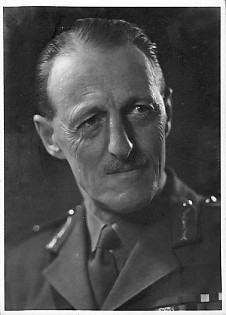
General Ross
Memories of Frank Yates CHAPTER 32
Now began the hectic rush towards the Seine. Most of the enemy had crossed the river, mostly in boats and ferries, and being hampered by air attacks, had lost a lot of their heavy equipment. The air forces had destroyed all the bridges between Paris and the sea, in order to protect our flank and to prevent the Germans from quickly reinforcing the Normandy army. Div HQ seldom stayed more than one night in any location as we joined the torrent of vehicles, tanks and troops heading for the great river. The Provost Corps did a terrific job of organising traffic and signing the routes.
The river, previously useful to us, now became a barrier to our progress and several bridges were constructed, in difficult circumstances, the river, about 300 yards wide, often had high banks, sometimes hundreds of feet high. We crossed a high level Bailey at a place called Muids, 20 miles south of Rouen. The assault crossing was done by 15 Scottish Div and then exploited by 53 Div. This arrangement, between our two divisions, was to be repeated many times on our way to the Elbe.
Now began the “Great Swan”. We crossed the Seine on August 29th and arrived in Antwerp on September 8th. The Germans provided some resistance at the Somme and the area round Amiens but we surged on into Flanders, making one night stops only.
The route, in built up areas, was lined with exultant inhabitants, showering us with fruit and wine, clapping and cheering, climbing onto the vehicles, shaking hands, and, in the case of the girls, kissing! Small boys were demanding “Cigarettes pour Papa”. We were passing through places with names redolent of WW1.Ypres, Bethune, Coutraix and Lens. Those who were on this hectic advance will never forget the warmth and affection with which we were greeted by the Flanders folk.
We camped for the night near Lens and a few of us had a walk after dinner. I was astonished to notice the similarity between this French coalfield and S. Yorkshire, the same slagheaps, the same terraced houses and the same cobbled streets, We did not get very far before we were “Kidnapped” by an exuberant group of miners, who took us to the street, where they lived, and plied us with much bottled beer and bonhomie. We danced with their wives and girl friends, to the strains of a piano accordion. I personally, have a “Thing” about piano accordions and I found it impossible to dance on cobblestones but, with many cries of “Vive les Anglais” and “Vive la France”, we celebrated the occasion appropriately and, in the small hours, staggered back to our jeep, full of goodwill and Flemish beer.
Next day we pressed on, over the border at Armentieres, famous as the place, in the WW1 song, where the “Mademoiselle” lived, Progress was slow because of the crowds who tended to block the road,
When we halted and got off the road, at a Belgian village called Gheluvelt, an astonishing reunion took place. The general visited the chateau which had been his HQ, when he commanded a battalion in the first war. We learned, from his ADC, that he was greeted by a middle aged, attractive lady, who embraced him with a cry of “Bobbee”
The progress continued the Recce Regiment and the leading 158 Brigade meeting isolated pockets of resistance, before entering Antwerp on September 8th. The division took over the security of the great city, completely untouched, and with its important lock gates and the Scheldt tunnel still intact.
Our HQ was established in fort No 7, one of the old forts which surround the City. It was a very comfortable billet and for a few days we rested, enjoying good food and wines, augmented by chicory, a favourite crop grown in the many glasshouses around Antwerp. Most of us had never tasted chicory as a vegetable, but had seen the name as one of the ingredients in a pre war form of instant coffee. This liquid “Camp” coffee was awful, but in those pre Nescafe days I suppose it was drinkable (Just).
John and I went into the town in the evening. We drove the jeep down the broad boulevards, meeting only trams and army vehicles. There were hundreds of “Cafes”, the Flemish equivalent of Pubs They were all celebrating like mad, and when we went in one of the larger ones we were besieged with goodwill and Pimms. I had never even heard of “Pimms” but they were delicious, laced with raspberries and redcurrants and such. Whilst sipping this nectar, we were approached by a young lady and her boyfriend. She was a very lovely blonde girl, and clearly upper class. She said, in perfect English, something like “Good evening, gentlemen, my name is Marie and I have been asked, by my Mother, to invite some British officers for dinner and I would be very happy if you could accept. We did not need any persuasion, so with the young couple occupying the rear seat of our jeep, we motored down the completely undamaged streets of Antwerp, to a block of flats in the south of the city. Here we met the charming mother and father, their name being Daems de Leyer, and then we had a super dinner, the best since the Wrennery in Rochester six months earlier. We visited again before leaving Antwerp, for coffee and then exchanged addresses and promised to stay in touch.
During our Antwerp days we had some personnel changes at, 53 HQ. We lost our never to be forgotten G1 and our town clerk G2. We gained, in common with other units, Dutch and Belgian liaison officers, the General’s Mess acquiring a middle aged Dutchman called Joe Nolte and we got our beloved “Dad” De Koning, our ever popular companion to the end of the war, He spoke English, French, German, Flemish and his native Dutch.
© Copyright of content contributed to this Archive rests with the author. Find out how you can use this.


 Recommended story
 Story with photo