

- Contributed by
- Peggy_Mcgrath
- People in story:
- Irene .A .McGrath
- Location of story:
- Guernsey/Portland
- Background to story:
- Army
- Article ID:
- A8809211
- Contributed on:
- 24 January 2006
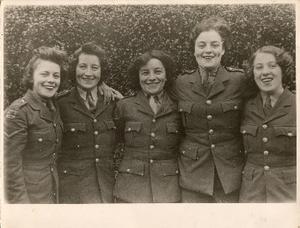
Picture Left to right-Pat, Helen, Kay, Miriam ,Irene (Peggy)
Guernsey 1940 : The Evacuation
I had just come back from town. When I arrived home Mum and Dad were in the dining room talking and looking worried. I asked them if there was anything wrong, Mum just looked at me and said “your sisters are going to see if they can get away today, do you want to go with them or come with us and Ruth ? ” — I answered that I’d go with the girls.
Helena, Pat, Miriam and myself ( Kay had already left before us) packed some clothes etc . We left home at about six o’clock and went to the White Rock harbour in St Peter Port to look for a boat however, they were all full. Then, the ship “Princess Astrid” arrived in harbour, it would be leaving again at 10pm. Our luggage was taken on board . We had time to return to Town and telephone Mum and Dad , saying that we hoped they would be able to join us soon. All to soon we had to return to “Princess Astrid” where we were given two comfortable Cabins with beds in each .We were invited to join the Captain for a snack before we retired for the night. It was a good trip and we arrived into Weymouth at about 3-15pm the following day.
Portland :
Upon arrival we were taken to a Medical centre and examined to make sure we were all ok and from there to Alexander Gardens where we went into a big marquis for tea. An ATS girl served us and Pat asked about the Army, telling her that we would like to join. She went and spoke to an officer when she returned she told us to remain behind after everybody had gone as somebody would fetch us, however within five minutes a truck arrived and we were taken to the Girls Friendly Society (GFS) where we were given a bed each in a large dormitory and then taken to meet Lady Jackson who was in charge. We had no identification with us but she told us she new someone who might be able to help, we then made our way to bed, an hour later an ATS officer came up and said we were wanted but that we need not all go. Helena and Pat went as they were the two eldest. Lady Jackson had Col Randall ( a family friend) with her who identified my sisters right away and gave an excellent reference. The next morning we were given breakfast and then made our way to the Recruiting office to join up. After we had been issued with our uniforms; which were not very nice but never the less we wore with pride we were taken in an Army truck to the Verne Citadel at Portland.
Helena ,Pat and I shared a room on the ground floor of a large granite house while Miriam was on the first floor sharing with two other girls. The next morning we were told that my eldest sister who had left before us had been traced and would be training at Aldermaster for the next 3 months.
That time soon passed and when Kay arrived we were five sisters once more !
After having been told where we were working I was sent to the officers mess where I had to stand in front of a very hot fire with a toasting fork, however after making slices of toast for only half an hour the heat got the better of me and I fainted ! I was taken off that job and then did washing up and waitressing.
We frequently endured air raids and after one bad one where, after having rushed to the cellar with bombs dropping everywhere, the all clear sounded and we found we were trapped — having to wait nearly four hours to get out. One girl had lost a leg and another had fractured both, while most, including myself had just black faces from the blasts.
Because air raids had become so frequent at Portland we eventually got moved by coach to Sandbanks, it was great because the ATS had three bungalows allocated to them, with the officers being in a Hotel. Having been sorted out everybody was happy but a few months later we had to move again and were given a big house in “Chadesley Glen” which again was fine because it was easy to get to Poole or Bournemouth on our off duties.
Eventually we five sisters were posted-Pat had been very ill with Rheumatic fever and was discharged with a pension, Kay the eldest went to Reading , Helen to Lulworth, Miriam to London and myself to Bovington.
I was lonely at first, missing my sisters. At just seventeen ( I had lied about my age to join the ATS) and it being my first time out of Guernsey I felt nervous and wondered how I would cope , but the girls were all so friendly and one took me with her on leave to Devon her family were so kind to me.
I soon got used to not having my sisters. Pat had got a very nice flat at Sandbanks, so we were able to stay with her when we had a break. Another pal took me to her home in Portland. One of the troops was a Londoner who told his wife about us five sisters. We were invited to their home, Helen and Pat first, then Kay and I, they were lovely people and gave us a really good holiday. Miriam went later on. All the people we met in London were fantastic and made us feel so welcome.
Deep down we were worried about our parents and young Ruth (our baby sister) as the Islands had been occupied by the Germans before they could evacuate. We had some messages from home but they didn’t say very much so we had no idea how the Germans were treating them. We did later find out that they had to put up one officer who was a horrible “Nazi” type, very arrogant and mum had refused to feed him or do his washing. As a consequence he got them thrown out of their home and took it over for himself. Mum, Dad and Ruth had been put in a large, cold house at Cobo where they stayed until the end of the war.
When news came that the war was finally over it was wonderful. A few days later I had a long letter from home; which I showed to my C.O, a lovely lady who said that she would try and get me some leave. Two weeks after that I was on my way! I had to go to Dover Castle until a boat came; it was full of Guernsey men as well as a couple of other ATS girls. Everybody thought that no boat was coming but eventually one arrived, we were all so happy and excited. It was a good journey back home and on arrival, St Peter Port harbour was packed with families and friends all cheering and waving with us doing the same.
Mum, Dad and Ruth had spotted me first and eventually I saw them. Ruth was not so little anymore she had grown much taller than me! She looked fairly well and Dad the same but Mum looked so thin and pale. We all kissed and hugged each other through tears of joy; it really was a lovely homecoming (although I knew that in 10 days I was going to have to return to camp). The neighbours had got together and shared their rations to make a treat for me, everybody was so kind. All too soon my leave was over and I did not know when I would get back home again. I left with a big chip basket full of local tomatoes to share with my sisters, at camp. I had so many things to tell my sisters and friends about the German occupation of our island. In time my sisters returned home on leave leaving me once more on my own, I didn’t mind this time as I now had so many good pals. On the 13th December 1945 I was demobbed and I could look forward to a Christmas with all the Family together. It was great!
On Reflection
I have some very happy memories of my five years in the Army and some sad ones. During one bad air raid at Portland a bomb landed on a hut opposite our billets and all the Welsh troops inside were killed.
When we emerged from our shelter after another raid we looked over the ramparts and saw the ship “Foylebank” on fire with sailors in the water. As we were watching, a German plane came and started shooting at us. We tried to shelter under the wall, fortunately no one was hurt.
These memories will stay with me forever but I will never regret joining the Army, it was a good training ground and we met people from all over the world.
We could not have been treated better.
These are my memories of days gone by and I prey we never have any more wars.
W/38446.VOL .Irene. A. McGrath
© Copyright of content contributed to this Archive rests with the author. Find out how you can use this.


 Recommended story
 Story with photo