

- Contributed by
- Little-Miss-Wood
- People in story:
- Mrs. Mary Kennedy, nee Littlewood
- Location of story:
- Cottingley, Yorkshire
- Background to story:
- Civilian Force
- Article ID:
- A2703610
- Contributed on:
- 04 June 2004
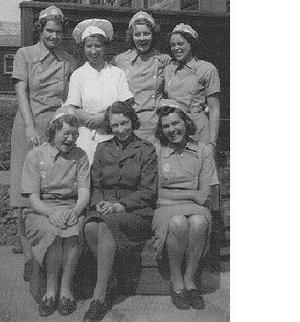
NAAFI Girls- Ashby Folville, 1942.
The following story was written many years ago by my Mother, Mrs .Mary Kennedy. It was written for a WWW 2 Project at my daughter's school. Unfortunately my Mother has since passed away but her War memories remain in this story.
“When War was declared on Sept. 3rd 1939 I was working in the office of a very large textile mill in Bingley, West Yorkshire. I was the invoice and shipping clerk. Most of our exports were through Hull, mainly to Amsterdam, Rotterdam and Antwerp by Ellerman Wilson Line. As time went on exports became increasingly difficult, and War Risk Insurance and export licences were imposed.
However, social life was very good. There was a lovely spirit of comradeship and patriotism about, that drew people close together.
Many women formed knitting groups, and would meet together at each others homes to have 'Picnic Suppers' Everyone would bring a few sandwiches and a bun, also a little tea and sugar. We usually knitted socks, scarves, gloves, mittens, whilst the more experienced knitters would 'show off' with Balaclavas ( all in khaki or Air Force blue of course)
Fund raising was the number 1 pastime. This was done in many ways, Concerts, Beetle Drives, Whist Drives etc. As I was a member of a Dancing School I had a very busy time, we gave displays almost every week, in Summer at Garden Parties and fetes, and in Winter in the Village Hall, at the Church Socials etc, and of course the big Annual Dancing Display and Pantomime. Dances were also held to raise money, so all in all life was very exciting.
One of the main fund raising efforts was for Spitfires. It was said that £5,000 would buy a Spitfire. Mind you in those days £5,000 took as much raising as ten times that amount would take today.
Even the blackout was exciting as we lived in the country I didn’t miss the street lights. We had to carry our gas masks around with us. Everyone wanted to do more to help the war effort, and sometimes we felt quilty and frustrated that life was going on so smoothly.
In July 1942 I joined the NAAFI as a manageress. These were canteens for the forces. I managed Naafis in, a Village Hall, an unused Chapel, a Stately Home, a Mechanics Institute, and finally on an Army Camp at Ripon. It was a wonderful life and I made many friends. We seemed to bring a bit of home to the soldiers, many of them so young. What they needed most of all, was someone to talk to about their loved ones. This was especially true of the American Forces. I found them very gentle, respectful and very, very homesick. They were so frustrated to be ‘ kicking their heels’ in a little hamlet in the middle of England, when what they wanted was to get on with the War and return home. They were billeted I Ashby Folville Manor where The Duke of Windsor first met Mrs. Simpson, at a house party given by the Smith-Carringtons.
As the bombings grew more intense, many children were evacuated to the country for safety. Some settled happily, and many life long friendships were made, but others couldn’t settle down to the different life and went home.
I didn’t have a lot of experience of Air Raids , only twice when I was on brief visits to Hull. The first time we were in a cinema when the sirens went. We left the cinema and the sky was lit up with searchlights and the anti-aircraft guns were blasting away. As far as I know no bombs were dropped on that occasion. The second time we spent the night in an air-raid shelter in Lambert Street. By this time they had started using whistling bombs and it was really terrifying to hear the whistling getting louder and nearer, you felt sure it was going to hit you. However , once again we were lucky, although a bomb dropped at the corner of De Grey Street and Newland Avenue demolishing several houses and another one ( which didn’t explode )
In January 1944 Tim and I were married, and in March I left the NAAFI. As it was compulsory to do some war work, I then went to work in a factory at Cottingley near home. They made radios for aircraft. The work was very boring soldering different coloured wires onto small components, but once again the atmosphere and company were terrific.
Towards the end of 1944 I retired to have my first baby. One chapter of my life was closing and another one beginning”
© Copyright of content contributed to this Archive rests with the author. Find out how you can use this.



 Recommended story
 Story with photo