

- Contributed by
- Wesley Harry
- People in story:
- Wesley Harry, Jim Power, 'Tich' Coward, Commander Hart, Mr Murray, Mr Greenfield, Mr Holt.
- Location of story:
- Poole, Dorset
- Background to story:
- Civilian Force
- Article ID:
- A4408508
- Contributed on:
- 09 July 2005
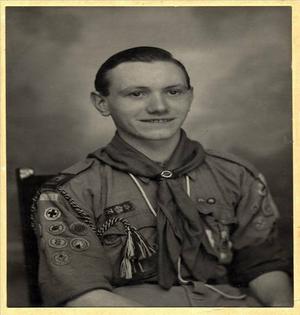
Wesley Harry 1942 Hospital Orderly
It is often forgotten that the young people of Britain played an important part in the fight against Nazi Germany during the years 1939-45.
During the years before the start of hostilities, many young people volunteered to be "casualties" for First Aid Teams, busy practising their tehniques. I, and many others, spent Sunday afternoons in some part of the town, a label attached to our clothing indicating our injuries, awaiting the arrival if the First Aiders. Often it seemed we had been forgotten, for we waited and waited for what seemed hours. On one occasion I was left on the outskirts of town, along with two other 'casualties'. My label indicating that I had a broken right clavicle. The First Aiders arrived and proceeded to treat my left shoulder. I tried to tell them they were treating the wrong shoulder, but was told to keep quiet.
On Sunday 3rd September 1939, having heard Mr Chamberlain's announcement, I, along with many others dashed off to the Municipal Buildings in Poole. There a temporary hut had been set up on the forecourt as an information centre.
As a Boy Scout I was determined to do whatever I could to help the war effort. I was directed to the rear of the main building and down a flight of steps to the "Control Room. It was explained that here a number of teenagers wwere to be used as messengers, carrying notes from one end of the room, where reports of incidents were arriving, to the other where telephones manned by representatives of the Fire Brigade, Police, Rescue and First Aid services were ready to deal with any emergency.
So much for my introduction to the workings of war.
Many Scouts, Guides, Cadets, members of the Boys' Brigade, and other youth organisations volunteered in a similar way, becoming messengers with the Fire Brigade, at ARP posts, etc.
For those first few months there was very little to do, so ehen Mr Murray, the Art Master at Poole Grammar School and the Local Boy Scout District Commissioner approached two of us at school to say that Commander Hart, Secretary of Cornelia Hospital would like two Scouts to act as Hospital Orderlies, I jumped at the chance to be doing something practical. Thus Jim Poer and I met at Cornelia and were given some idea of what was expected of us. WE were to make ourselves fully conversant with the layout of the hospital, know where all the fire extinguishers, fire buckets, sand etc. were situated, and to provide general help to the staff whenever required.
Whenever the warning sirens sounded I would dash off to the hospital to help move the children from their ward out into the corridors. Usually this meant dragging their beds to a safer place that the 'all glass' Children's Ward.
Whenever there was a night-time raid, stretchers were laifd out in other parts of the corridor, so that nursing staff might get some rest. It also meant preparing and delivering innumerable cups of tea, to anyone not able to sleep.
Much of the time when the sirens sounded it was because we were in the flight path of the German bombers on their way to the midlands, or because we were near Soumouth, etc.
There were some interesting moments, one I recall was late on a Wednesday afternoon; the sirens had sounded but nothing seemed to be happning. A lone plane approached the town from the south, flying very low and started to circle the town. We had all, confidently identified it as British, until black dots started to fall, follwed by the thump of explosions! We dashed inside, put out stretchers in Outpatients and waited for the casuaties. By this time a message had been received from the Control Centre to say that bombs had fallen on the High Street and that there were a number of bodies scattered around the road.
More Stretchers, and everyone on high alert, and a wait - a long wait, until we were told that there were no casualties - it was early clsing day, so very few people in the street, and that Burtons the Tailors had been hit, and the 'bodies' were tailor's dummies. During this raid an air raid shelter at an Infants School had been hit, fortunately it was after 4-00 pm and all the children had gone home.
On the evening of 11 October 1940, Jim Power and I went to the Hospitl at the beginning of another air raid. As usual, nothing much happened for some time, just the constant drone of aircraft passing overhead, and the crack of the anti-aircraft guns. Jim and I did our normal tour round the corridors, finishing with a visit to the boiler house to check that the boilers were stoked and the heating working. As we emerged from the boiler house, Jim was hit on the elbow by what as probably a piece of shrapnel; it was not much more than a slight cut, so with a clean handkerchief wrapped round it, we headed back into the main corridor. Everone was dashing about, and as the Assistant Matron saw us, she called out "Here are the Scouts, they will know." WE soon found out that no-one knew the wherabouts of stirrup pumps, sand, etc. There were incendiaries in various part of the roofoldier patient, a hospital porter ('Tich' Coward) and we Boy Scouts tackled the bombs with the equipment we had collected and extinguished the fires and removed the bombs.
The patients were not aware that the hospital had been hit until the next day's edition of the Bournemouth Echo described the bombing of a 'South coast Hospital' and recounting the fact that the building had been saved by the actions of these people. My Mother bought as many copies of that paper as she could afford!!
During that winter and the following years, I spent many hours at Cornelia Hospital, helping nursing staff to lift patients on and off trolleys, taking patients to the operating theatres, taking part in Christmas entertainments, working in the dispensary, and helping in any way I could. I am afraid my school work suffered, and on one occasion was reprimanded by Mr Greenfield, the Headmaster, who reminded me that my education was much more important. I took the attitude that as much as anyone in the Services and on the Home Front, I was determined that the Germans would not beat us.
When children were evacuated from London and other cities, many were sent to Poole. Again, some Scouts from Poole Grammar and Guides from Parkstone Grammar Schools were on hand to look after them.
We were based at Sandacres Hotel, Sandbanks (owned by Mr & Mrs Holt), and our job was to look after these evacuees, make sure blackouts were in place and secure, and most of all, try to stop the children climbing through the barbed wire on the beaches. Then, after a few days, we escorted these same children to various parts of the county, travelling by bus and arriving at villages I did not know existed, to deposit wide-eyed children in the middle of a quiet, rural community.
When I sat my School Certificate Examination in the Summer of 1941, I and the rest of the 5th Form candidates were sitting in the Woodwork Hut in the grounds of Poole Grammar School. The examination was the Geography one, and the question paper was a 'stinker'. There was a compulsory question and a choice of three (or was it four?) fom a number of others. I couldn't answer any of them!! I glanced around and everyone seemed to have a similar look of despair. However, I wrote as much as I could on the compulsory question (many years later someone who was also there told me the question was about sheep farming in Wales), and attempting bits of the other questions. Then the sirens sounded. Off I went to Cornelia Hospital, returning some time later to find the Woodwork Hut empty. A short while later I met a school friend who told me the exam had been stopped and that the papers would be marked on what we had done so far. I obtained a Credit! The only good thing that Adolf Hitler did for me.
In finished my education in July 1942, and joined the Laboratory staff at the local Royal Naval Cordite Factory, By this time
there were fewer raids, and I was notrequired as often at the Hospital. However I did spend much of my spare time, especially at weekends, helping out, by manning the hospital switchboard, directing visitors to appropriate ward, operating the Autoclave steriliser, winding bandages in Outpatients, and working in the Pharmacy for a fortnight.
It is sad to realise that the work put in by Messengers, Hospital Orderlies and others has never been recognised. The fact that as young teenagers we were not covred by insurance, and that we were never officially recorded means that we did not exist, in spite of some of these volunteers were killed on duty.
Nevertheless we did our job and are proud of it.
© Copyright of content contributed to this Archive rests with the author. Find out how you can use this.


 Recommended story
 Story with photo