

- Contributed by
- John Constant
- Background to story:
- Army
- Article ID:
- A6951107
- Contributed on:
- 14 November 2005
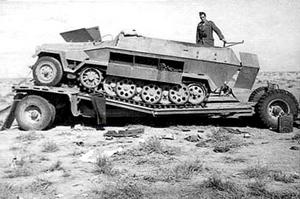
Capt Bond with German half-track
The March Equinox 1941.
The German air raids increased in strength day-by-day, and the low-flying strafing attacks were alternated with screaming dive-bombers. We therefore extended our dispersion from 100 to 200 yards between vehicles and, indeed, the whole day appeared to be spent walking from one vehicle to the next. From the day of our arrival in Cyrenaika our rations consisted of bully-beef and biscuit with very few, if any, other ingredients at all, though an occasional Arab egg could be obtained by local barter. The Field Park had got into the area early enough to buy all the chickens they could, and were keeping them alive on their vehicles, in order to use the birds as a supplement to the rations, whenever they had time to kill and cook them.
As the enemy forces built up, their pressure on Aghaylah increased and the Armoured Cars had to yield the place to them by 25th March, but then there was a pause for a while. With hindsight, it is probable that the extensive salt-pans restricting manoeuvre in that area were still sticky at the time, and the enemy were waiting for them to harden sufficiently, When the German armoured thrust was launched, it was on that lightly defended flank of the Support Group’s position, with a view to the quick re-capture of the port of Bengazih. When our HQ had joined Advanced Div HQ, they were at 30 minutes notice to move, so the Chief Clerk and most of the office equipment was sent back to "Rear Div" about 13 km north of Ajedabiya; however, Advanced Div’s notice to move had then to be extended to 4 hours, to allow enough time for re-charging the wireless batteries. The CRE visited the Field Park about 6 km south of Gitafiya, taking direct control of their Workshop, and moving it 10 km north of Ajedabiya, whither he also moved the First Troop of the Squadron, leaving only 2Lt Graham, with a Half-troop of some 24 Other Ranks, remaining under command of that Group.
On 27th March, the General G P agreed to the CRE’s policy for the use of minefields in the Divisional Area; several pairs of craters to be blown on the main road in each defile, with rays of mines about 50 yds long to catch vehicles skirting the craters. Mines were to be laid in other defiles, such as dry tracks in marshes and between sand dunes, also in certain crossings of the Wadi Fareg. 1,000 anti-tank mines were to be kept on wheels in the Field Park, for immediate use, but the supply of engineer ammunition, such as explosives and mines, by the Service Corps was difficult, as there was no Divisional Troops Company; for the moment, existing dumps of much less satisfactory Italian mines had to be utilized. On 29th March, the CRE visited the Squadron some 6 km West of Antelat, where they were spending a day on vehicle maintenance. Air reconnaissance had reported that some 200 enemy vehicles in the Wadi Fareg south of Aghaylah presented an excellent bombing target, but "our" General’s call for bomber support was rejected, as none were available; perhaps all the aircraft had been sent to Greece. In fact, the reported "vehicles" might have been nothing more than deception to fool the photo interpreters ?
On 30th March, the CRE accompanied General Neame with our General on a tour of the Divisional area, visiting the Armoured Brigade HQ, as well as the KDG, south of the Wadi Fareg, and to the Infantry Group in the Sebket Serrira area. Orders were given that, if the expected threat materialized, the destruction of stores should not give away an intention to withdraw,— e.g. fuel-stocks to be spilled, not burnt. The wells at Ma’aten Besheir appeared to be in use by Bedouin, and were not to be destroyed, although air reconnaissance reported a suspicious influx of "Bedouin tents" at the western end of Wadi Fareg; also concentrations of enemy vehicles near Aghaylah. Although stocks of wire were available at Ajedabiya, such obstacles could not be used to improve the Infantry Group’s defensive position, owing to the lack of any suitable pickets.
In order to indicate some aggressive intentions, Advanced Div HQ had earlier been moved forward again to an area west of Bilal Airstrip, which our Sappers then refurbished in case any RAF came our way. On 31st March some enemy tanks, with supporting infantry, attacked the position held by the Tower Hamlets and obtained little success, when a cruiser squadron of Fifth Tanks appeared on their flank. Afterwards, the Infantry Group retired slowly, while the Sappers damaged the wells in the area, including those at Mersa Brega in the face of the enemy. Four pairs of craters were blown on the main road between Mersa Brega and Ajedabiya, with rays of anti-tank mines laid from each crater. Divisional instructions were issued for the Axis of Withdrawal to be Antelat-Mesous-Mekili, so the Field Park retired to a position 8 km north of Antelat. Advanced DivHQ relocated to a position 9 km north of Ajedabiya, but was badly hampered in the move by their drivers’ desperate lack of training in driving without lights at night.
April 1941.
Bad as the signal arrangements were in the Division, on 1st April they seemed to be worse than usual, while the Infantry Group was still retiring towards Ajedabiya in a series of positions astride the main road. Their attempts to withdraw by leap-frogging was hampered by the fact of its having only one battalion. A new position 4 km north of Ajedabiya was prepared. All identified engineer stores were destroyed by the Workshop, who then re-joined the Field Park near Antelat. As the Third Troop was expected back from Jarabub, the CRE signalled to Barche to intercept them and to hold them in readiness, near Abyar. Some Australian Engineers were demolishing the dumps of Italian ammunition at Beda Fomm and elsewhere on the main road, while the First Troop did their best to deny the airstrip and other installations at Ajedabiya. They also were standing by to deny the wells. One of the few signals which did succeed in getting all the way from the front line to GHQ in Cairo was a report from the KDG that a black leopard had been seen slinking round the night leaguer of a troop on their South flank near Maradah; this was generally disbelieved, but subsequently expert opinion has confirmed the presence in that area of such animals
The enemy advance continued on 2nd April, and Advanced Div retired to 15 km south of Antelat. With the complete absence of any wireless equipment for the Engineers, all orders had to be conveyed by the CRE himself or by me, as his Adjutant. There were no jeeps in those days, and each of us was equipped with a smart Ford saloon-car, just the sort of target the Messerschmidt-pilots welcomed, because these cars had no sunshine-roof or other means of looking backwards to see if any strafing aircraft were coming in for the kill at 200-knots. Continually in this danger, the CRE visited the Squadron, placing them at 30 minutes notice to move, and ordered them to send all baggage and craftsmen’s tools back to Dernah, in order to give spare capacity to replace the inevitable losses of vehicles from enemy action.
Meanwhile, tracks near Antelat were reconnoitered and sign-posted, and Rear Div withdrew again, now to Shelideemah. Under these conditions the inevitable rumours multiplied, and the most common greeting was "Haven’t you heard; it’s all been changed", sometimes it had been, but not always. Suddenly, the Axis of Withdrawal really had been changed from Mesous-Mekilih to an unknown route via Rejimah, because of a rumour that the enemy had reached Mesous, to which the Hussars were diverted for observation. The Field Park moved to Shelideemah and the Squadron to 18 km north of Antelat, with Advanced Div just North of it. A crisis occurred when the stocks of petrol existing there had been issued to the Armoured Brigade and to the Infantry Group, leaving Div HQ thirsty, but hoping for a Service Corps column bringing further supplies. During that night, in the course of my liaison duties, I happened to sight them, quite by chance, apparently lost in the rolling down-land nearby. The wind-pumps of the deep wells at Beda Fomm were now being destroyed by the Squadron, and the remains of the supply dump there were tipped into the wells.
© Copyright of content contributed to this Archive rests with the author. Find out how you can use this.


 Recommended story
 Story with photo