

- Contributed by
- actiondesksheffield
- People in story:
- ARTHUR WARD, Curly Bointon, Capt Smith, Alf Titterton, Carroll, Stewart, Regt Sgt. Major Charlie Butt, Gunners Earle, McWade, Tommy Craven, Lowe, Myers, Renolds, Towers, Sgt. Birkett, Sgt. Baldwin and BSM Lawson, Richmond, Captain Smith .
- Location of story:
- Goubelliat, Salt (sugar) Lake, Mount Kournine, Mjez El Bab, Tunis, Hamman Lef, Cape Bon, Bou Ficha
- Background to story:
- Army
- Article ID:
- A4517606
- Contributed on:
- 22 July 2005
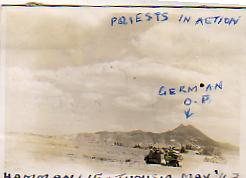
May 1943 - Priest in action near Hamman Lif, Tunisia. Note: the 2 “Tits” or Pimples where the Germans had observation posts well dug in. Near this position Bombardier Arthur Ward hit with the 15 Browning, together with many other machine guns, a German ME 110. The plane crashed nearby.
This story was submitted to the People’s War site by Roger Marsh of the ‘Action Desk — Sheffield’ Team on behalf of Arthur Ward, and has been added to the site with his permission. The author fully understands the site's terms and conditions.
Refer to Chapter 1-- A4345544 -for links to other chapters.
LIFE IN THE ARMY
by
ARTHUR WARD
Chapter 16 — The Germans are Kicked Out of Africa
April 22, 1943
Started firing at 05:10 hours and fired 60 rounds a gun.
In our sector were 3 Regiments i.e. 72 guns. We ceased fire at 07:30 hours and moved forward at 14:30 hours with 6th Armoured Division and gave close support to our tanks.
‘A’ and ‘D’ Sub were sent in front of the forward troops as "winkle" guns. The idea being that we had to fire direct fire that is we could see the targets to destroy enemy tanks and anti tank guns. We had a very good day but a very frightening one and wiped out several pockets of infantry and A/T guns. We were not too thrilled about this job as we would have been no match for German infantry if they had counter attacked.
Then we had some very bad thunderstorms and very heavy rain, so we had to leanguer near the enemy lines. One German soldier walked into the area and gave himself up to a ‘B’ Troop Guard.
April 23, 1943
Moved forward again with the leading tanks and had a very successful day and fired 221 rounds.
The Germans were still putting up a strong resistance even though they were withdrawing,, and we had some very heavy attacks from ME and Focke Wolfe fighters; no one was hurt but 5 tanks were set on fire very near to us.
I fired 250 rounds with the 0.5 Browning at enemy planes. At 16:30 hours we moved sideways to join up with the Queen Bays and the 1st Armoured Division.
On this move our priest hit a very large stone, which stripped off one of the tracks. The battery fitters repaired and refitted it but whilst doing so, we were attached by ME fighter planes. I fired 90 rounds with the Browning and we were lucky not to suffer any damage. We managed to catch up with the battery as they bedded down in a defensive position at 20:30 hours.
During the night, butterfly bombs dropping nearby kept us awake and enemy flares lighted up the area.
April 24, 1943
The Queens Bays attacked and we supported them by firing at A/T guns and tanks.
We had 2 positions in cornfields where care had to be taken as mines were laid everywhere. Another hazard was that the corn was nearly ripe and the danger was if it was set of fire. During the day we were attacked by ME fighter-bombers and I fired 300 rounds with the Browning.
Our priest fired 160 rounds during the day. At night we moved behind the tanks of 6th Armoured Division ready for another big attack.
We saw an ME fighter brought down by Spitfires and the pilot baled out safely nearby.
April 25, 1943 EASTER SUNDAY
There was a very large concentration of troops in the area and we were shelled when moving to a new position which was in a wadi, which overlooked Goubelliat plain near Salt (sugar) Lake.
We were machine gunned by ME’s, which dropped bombs about 200 yards behind us.
We saw 2 more brought down by Ack Ack fire.
April 26, 1943
I had a spell on guard and we all had to stand to at 05:30 hours. Our gun fired 265 rounds and I fired 500 rounds with the Browning machine gun.
April 27, 1943
We were firing all day, mostly at enemy tanks, some of which were Tigers. We had one pinpoint target that was a Tiger MKVI (one of the latest), and we knocked it out after firing 78 rounds.
A change for us, the mail came up and we all received a bottle of beer and 50 cigarettes.
The weather now was very hot. We were getting many visits from enemy fighters (the level land was ideal for them as there was not much cover). One ME flew very low over us and I think every AA gun in the district fired at it; there must have been many hits. I was firing tracer and armour piercing bullets with the Browning, and I am certain that some of my bullets hit the plane. The plane caught fire and crashed about a mile away. The pilot baled out but he hit the ground about 400 yards away before his parachute could open.
April 28, 1943
We were heavily shelled, but most of them fell just behind our gun position.
The AA fire from nearby Bofors guns was very heavy and the shrapnel from these guns fell in our area, and Curly Bointon was hit in the chest and taken to hospital.
The battle was in a stalemate just now as we were all on the plain, and overlooked by 2 mountains, which stuck up out of the plain and provided ideal observation posts for the Germans.
They were called Mount Kournine but we had various names for them such as 'the Two Tits' or 'the Two Pimples'.
May 01, 1943
We were still in the same position and we were all issued with Khaki drill shirts and shorts as the weather was really hotting up.
At intervals, in turn all the regiment fired airbursts over the tops of Kournine, to help keep the heads down of the enemy OP's.
We moved 18 miles to an area near Mjez El Bab and rejoined 6th Armoured Div., and 166 Field Regt RA (Newfoundlanders) took over our position.
May 02, 1943
Reveille was elastic, i.e. we could get up when we wanted. I was up at 11:00 hours to help with the usual maintenance.
Our priest (‘B’ Subsection) had to go back to LAD (Light Aid Dept) for repairs. Then travelled back to the battery.
May 03, 1943
Capt Smith gave a lecture on our role in the next battle. We drew rations and mail came up.
Reveille was at 03:45 hours and we moved at 04:30 hours ready to support the Lancers (the Lancers were famous in the 6th Armoured Division as the 17th/21st known as the Death or Glory boys, and their cap badge was a skull and cross bones).
We fired all night in a very large barrage and we also heard that the infantry had attacked with the tanks.
We received more mail, which included a photo of a priest sent by my dad. We followed the tanks in reserve and the largest air attack of the war so far took place when 12 to 18 Boston (American) bombers flew over us in relays, about every 5 minutes, for 3 hours. The day was very hot and a message from Mr Churchill to the 1st Army was read out to us.
We went into action 4 times during the day and chased the enemy for 8 miles.
We leaguered at night with the 17th /21st Lancers.
May 04, 1943
Reveille on Friday was at 04:00 hours and we moved off at 04:30 hours. We had several quick actions where we fired a few rounds and then moved on after the enemy.
We heard the news that Tunis had fallen to the allies when we were 5 miles away from the town.
We kept up the chase and put out of action many 88 mm guns by indirect fire.
Now thousands of German and Italian troops surrendered and walked past us to the rear area. It was good to see large groups of dirty unshaven and hungry enemy troops passing with perhaps 1 or 2 Infantrymen with a rifle guarding them all.
We arrived at the first town in the area, which seemed to be civilised and not the usual mud huts round a few date palm trees.
The people were mostly French and they ran out with flags, flowers, wine and dates, and gave us a great welcome, as they were so relieved that the Germans had gone.
We had never seen so much excitement and we were all hugged and kissed by young and old alike.
We leaguered at night just outside the town. Everything was quiet during a lull in the fighting, so we went into town and were invited into a private house owned by an English man who was married to a French lady, and his name was Charlie. He had a stack of vino hidden away, which he brought out, and we all had a real party which left us all with 'thick heads'.
What a relief from the past months where all we had were bombs, shells, bullets, dust and worry that every day could be our last.
After a night's sleep (or part of it), we were woken at 04:00 hours and brought back to reality. We moved 2 miles and fired a heavy divisional concentration on to Hamman Lef. We moved 3 more times before reaching the town where we received another reception from the French people. More flowers, roses, sweet peas etc, vino and civilians riding on the tanks, it was just like fiesta day. I bumped into Alf Titterton who had played football for Swallownest before the War (he was in 12th (HAC) RHA).
We advanced another 5 miles and leaguered near a range of mountains which we were told was full of German Infantry, but we had a quiet night.
We had to have a large guard on duty all night, which consisted of 1 officer, 1 Sgt., 1 Bdr, 1 L/Bdr and 20 gunners during which I had my turn.
May 10, 1943
The Germans were now concentrated on a spit of land called Cape Bon, which jutted out, to sea and they were putting up a heavy resistance.
They hoped to have there own 'Dunkirk' but unbeknown to us, the RAF were keeping their ships away from the land by continual bombing and machine gunning.
They had many 88mm guns used as artillery and Anti tank, and very large 210 mm guns, which sent shells over at regular intervals. They gave an almighty shriek and the explosion where they landed, had to be seen to be believed.
In our sector the going was very tough and in one engagement advancing up a Wadi, 5 Shermans in a row were knocked out and fortunately the 6th one escaped - it was our Battery Forward Observation Officer's tank. 30 of the enemy’s anti tank guns were seen in one area so we put down a massive barrage to put them out of action.
We advanced another 7 miles, then 88 mm guns and at least 1 tiger tank held everyone up again.
My subsection (Don Sub) had to go forward with the Observation Officer, and fire over open sights at an enemy 88 mm gun hiding in a farmyard. Fortunately we put it out of action before they saw us and we were very pleased that we did not come across the feared tiger tank.
Our tanks soon moved forward again and we came across many abandoned enemy trucks of which many were looted by our infantry.
We advanced 12 miles to Soliman and our battery was right at the front with the Sherman tanks and infantry.
Many prisoners were roaming around in a daze, and I fired the Browning machine gun over a small wooded area, and dozens of Germans with white flags came out and were put "in the bag".
At dusk we were in action again, then we moved forward 6 miles and leaguered for the night.
We saw a British Mustang fighter, which had made a forced landing at the side of the road. I think the pilot must have been OK.
The next day we moved off at 09:30 hours. There was a very dangerous diversion as the Germans had blown up all the bridges to try and delay us.
We advanced another 8 miles through Bannet where we found an abandoned enemy cookhouse with plenty of grub, so we had a real set to with the food we fancied. The enemy was now leaving their guns behind, they were so anxious to escape and they did not have time to spike (blow them up) before retreating.
We were in action again and fired 30 rounds. Then advancing and firing a few rounds every few miles.
The 210 mm gun was still making things very uncomfortable for us, as it must have a very long range.
At dusk we leaguered but at 20:30 hours we had to move quickly to another area as we had to support a night attack by the Rifle Brigade at 12:30 hours. The attack went in and we fired 30 rounds, then were told to bed down for the night.
Reveille 04:15 hours. During the day we moved to 3 positions from which we kept firing all day and the 90th German Light Infantry were well dug in to make their last stand. The 90th Light had been chased by us all the way from El Almein and was one of Germany's best units.
We were firing all day and the next day.
At 13:15 hours, an English envoy went forward and gave an ultimatum for unconditional surrender, or they were to be blasted by 1,000 bombers.
The Germans refused to surrender, but the Italians all walked towards us with white flags.
We then fired smoke shells to surround the area where the Germans were dug in. A deathly silence fell over the area except for an odd shell or bullet being fired, and then we heard the drone of airplanes.
Waves of 18 bombers appeared, and the air was filled with whines of bombs and mighty explosions. At 15:30 hours, after 3 waves of bombers (54 planes) had dropped their loads of HE, many white flags appeared and all resistance was over.
Our infantry went forward; we were given the order CEASE FIRING - it was Unconditional Surrender and ALL FIGHTING IN NORTH AFRICA WAS OVER.
We moved into an olive grove and bedded down at 20:30 hours.
Next day we moved into 26th Armoured Brigade area on the sea front near a French Military Camp at Bou Ficha.
We had been surprised at the large numbers of Germans we saw marching, or most of them staggering into Prisoner of War Camps.
We heard that the 90th Light Infantry had destroyed all their equipment and they had marched in perfect lines of three into captivity and insisted that they were taken prisoner by their old foes the Eighth Army.
Reveille 0630 hrs. Maintenance and parades now started in earnest. Plenty Bull - we had to scrub webbing, polish boots and brasses and wash all our clothing.
We were able to swim in the Med - it was hot and glorious. The sun shone all day.
Reveille 06:30 hours. We paraded at 11:00 hours and travelled by truck to Tunis for a day out. It was 50 miles away.
We had a walk around the town and into the native quarters, which were out of bounds. We were invited to a Wog house and supplied with stacks of wine.
I had a haircut and shampoo, which cost 60 francs = 6 shillings (30p), we had to carry gunners Carroll and Stewart back to the truck drunk.
On the way back to camp, we called at St. Germaine and had a singsong and more wine at Charlie's house.
Sunday. Church parade was by the RHQ flagstaff. We enjoyed the service by the new Padre. Afterwards we had a swim in the Med then a lecture by the CO - Our role in the next battle - INVASION OF EUROPE.
May 17, 1943
Monday. Swimming in the Med
After maintenance, I had to report to the Regt Sgt. Major (Charlie Butt) as I had been chosen from the troop to represent the Regt. on a Victory march in Tunis.
We had a practice march past but had it cancelled at 06:15 hours, as the heavy rain came down and wet us through.
May 19, 1943
Wednesday. Travelled in truck to Tunis where we had to sleep one night in a field on the outskirts of the town. Here I met several lads whom I knew in the 70th Field Regt., as they were also taking part in the march. I saw Gunners Earle, McWade, Tommy Craven, Lowe, Myers, Renolds, Towers, Sgt. Birkett (my ex No.1), Sgt. Baldwin and BSM Lawson.
May 20, 1943
Cleaned brasses etc. Inspected at 11:30 hours then marched on Victory Parade.
11th (HAC) Regt RHA (comprising 36 men) led the 26th Armoured Brigade, then the 6th Armoured Division led by Major Richmond, Captain Smith and R.S.M
Butt. We marched through the town where the roads were lined with cheering crowds. Guns, tanks and vehicles were lined up in the centre of Tunis near the saluting base.
RAF planes flew over low in salute. On the saluting base were General Giraud (France), General Montgomery, General Alexander (area commander) and General Eisenhower (USA). The parade was very long and was accompanied by Pipe bands.
It was a very impressive display and afterwards, we heard that the British troops were said to be the smartest on the Parade. We returned to camp at dusk and I was on duty as Guard Commander.
Pr-BR
© Copyright of content contributed to this Archive rests with the author. Find out how you can use this.


 Recommended story
 Story with photo