

- Contributed by
- matthew moss
- People in story:
- john moss and interviewer matthew moss
- Location of story:
- burma
- Background to story:
- Army
- Article ID:
- A6836204
- Contributed on:
- 09 November 2005
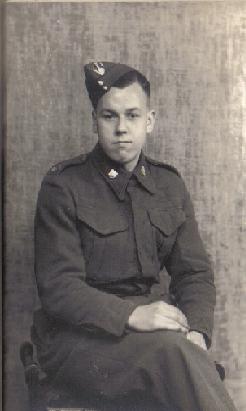
this is a picture sent home by my grandfather to his parents at christmas circa 1940 probably sent from his training camp in scottland.
Age: 86 years (Born 12/5/19 in Preston)
Rank on discharge: Pte/Trooper (A coy, 8th Platoon, 18th Battalion, reconnaissance corps)
article written: may 2005
Army serial No. 3858029
Discharged: 17/4/46
Interviewer: Matthew Joel Moss
Mjm: where did you report for duty?
Jjm: I went from Preston to Frasier street drill hall in Liverpool.
Mjm: How old were you?
Jjm: it was 1940 so I would have been 20.
Mjm: where did they send you to train?
Jjm: somewhere in Scotland in the lowlands I think.
Mjm: what did you train to do?
Jjm: I trained to drive a Bren gun carrier, which is a truck with tracks that carries a Bren gun.
Mjm: where did you go next?
Jjm: we where sent to India we stopped off at the cape and then went on to India we landed at Bombay.
Mjm: what did you do once you got their?
Jjm: as I recall we went to a district to gather our division so we could go up into the jungle to the northeast.
Mjm: where exactly were you captured?
Jjm: we were evacuating from Singapore just as most of our forces were surrendering. That would have been February; we were leaving on an Australian ship when Japanese zeros attacked us with incendiary bombs and the boat was forced back into the harbour where we were ordered to disembark and not long after that, we surrendered with rest of our forces in Singapore.
Mjm: what happened next?
Jjm: we were marched to Changi that at one point had been an English barracks. The Japanese guard took the barrack rooms to sleep in and made us sleep out side with the mosquitoes.
Mjm: what did they put you to work on?
Jjm: well we did several things but first we had to build a railway for them. (The Rangoon to Bangkok; or more commonly known as the Burma railway.) We took railway sleepers off the back of a diesel tram and laid them so that the tram could move forward then we put the track down and nailed it down. I think the track was brought from Malaya. When they ran out of diesel for the tram had to cut rubber trees for fuel from the jungle. I also worked in a copper mine in a village called Iruka where we had to hack at the rock face and blast to get the copper out of the rock we had to move the rock into five tubs; the tubs held 2500 lb. They moved on rails; like a miniature railway.
Mjm: What were you wearing while you were doing this?
Jjm: our uniforms were either taken or fell apart so we had to wear loincloths
Mjm: what were the conditions like in the camp?
Jjm: well we had terrible rations we got ½ a pint of water and either rice, wheat or barley and for our main meal
We had either rice, wheat or barley again with potato and carrot tops we grew our own vegetables in our own manure and we got some seed’s from the locals and maybe some meat. The rations where poor because the Japanese were eating the Red Cross parcels instead of giving them to us. The air was humid and mosquitoes were everywhere men had malaria, beriberi and our hand became blistered; the blisters were filled with yellow puss we had to cut them of and put Condeys fluid on them. Condeys fluid was a substitute for iodine.
Men got cholera from drinking water from the Kwai.
There were about 400 men from different regiments there where Australians, Indians, Canadians and British troops. There weren’t any toilets so we had to go in the jungle.
Mjm: what were the Japanese guards like?
Jjm: the compound where we where held was in the middle of the jungle there was a fence round the camp only a few foot high made of bamboo. The guards were mostly wounded soldiers not fit for duty they were recuperating; their commander rode a horse I cannot remember his name but we used to call him Terrymoto that was his nickname.
Mjm: how did the Japanese punish the prisoners?
Jjm: well four men tried to escape they where caught and made to dig their own graves and then they where shot.
Other punishments like tying you to a stake in the sun and not getting any water and making stand outside the guardroom and every time a guard came out, they would beat you.
Mjm: what did the Japanese do when the allies were getting nearer to the camp?
Jjm: When the Americans began to get closer, the Japanese started giving us the Red Cross food parcels they had been eating.
The guards started to filter into the jungle as the Americans got closer and they just left us to it.
Mjm: where did you go when the Americans freed you?
Jjm: we where taken to Manila by train and truck and once their we were given as much food as we wanted. Then they gave us the choice between flying home and going home by ship via America; I decided to go home by ship.
Since his three years as the prisoner of war at Changi and Iruka John Moss developed skin cancer and lost his eye this was due to working in the hot sun with no protection.
Service dates:
® Singapore: 27/10/41 - 14/2/42
® POW: 15/2/42 - 2/10/45
® Allied Hands: 3/10/45 - 4/11/45
® Discharged: 174/46
© Copyright of content contributed to this Archive rests with the author. Find out how you can use this.


 Recommended story
 Story with photo