

- Contributed by
- John Inman
- People in story:
- Anthony Inman Lt RNVR
- Location of story:
- England
- Background to story:
- Royal Navy
- Article ID:
- A8109001
- Contributed on:
- 29 December 2005
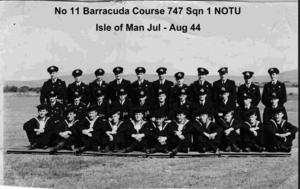
Barracuda Course,Isle of Man Jul 44, Tony Inman back row third from right
A View from the Back: The Recollections of a Fleet Air Arm Observer 1941-1946 by Tony Inman Part 8 of 14 (Aug-Sep 44)
Ronaldsway
The course finished at the end of July and we went on leave knowing we were to go on an OTU before joining a carrier or being sent overseas. In fact we went then to Ronaldsway in the Isle of Man. We didn't have any leave actually and we travelled from Arbroath down to Blackpool (this is the famous kipper incident). One of the air gunners had been on this refresher course and was sleeping in the guards van for some reason and in the van were crates of kippers. He took exception to the kippers, he had put his head on one and didn't like it so he threw the box out of the compartment and from then on that was his nickname.
747 Squadron at Ronaldsway was a rather strange place. The Station CO was a commander called Montgomery and he was a relation to General M and he boasted that his station could stand an Admiral's inspection without notice, so you can guess what a fearful bullshit place it was. It wasn't helped by some reputed episodes in the Atlantic previously. It was rumoured that on one or two of the escort carriers on the Atlantic run, the weather had been so bad that the aircrew had point blank refused to fly although the Captain and Commander Flying had ordered them to. This was treated as aircrew mutiny although probably the full rigours of taking part in the mutiny were not applied, but it came down that aircrew had to be under tighter discipline. So if there were more than two of us going anywhere, one was to be in charge and the others had to march as a squad, so you can imagine how daft that looked when there were only three of us - one trying to march the other two around.
The senior pilot of the squadron had a DSC and it was reputed (by WREN stewards) that he had a medal ribbon sown onto his pyjamas, and when we came to know this chap we could well believe it was true. We were going to crew up with the pilots and when they arrived they turned out to be the remains of a group that had started out together on the same pilots’ course. When they had joined up together and done their advanced flying there were 18 of them, and they were now down to 11, through various flying accidents etc.
We had to try to find a pilot and an air gunner. I was talking it over one evening with Alec Gardner who asked me if I had found a pilot yet. I said, "No", and he replied that he had joined up with another Scotsman. He asked me what I intended to do and I said I didn't know really and he said let's go down to the flight hut and look at their log books and see the ones with the better marks. Down there we went, and the pilots were usually reported as ‘below average’, ‘average’ or ‘above average’. I came across one ‘above average’ - Norman Grant. We went back to the Mess and asked "Which one's Grant?" "Oh, the General” they said — “that one over there". I went up to him and said, "Are you Grant?" He looked at me and said, "Yes". I said "Are you crewed up yet?" and he shook his head. I said "Will I do?" and he nodded and said, "OK" and shook hands. And that was all we said to each other and he was one of these talkative fellows who never said anything to anyone - he hardly ever spoke a word - but by God could he fly. He was a genius, he really was. We picked up an air gunner who was an acting PO, he had been in some time, but what he had been doing I don't know. That was Jim Smart.
We then started flying this course on Barracudas. The Barracuda had been designed for naval work and it was said that the designer had sat an observer down and built the aircraft around him. You had 2 big bulbous glass panels one on each side of you and you sat on a seat which was almost on the floor. As it was a high wing monoplane you had a marvellous view. If you stood up there was a gun mounting at the back of the cockpit and there was a little tilting top which deflected the slipstream over your head.
It was the only high winged monoplane with a retracting undercarriage in service and it had to be seen to be believed. It was said that the Napier Sabre engine had been designed for the aircraft but that in the end it was not fitted, one because it needed such a lot of maintenance (too much for carriers), and two because the RAF wanted to put it in the Tempest and the Typhoon. The Barracuda got the good old standby, the Merlin, but it was underpowered, so in the Pacific it was found not to be strong enough and if there was not enough wind the kite had a tendency to fall off the end of the flight deck into the sea on take off. In the end it was withdrawn from that part of the world and used only by the Home Fleet.
It had been found in training that, during the anti submarine runs, if the pilot tipped the nose straight down the carburettor would cut out (to do with gravity I suppose) and the engine would falter so to remedy this what they had to do was tip it on its side and rudder it round in a curve. The pilots had flown together for a long time and all knew each other and they generally worked in threes. There was us, a pilot called Pete Watson and another called Johnnie Abrahams. These two, with Grant, were very good friends and we got on all right with the observers. Take-off and landing were controlled from the tower with green or red Aldis lamps, but they had a new RAF idea to have a vehicle with a glass roof at the end of the runway in contact with the tower and the erk in this vehicle flashed the Aldis. The RAF trained them but they were not used to Fleet Air Arm stream landings designed to get your aircraft down onto the carrier in the shortest possible time which we practised on aerodromes. These erks had been trained that there was one aircraft on the runway at a time and the next was not allowed on until the first was clear. Our training was a bit different and it was nothing to have 4 aircraft on the runway at the same time landing rapidly one after the other, whilst this poor chap was desperately firing his Verey pistol and trying to control what was happening. They did this business of flying the downwind leg, turning across wind to come into land but only levelling out just as the wheels were about to touch the ground. It was a delight to be in this team. We would come back in V formation and the leader would make a hand signal at which one on the left outside would tip down and come up on the one on the right so we would go from vee to echelon starboard. When we arrived, the chap in front would pull his nose up and go straight up, and at the point of stall, fall over to port, the rest of us were to starboard, and dive down into the landing pattern. As he came past the next one would pull up and then the third, all of us very close on the circuit to land one, two, three with virtually no intervals.
We did anti-submarine bombing, radar work, torpedo dropping (dummies of course) and navigation exercises. We did it by day, and then by night. We flew singly or in formation. We torpedoed without torpedoes, with dummy ones, that is, no warhead, and with concrete ones which were the shape and weight of real ones. Torpedoes had to be dropped at a height between 50 and 150 feet. Any higher and the torpedo would either nose-dive and porpoise, or just break up. Any lower, and you were in the water. So you will realise that at night there needed to be some very careful flying. We did all the things there were to be done at a Fleet Air Arm Operational Training Unit; all in a period of about 5 weeks which often necessitated 2 flights a day (or night.) Some of the flights in my log-book are described by initials and I do not remember what they mean.
The aerodrome had, as well as a windsock, a large white letter T, the crossbar acting as an arrow pointing into the direction of the wind, or the direction of the duty runway. At night this T was illuminated. Being a naval air station the runway lights were Naval rather than RAF. This meant that they only shone in one direction, not all round. They could only be seen if you were landing in the right direction. These lights were used at sea so that there were no all round lights that could easily be seen by the enemy. One of the pilots was known as Hick, not his surname. He was one of the original pilots course and how he had ever survived was a mystery. He was coming into land one time when his observer was heard to say to the air gunner, " Do your belt up tight, we're coming in to land". We had by this time progressed to RT from WT and intercom was being broadcast by mistake. They needed to be strapped in tight for his landings were always hair raising affairs: more of an arrival than a landing. One night he surpassed himself. We had taken off, probably to do a night navigation exercise, as we were away a couple of hours, by which time there had been a change of wind and the runway in use was different from the one we had taken off from. This was indicated by the T pointing in a different direction, with no lights on the original runway, but lights (directional) on the new runway. Runway lights were red but those on the taxi track round the perimeter were blue. Those of us who came back before Hick had all seen the change and were down OK. It did not seem Hick gave any thought to the colour of the lights for he arrived over the strip in the same direction as take-off and landed along the only lights he could see - the blue ones on the taxi track. Other aircraft had landed before him and gone round the track to the parking bays. Luckily there were none on the track when Hick came in, but some were only just off it and the sight of this idiot roaring down the avenue of blue was absolutely terrifying - bodies running in all directions, some aircraft accelerating out of the way. Utter panic. He did not hit anything but saved himself for another day.
Nine of us were going on a torpedo-dropping exercise armed with concrete dummies, which were economical but gave the pilot the experience of the change of feel of the aircraft when the heavy torpedo had been released. We were flying in three vics of three stepped down astern. As we approached the target the leader gave the order to arm the release. The bomb release had been on "safe" but on this order the safe button was over ridden so that the torpedo could be released during the attack. Hick was in the leading vic and went from "safe" to "drop" in one go. His concrete torpedo was released and cartwheeled through the two vics below. He missed! After we left Ronaldsway we saw no more of him but stories filtered through. He joined one of the carriers that attacked the Tirpitz in Norway and his crew asked for re-assignment after he flew into the island when he missed all arrestor wires. He and his crew seemed to lead a charmed life but his luck ran out and he drowned while out bathing.
The torpedo attack we had been practising was known as ‘Shattock Shambles’. This was a method devised by a chap named Shattock and was for all the aircraft to attack at the same time, all from different directions. This avoided a concentration of defensive fire and meant that whichever way the target turned there would be torpedoes coming at it from the side. A nasty snag was that, after dropping, each aircraft was flying towards half a dozen others, some still flying straight and level before dropping. The system then was to turn away so that you were flying on the opposite course to the target, thus opening the range as fast as possible. I believe this method had been used at Matapan where one of the Italian ships had been disabled by a torpedo strike on the stern which put propellers and steering out of action. I don't know of it being used again, but then neither were many torpedoes.
Most of our flights during this period were about an hour long so even on the days when we flew more than once we spent a lot of time on the ground and I cannot remember what we did then. I don’t think we just did nothing, so I expect there were the usual lectures. Off duty there was a nice pub on the riverbank that was within walking distance and it was pleasant to sit out in the evening and chat. Nearby was Castletown where the main attraction was a place called the "Snakepit". I didn’t go there, of course. A bit further away was Douglas, which was reached by train - a narrow gauge -and none of the stations had platforms (as in America). It was not unknown for people to forget this and step out expecting to find a platform and to descend from a great height on to the gravel trackside.
At Ronaldsway, sub-lieutenants with wavy lace and wings on their sleeves were not looked upon with any great favour, especially by those with straight lace. ENSA came to give a show and the artistes were invited to the wardroom afterwards for a party. The main attraction was a young girl singer whose only accomplishment was a magnificent chest. She certainly couldn't sing, especially as the microphone would not work. There was much drooling over her by the more senior ranks, (we subbies, of course, didn’t go in for drooling) and aircrew under training, (us) were banned from the party. So we lingered in the anteroom which was between the wardroom and the kitchen and intercepted a lot of the food from the Wren stewards.
One night, after a party someone had the bright idea of breaking open Very cartridges and putting the flare parts in the stove. This was most spectacular but nearly burnt the hut down. Perhaps the seniors were right to try to keep us under control. The course came to an end, and compared with Machrihanish, it had been almost quiet. No casualties, not even any bent aircraft, though Hick Slaney had tried hard with his antics.
© Copyright of content contributed to this Archive rests with the author. Find out how you can use this.


 Recommended story
 Story with photo