

- Contributed by
- angelata
- People in story:
- Steve Norcott , Bill Barrett , Mr. Dorset, Aubrey Tapping, Joseph Rowntree, Ted White, Harry Holland, Alan Simmonds,Arch Sears, Mr. Hutton
- Location of story:
- Radnage, Buckinghamshire
- Background to story:
- Civilian Force
- Article ID:
- A4676501
- Contributed on:
- 02 August 2005
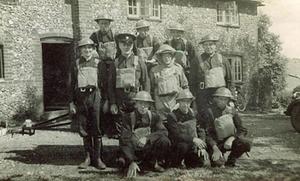
Radnage Fire Brigade
Our small village, Radnage, in rural Buckinghamshire about 30 miles from London had a branch of The National Fire Service during the war. The firemen were men who worked during the day and were in the fire service out of work hours. They manned the fire hut which was a wooden hut. It was equipped with bunks and a Primus stove to make tea-I think the war was won on tea! The firemen were on a rota to man the hut each night —but when there was an Alert they all turned out. The equipment, pulled by Mr Rowntree’s car, was a trailer with ladders and a Coventry Climax pump. My dad, Bill Barrett, was an engineer so he was in charge of the pump which was a little temperamental at times. As part timers they were responsible for the first aid at local fires and when the blitz was at its height they would be ready to stand in if needed for Stokenchurch , who were an actual Fire Station with a proper tender, when they went to Wycombe as the Wycombe firemen were sent to London.
The fire Service drilled on Sunday morning near the Chapel, which we kids loved as we watched before going to Sunday School.
I remember one night when there was a really dreadful raid, even at Radnage we could hear the bombs, the planes overhead and the anti-aircraft guns. Dad popped down to see if everything was O.K. as there were stray bullets, jettisoned incendiary bombs etc., about. They would patrol the village to see if all was well. “ London’s taking a real pasting tonight the sky is bright red” We found out later that it was the worst raid on London of the whole war.
The members of the Fire Service were all men who worked full time during the day.
They worked in all sorts of jobs which the Government considered to be of national importance, these were called Reserved Occupations. Several of the men worked on the farms. One was a forester, wood was urgently needed, several worked in factories in Wycombe, one or two ran their own businesses, some were too old for active service and some may have been classed as not fit enough.
The photos were taken outside The Three Pigeons pub. Now a private house. I think that this was the fire service pub, while the Home Guard used The Crown. The personnel are Front row kneeling from left: Steve Norcott (factory worker), Bill Barrett (Engineer), Mr. Dorset (farmworker).
Middle row: Aubrey Tapping (Chairmaker), Joseph Rowntree (factory owner), Ted White in the gas outfit (Publican of The Three Pigeons), Harry Holland (builder and Smallholder)
Back row: Alan Simmonds (Carrier), Arch Sears (forester), Mr. Hutton (artist)
I don’t think there were many great conflagrations for them to deal with, Dad would come in sometimes very dirty and smelling of smoke, I remember he said once that some incendiary bombs had set fire to some hay stacks but they were there if needed and allowed the full-time fire fighters to concentrate on more important fires. There were still ‘normal’ fires, chimney fires, bonfires out of control and in the country sometimes ricks would spontaneously combust
At the end of the war they were disbanded and for many years the old fire hut was used as a garage, until it was demolished in the l960’s when houses were built there. It will be good for the quiet dedication of these very ordinary men trying to do their bit in those difficult times to be remembered. After nights spent fire watching they were all back at work the next morning. Dad would leave for work at about 6a.m. and not get back until after 6.30p.m. and the others were the same. Once a fireman always a fireman! We lived in Cranborne in Dorset where my husband was a retained fireman. When Dad visited us if the bell went Dad would be out of the house following my husband down to the fire station to watch the tender go out and come back grinning from ear to ear.
© Copyright of content contributed to this Archive rests with the author. Find out how you can use this.


 Recommended story
 Story with photo