New technology
New technology
Although artillery and infantry remained central to the successful fighting of battles, the British army also made use of many pieces of new technology. Some of these are well known - the tank, the aeroplane and poison gas all achieved considerable success at different points in the war - but others are less familiar.
Enemy barbed wire was a major problem for British forces on the Somme, and it was very difficult to destroy with conventional artillery fire, which often either left the wire unscathed or broke up the ground so severely that it became impassable anyway.
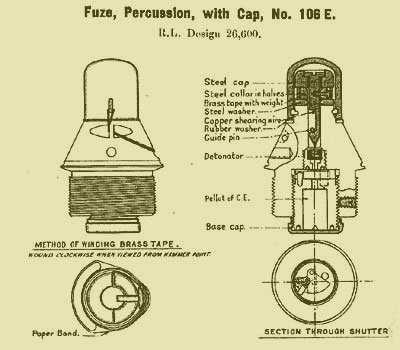
In response, the British created the ‘106 fuse’, illustrated here. It caused artillery shells to explode on the slightest contact and to expend their force horizontally rather than burying themselves in the ground. It was extremely effective at cutting barbed wire. Available in small quantities in 1916, it was in 1917 that it came into its own as a weapon against wire and troops.
No new weapon was a war winner in itself. World War One tanks, for example, were mechanically unreliable, desperately uncomfortable to fight in, and remained vulnerable to enemy artillery and impassable ground.
The Germans quickly developed counter-measures to every Allied technical innovation. New technology had to be integrated with existing arms in order to achieve the best performance. It was not until the last year of the war that the British became truly adept at combining new weapons and tactics to break into and then break through the German lines.
Although tanks were first used at the Battle of Flers on the Somme in 1916, they did not start to come into their own until the Battle of Cambrai, in November 1917, and were arguably only truly well integrated into ‘all-arms’ battles in the summer of 1918.