| 24 September 2014 |

| |
| BBC Homepage | | |
| |||
| Contact Us | | |
AbolitionYou are in: Hampshire > Abolition > Chasing Freedom 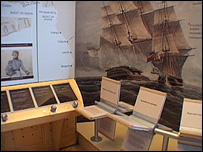 Chasing Freedom Chasing FreedomAs 2007 marks the 200th aniversary of the abolition of the slave trade, the Royal Naval Museum is taking visitors on a voyage discovering the harsh realities of the slave trade and the navy's role in halting the trade of African men and women. On 25 March 1807, Parliament voted to abolish the slave trade which had seen millions of Africans sold and forcibly taken across the Atlantic to work on plantations in the West Indies. A special exhibition at Portsmouth Historic Dockyard’s Royal Naval Museum explores the slave trade and, in particular, little-known role played by the Royal Navy’s West Africa Squadron in helping to combat slavery. 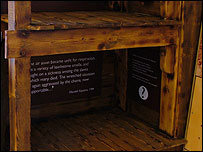 A reconstruction of the slave deck Visitors can imagine the traumatic crossing endured by millions of enslaved Africans by crawling into the reconstruction of a slave deck. They can also handle artefacts related to the slave trade, including leg irons, handcuffs and a neck collar used to restrain Africans after their capture, during their journey and in the plantations. The Museum Learning Development Officer Deborah Hodson explained the interactive feel of the exhibition: "We want it to be reflective - we want people to come away with greater empathy both with the Africans who were taken into slavery and the men of the Squadron who were trying to suppress the trade. "Obviously we are never ever going to get near the actual experience as the conditions were so horrendous but we're hoping people will understand a little bit of what life was like." 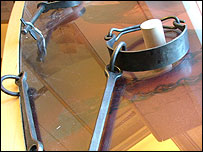 A replica of a neck iron used on slaves In two specially produced films, both sides of the political argument of the time are played out - the plantation owners and slave traders who relied on their human cargo for profits and the humanitarian arguments against slavery. Even Admiral Lord Nelson, presents his arguments for and against the Navy’s involvement in the suppression of the slave trade. There are also the views of liberated slaves who managed to record their stories and an African Chief, King Guezo of Dahomey, describing their first-hand experiences of the suppression of the trade. After the trade was abolished, the Royal Navy's West Africa Squadron was sent to West Africa to police the ban - they faced many dangers including outbreaks of tropical diseases which took a terrible toll on the ships' crews. 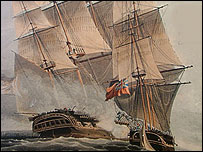 Enforcing the abolition (Royal Naval Museum) By 1865 nearly 150,000 people had been freed through anti-slavery operations by the Royal Navy but many sailors had given their lives to end the suffering of the slaves. Boarding disease-ridden slave ships posed dangerous risks of infection. Many sailors died from the tropical diseases including dysentery, yellow fever and malaria. The exhibition includes harrowing accounts on life on board the ships from sailors like Midshipman CH Binstead: 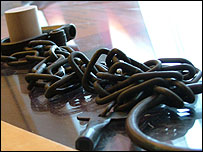 Chains used on enslaved Africans "Many large whales and sharks about us the later is owing to the number of poor fellows that have lately been thrown overboard – the ship is now truly miserable many of our own crew very sick and the decks crowded with black slaves who are dying in all directions and apprehensive their cases of fever are contagious." Although the act of Parliament abolished the slave trade, slavery has continued in various forms around the world ever since - and the exhibition also highlights the continuing role of the modern Royal Navy in combating people trafficking and piracy and defending human rights. The BBC is not responsible for the content of external websites Chasing Freedom: The Royal Navy and the Suppression of the Transatlantic Slave Trade (1807 - 2007) - Royal Naval Museum at Portsmouth Historic Dockyardlast updated: 12/03/2008 at 10:21
|
| | About the BBC | Help | Terms of Use | Privacy & Cookies Policy |