Although a History Of Violence is bloody, it's more restrained than what we've come to expect from director David Cronenberg. It's a plainly told story with Viggo Mortensen playing a small-town guy whose family is torn apart by ghosts of the past. Critics noted "layers of complexity" and there were Oscar nods for writer Josh Olsen and actor's actor William Hurt (for a brief but blistering turn as an old-school gangster). Even so, it only just about broke even in ticket sales.
Shooting People
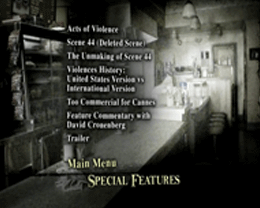
The centrepiece of the extras package is an eight-part documentary that gets up-close-and-personal with Cronenberg and the cast as they tackle key scenes. In addition to the usual issues of staging and dialogue, they discuss the themes and subtext driving the action. For instance, when Tom (Mortensen) shoots the bad guys in the diner, Cronenberg draws attention to a visceral reaction, which is exhilaration - not just for Tom but for the audience too. "Violence is a real and unavoidable part of our existence," he asserts, "And you can't really say it's never justified." However, Mortensen is also keen to get across that the violence is "not glamorised".
Later we see Maria Bello (Edie) flustering over a confrontation with Ed Harris (Fogerty) who ends up coaching her through the scene. It's obviously a moment of great vulnerability for Bello and, for us, offers a rare moment of intimacy with the actors. Two sex scenes were also tricky for both Bello and Mortensen - particularly the latter, more violent one. Cronenberg explains that he added these to reflect the change in tone for the relationship between Tom and Edie.
There's only one deleted scene, but it's presented with optional director's commentary and a separate making of featurette. It's a nightmare sequence that finds Ed Harris grinning like a maniac even though his chest has been blown apart like a ripe watermelon. It was cut because, as Cronenberg says, "It felt like it was from another movie." Indeed, in the featurette, he momentarily considers having Fogerty pull a gun from the smoking wound as a nod to his earlier work. "It would be an homage to myself which I'm not above doing," he explains, "but I think not." (That's bad news for the guy the big rubber fly suit...)
Cut, Slash, Crunch
There's a brief demo of the subtle changes between the US cut of the film and the international cut in the Violence's History featurette. Basically, the sound of bone being crunched is subtler in the US version and blood dribbles as opposed to spurts. It's a prime example of how ridiculously finicky the American censors are. Going to the other extreme, the French crowd apparently cheered at the violent bits as revealed in Cronenberg's festival diary Too Commercial For Cannes. The director is gratified by this, telling the international press, "I wanted them to be complicit in it [the violence]... so I can deliver to them the paradox of enjoying something that, morally, you find reprehensible."
It's a subject that Cronenberg talks more about in his audio commentary. He picks on the cut between Tom shooting Leland (Stephen McHattie) and the close-up of Leland's jaw hanging in a bloody pulp off his face and explains that it's supposed to be jarring for the viewer. "If you're going to like the violence," he explains, "you have to accept the consequences of it. That, of course, has a lot to do with the theme of the movie." Certainly there's a lot of splatter on this DVD, but its dissection of the film's subtext is clean, efficient and compelling.
EXTRA FEATURES