User Rating
Batman first swooped on to the big screen in 1989 with then up-and-coming director Tim Burton at the helm. Michael Keaton donned cape and cowl to battle Jack Nicholson's Joker in a story based on the graphic novel The Dark Knight Returns by Frank Miller. It made a killing at the box office and won praise for a gothic, 'Wagnerian' approach that was a world away from the kitsch TV series.
Dark As Knight...
Legends Of The Dark Knight offers a comprehensive history of Batman from his first comicbook appearance in the 30s. Between then and the late 80s, The Caped Crusader has been through many permutations, but Miller seems particularly offended by a modern whimsy for bringing "realism" to superheroes, calling it simply a "stupid" idea. We can only assume he's hinting at Batman Begins, but he takes a different reference point, saying, "I don't really need to see the sweat patches under Superman's arms - I just want to see him fly."
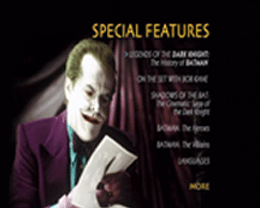
Meanwhile, the documentary Shadows Of The Bat investigates how the filmmakers shed the "pow, zap and wham" of Adam West's TV Batman. Miller's vision of The Dark Knight was the only route Tim Burton was willing to go and he admits, "I could relate to the duality [of Batman] - the darkness and the light." Screenwriters Sam Hamm and Warren Skaaren explain what they each contributed top the script while Michael Keaton reflects on the controversy caused when he was cast in the title role. Few people could stomach the idea of "Mr Mom as Batman". But even Keaton had his doubts, revealing that, if it wasn't for Burton's involvement, "I wouldn't even have read the thing". On the flipside, the casting of Jack Nicholson as The Joker seemed like kismet, but Burton first had to convince him that he was up to the task.
Going To Bat
Nicholson makes the shocking admission that, "I was a comicbook fan," in Beyond Batman - an even more in-depth look at the production. Despite initial reservations, Nicholson ended up being a great ally of Burton in his tangles with interfering studio execs. Burton also benefited from shooting outside Hollywood at England's Pinewood Studios where production designer Anton Furst used a "machine aesthetic" to create Gotham City. As well as the impressive sets, the largely British effects and design team talk about developing the Batmobile with all its bells and whistles. "It looks great," said Burton, "But where's the door?"
Among other topics of discussion are the Batsuit (underpants over tights was never an option!) and other props and gadgets, eg Batman's spear gun, steel gauntlet and Batarang (basically a modified boomerang). Elsewhere on disc two are video profiles of all the heroes and villains and a set visit by Batman creator Bob Kane. Fans of the comicbook will be just as intrigued by a storyboard sequence that introduces sidekick Robin. As Burton explains in Shadows Of The Bat, the Boy Wonder simply did not fit into his vision and few other people debated the issue. He talks more about this and other facets of the production in a well-rounded audio commentary on disc one where he sums up his approach as, "exploring the dark recesses of the mind".
Although there's only a smattering of behind-the-scenes footage, this selection of extras offers a detailed and engrossing look at the making of the film while also taking into account the bigger mythology of Batman. In a word: essential.
EXTRA FEATURES