Nick Cassavetes' The Notebook is an old-fashioned weepie based on the popular novel by Nicholas Sparks. Ryan Gosling and Rachel McAdams smooch against the backdrop of 40s Charleston in a story that "will have romantics blubbing and cynics hurling". Naturally it divided critics but did rousing business at the worldwide box office, eventually grossing just over $81m. In case you're wondering, that's a lot of Kleenex.
The Two Nicks
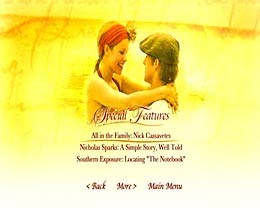 "He usually errs towards screaming," says Gosling, the lonely voice of dissent in All In The Family, a featurette entirely geared towards singing the praises of Nick Cassavetes. There's also a look at how he was influenced by dad John Cassavetes - often dubbed the father of American independent cinema - while behind-the-scenes footage captures the man at work.
Not to be outdone, author Nicholas Sparks gets his own forum with folks lining up to tells us what a gosh-darn great writer he is. His rise to fame is an inspiring story though, having penned The Notebook while still working as a pharmaceutical rep and going on to sell the screen rights to Warner Bros for $1m. Needless to say, he's not pushing drugs anymore.
Old Southern Charm
Ah, sitting on the porch sipping mint juleps in the afternoon sun... Southern Exposure offers a nostalgic trip back to the Deep South of the 40s, showcasing the efforts of various designers, costuming bods and hair and makeup people whose job it was to recreate the period. And there's more Southern-style backslapping in a featurette about the casting of the leads with a screen test by McAdams also included.
Among 12 deleted scenes is a sizzling love scene, which - as Cassavetes explains in an optional commentary - was cut after a kafuffle with the MPAA ratings board. Other than that, you'll find moments that reveal a little more about the dynamics between the leading players eg Fin (Kevin Connolly) consoling a drunken Noah (Gosling). There's also an alternate ending that recaps the story -eventually cut when test audiences found it redundant.
Footnotes
Cassavetes talks more about the development process in a sometimes-waffling feature commentary. He's rather fond of dispensing generalities like, "Directing a movie is like telling a joke... you don't want to get sidetracked." (Oh, the irony.) Fans of the novel will appreciate an alternative track by Sparks in which he reveals what inspired him to write the book, as well as pointing out what didn't make it to the final cut.
Altogether this DVD offers a good amount of bonus material, but it doesn't go into much depth about the nuts-and-bolts of actually making the movie. Budding filmmakers can put their notebooks away.
EXTRA FEATURES