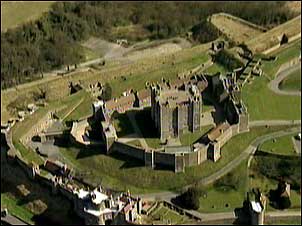
The Romans came to Dover and left their mark in grand style in the shape of the faros or lighthouse. It's the tallest Roman building north of the Italian Alps that's still left standing. Its stone tower is almost 2,000 years old and was used as one of the beacons to guide the Roman navy across the English Channel. A thousand years later and Dover was under the Normans who also left their mark in the shape of Dover's huge keep. Built between 1179 and 1188 it was a massive symbol of King Henry II's power. Built entirely of Caen stone, it's 100 feet square and just under 100 feet tall. Hidden within its walls is a gem of a small chapel dedicated to the memory of Thomas a Beckett, the murdered archbishop of Canterbury. By the late 18th Century Dover Castle had expanded again - three and a half miles of tunnels had been dug out, some of them 150 feet deep. The oldest tunnels were hewn out of the chalk bedrock in the 1790s, and led to a large underground chamber. The tunnels later became an important defensive nerve centre during the Second World War. |