| 13 November 2014 |

| |
| BBC Homepage | | |
| |||
| Contact Us | | |
Arts & CultureYou are in: Edinburgh, Fife and East Scotland > People & Places > Arts & Culture > Traditional kiltmaking lives on 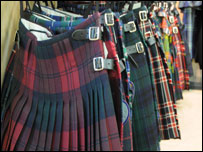 Traditional hand-made kilts Traditional kiltmaking lives onKiltmaking in Scotland has gone through many different guises in its long history. Yet the tradition of bespoke kiltmaking, hand-making the kilt to a fine quality and fit, continues to live on. Despite ever more cost-efficient and manufactured kilts making their way into stores, bespoke kiltmaking still has its place within the industry. The process of hand-tailoring a kilt is a long one. Using only a needle and thread and a good steam iron, handmade kilts can take up to 30 hours to make and cost many hundreds of pounds. They may be expensive but a hand-made kilt is made to endure and should last an entire life-time and beyond. Indeed, one of Prince Albert's kilts is still in use over a hundred years after it was made. 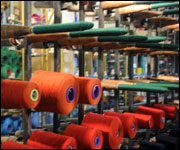 Spools of thread ready to be fed into the tartan Marion Easton, an apprentice bespoke kiltmaker has just completed her first three kilts and has another twelve to make before she gains her qualification. "It's going back to the purity of kiltmaking. The aim is not just to make a cost-effective kilt but to ensure its quality." One problem facing traditional kiltmaking is that the knowledge of kiltmakers has generally been passed down from person to person verbally. The lack of written information is understandable, as kiltmakers need to protect their trade secrets. Geoffrey Nicholsby has been involved with kilt-making since he was a boy, "It is not just sewing a kilt but you need to know how to plan a kilt so that the pleats all work out with the pattern and that can take years because every tartan is different." However, there are upsides to machine-made kilts. The expense of hand-made kilts can be a stumbling block for people, whereas machine-made kilts cheaper cost means that the tradition of wearing kilts can be made more accessible to people. It also opens the trade out to more tourists who possibly cannot afford the time or money to have a bespoke kilt made for them. 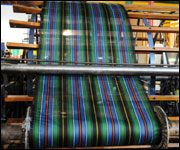 Tartan being made the traditional way There are arguments that the kilt has begun to lose its traditional values as new modern styles and techniques become available to kiltmakers. The last decade or so has shown that the kilt can be a fashion item and thus is vulnerable to change and alteration. Traditional kiltmaking does have problems facing it in the future. However, with apprenticeship schemes and continuing high standards of many kiltmakers, the traditional techniques should live on despite the threat of changing styles and modern manufacturing. last updated: 25/08/2009 at 10:28 SEE ALSOYou are in: Edinburgh, Fife and East Scotland > People & Places > Arts & Culture > Traditional kiltmaking lives on |
| | About the BBC | Help | Terms of Use | Privacy & Cookies Policy |