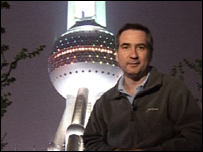
“We have nothing to fear about the future” said one young Sichuan teacher to his counterpart from Melton Mowbray. And when you go to China it’s easy to see why. 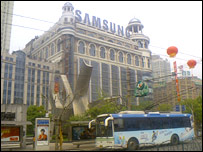 | | Shanghai is China's biggest city |
If you’re struggling to get your hands on cement or steel, it’s six thousand miles away. More than a quarter of the world’s steel and 40% of its cement is used up in China. Much of the country is a building site. Cranes are everywhere. Pudong is the fastest growing area of Shanghai. Twelve years ago it was virtually empty. No-one had worked out a way to build on the marshland. Now they have and you get neck ache looking up at the skyscrapers which at night gives the city its fantastic back drop. Fifteen years ago there were very few cars in Shanghai. Now it’s grid-locked for most of the day. My best driver by a mile was a woman. She described the driving habits in the city as “chaotic”, which is putting it mildly. Everyone weaves in and out of lanes, constantly hooting and missing each other by inches. Terrifying as it is, it seems to work. I was in Shanghai for the first leg of my assignment looking at the growing links between the East Midlands and China. 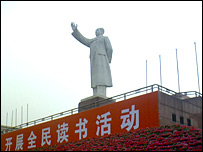 | | A reminder of Chairman Mao |
The most recent figures show that trade with China is worth three quarters of a billion pounds to the region. Almost 4,000 East Midlands companies now have trading links. Abacus Lighting, based in Sutton in Ashfield, is reaping the rewards. It manufactures lights for major infrastructures such as ports, highways and sports stadia. It spotted the opportunities in the mid-90s. Its Shanghai subsidiary is growing so fast it needs a new factory which is half as big again and is now bidding for the contracts for 50 new airports. South of Shanghai there was a surreal sight. On the outskirts of the City of Ningbo a familiar silhouette appeared. It was the Trent building at the University of Nottingham. Except that this was the University of Nottingham in China and this was an identical building. 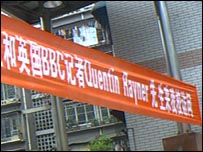 | | A warm welcome for Quentin |
The original took six years to build. Ningbo’s went up in eleven months. Nottingham is the only foreign university to have an independent campus in China. It officially opened a year ago. By next year student numbers will have doubled to 4,000. Throughout my visit I was greeted by bright-eyed friendly students with exotic names like April, Saxon and Yoyo. They were thrilled to be interviewed by the BBC – telling me it was a great honour. They also told me they enjoyed the chance to think more freely at a British university. Exchange students from Nottingham were also thriving on the experience.
They acknowledged that Chinese students were much more focused on their work but hinted that they ought to relax and let their hair down more. But with little nightlife on campus and an eleven o’clock curfew, Chinese students might have to stick to their studies. 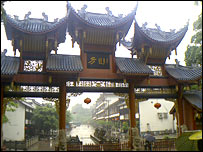 | | Buddhism is a major religion of China |
Having said that, some thought a bouncy castle had been brought onto campus for their entertainment. The transparent inflatable object looked like a giant igloo, glistening in the bright sunshine. It attracted crowds of puzzled Chinese onlookers trying to work out what it was, pushing against its sides and taking photos on their phones. It turned out to be a prototype for new bubble technology which the University is developing to help cut pollution and save energy. Bubbles you use in your bath or washing up bowl are pumped into the double-skinned structure and heated up by the sun. Temperatures inside reached 60 degrees, so hot that I could barely grasp the metal handle on my camera afterwards. This highly efficient form of insulation is said to be fifteen times more effective than single glazing and promises to cut carbon emissions and fuel use in your home by 80%. For £200 it could be available in a year and a half. 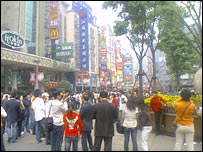 | | About 1.3 billion people live in China |
Such simple and cheap technology is badly needed in China. With a new coal fired power station opening virtually every week, the country now has sixteen of the twenty most polluted cities in the world. In Shanghai, a haze hangs over the city for most of the day. But earlier this year the Premier told the country it must do more to save energy and protect the environment. I took some comfort from the fact that I noticed by 11.30 at night all the lights in the skyscrapers had been switched off. My Ningbo nights offered up some of my more memorable meals. At one seafood restaurant you saw your dish swimming about in a tank beforehand. You pointed, and it was on your plate ten minutes later. 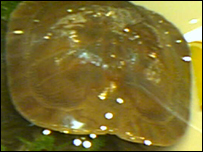 | | Soft shell turtle... mmm mmm! |
I didn’t point the finger at manta rays; Ningbo eels or soft-shelled turtles. But a dining companion went for cold jellyfish salad. If you like boiled, sinewy gristle then I’d recommend it. Then again at breakfast why not go for Century egg? This delicacy is an egg which has been preserved in its shell for a hundred years or more. The white becomes a green jelly; the yolk turns a dark green. It’s said to taste like a very smelly Stilton. I was happy to take their word for it. But in the Sichuan Province I got a taste of the real China. I was there following a delegation of teachers from Leicestershire visiting their exchange schools. 'SINGING AND MUSIC'Hospitality was on a grand scale. Meals were an event. Twenty dishes weren’t uncommon and sometimes there was singing and music. | "I found them charming, courteous, helpful and above all curious about everything." | | Quentin Rayner |
As honoured guests in the city of Luzhou, David Brindley (Principal of Rawlins Community College) and myself would be toasted up to ten times with Laojiao – a potent white wine the city is famous for. I sampled Chairman Mao’s favourite dish (a simple pork recipe) but I was surprised he didn’t go for pork cooked for six hours in ginseng – as mouth watering as it sounds. The work ethic I saw at the University of Nottingham was even more visible at the No 2 High School in Luzhou. 3,500 pupils attend, aged 16-19. NO FALLING IN LOVEAlmost two thousand board because they live in the surrounding countryside. Average class size is sixty and classes start at 7.30 in the morning and end at 9pm. Students are strictly forbidden from falling in love. Everything is focused on passing the exam and getting a place at a good university. No distractions are allowed. When a teacher enters the classroom there is instant silence. Respect comes with the job. Concentration is a given. Much of the learning is by rote and this is something the Chinese are looking to change. As a result of the exchange programme they have seen the more creative approach in British classrooms and want to apply it to their schools. One drama teacher in the Leicestershire party told me the Chinese pupils couldn’t believe their eyes when she cleared the room of desks and made them improvise. They loved it. 'TOO PRESSURISED'But a number of the Luzhou students have visited Rawlins Community College and want some of the same freedoms students there enjoy. They do feel they have to work too hard and crave more free time. At a school in the Provincial capital Chengdu, a teacher privately admitted that students weren’t happy because it was too pressurised. Another member of the Leicestershire delegation, who’s also an Ofsted inspector, told me he wished the two systems could meet somewhere in the middle. He believes things have gone too far in the UK and we can learn a lot from the Chinese about respect for teachers and attentiveness in class. I went to China with many preconceptions. I left stripped of most of them. The people were the biggest revelation. I found them charming, courteous, helpful and above all curious about everything. It’s a country of smiles. People just seem to smile a lot. But then again the future’s theirs. |