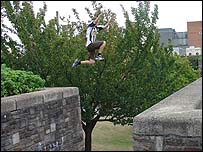
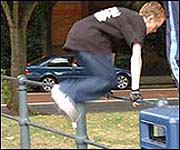
WARNING: Parkour should not be undertaken without instruction. Please seek advice and help from an experienced instructor before attempting any of the moves on this page. Do you remember the BBC promo with the man who effortlessly jumps between park benches, spinning and flipping along the way? Well, that man was one of the founders of free-running sport parkour, David Belle. The moves and techniques he used in the advert summarise the look of the urban sport. It's more than an urban sport, however. Parkour also has a unique philosophical element, encouraging you to look at where you live in a different way. Parkour is described as 'absolute freedom of movement' by Urban Freeflow, a forum dedicated to the sport. It can be done in any town or city, needing no equipment except your body, mind and a concrete backdrop. By jumping over walls and vaulting railings, parkour theorises that your journey from A to B is freer, and is not pre-determined, hence it also being known as 'free running'. | "You don't have to go by any rules- it's individual to you. " | | 'Mental' Matt, 18. |
In Bristol, the parkour scene is alive and organised meetings allow the traceurs, as they are known, of Bristol to meet up regularly. Leap of faith Since the airing of Channel Four documentary Jump Britain earlier this year, the originally French sport has increased in popularity. Many of the young men I spoke to explained they saw the documentary and got interested, joined a local group, and have not looked back since. It's a highly individual discipline, and many explained that it means different things to different people. Matt, 18, said "it's individual to you." This unique aspect of personal interpretation doesn't often accompany such physically demanding group activities. And it's this strange balance - a clever mixture of a supportive community spirit, and space for original, separate meditation - that makes parkour work even better. Airborne Parkour is also unusual in appearance. The almost balletic quality of the jumping has been compared to skateboarding, but without an actual skateboard. Instead, the traceurs rely on themselves, twisting their bodies to flip and turn, using their hands and feet to propel themselves. Simon, 31, told me that, "You always feel sore in the morning", but that the improvements to co-ordination and fitness are worth it. He added that "there's a fear factor with most of the moves." The satisfaction of working at a particular move for a few weeks is apparently one of the best parts of the sport. After trying to crack a move for weeks "the feeling is unbelievable," said Simon, 15, who is currently learning a difficult move called the wallspin. So, it's unfortunate that these young men, who have chosen to fill their time with something so productive, are sometimes seen as more threatening. "The police can get suspicious and try to move you on," Jarrad, 16, said. It's almost ironic that as more physical barriers are put up, the traceurs get more opportunities for parkour and freedom. Jump Bristol? It's debatable whether parkour is an art, a sport or a discipline. The most important thing about it however, is that it is whatever you want it to be. "There's nothing holding you back," said Jak. If you'd like to get involved or find more information, check out international forum Urban Freeflow at the link above. |