| 28 October 2014 |

| |
| BBC Homepage | | |
| |||
| Contact Us | | |
Credit CrunchYou are in: Bradford and West Yorkshire > Credit Crunch > Riding the 'credit crunch' in Hemsworth? Riding the 'credit crunch' in Hemsworth?By Martin Coldrick Every day on the news we hear about the 'credit crunch' and how it could affect us, but is there any way to make the ride a little less rough? We've been out to Hemsworth to find out why being a member of a credit union might just be a start... "Credit unions started, I believe, in the Middle Ages in the agricultural community," says Richard Stevens, Branch Supervisor of the Hemsworth Branch of the White Rose Credit Union. "They were started by people saving into a communal pot and then they'd borrow from that same pot...Largely, they're much the same now as they were then, although we've perhaps got a little more sophisticated!" That, in a nutshell, is what credit unions are all about. Or, as Richard describes them in more 21st century-speak: "Credit unions are not-for-profit financial co-operatives." In other words, people in a workplace or in a small community like Hemsworth can save their hard-earned cash without turning to the big high street banks which are currently the focus of so much financial angst. And Richard thinks that credit union members could be better-placed than others to ride out the worst effects of the so-called 'credit crunch' or any impending recession.  Richard Stevens in Hemsworth So how can it be that these small groups of people managing their money together might be on firmer ground than the majority of us who are closely tied in with the fortunes (if you'll pardon the pun) of the big banks? The key, says Richard, is that credit unions like the one in Hemsworth keep things simple and at arm's length from the way the big financial institutions work: "We don't have shareholders to pay. We're very much a co-operative in that any surplus left at the end of the year gets repaid to members as a dividend and every member is an equal shareholder of the credit union - an equal owner. We're also run by a voluntary board rather than a paid board of directors, all of whom are members of the credit union. And any member of the credit union can offer their services as a director." Not only that, but Richard adds that every credit union in the UK is regulated by the Financial Services Authority (FSA), the organisation which is this country's main financial regulator. With up to 600 credit unions in the UK, approximately 500,000 members and assets of £400million, they clearly offer an alternative to the mainstream way of saving money and taking out loans. Now, as the high street banks come under seemingly more and more stress as the 'credit crunch' begins to have an impact, Richard says people may increasingly turn to credit unions - but that's not to say that there are many signs of the 'crunch' on the streets of Hemsworth today: "We are, and have been for the past six months, recruiting around fifty new members a month. That hasn't suddenly increased or decreased so I don't think the current situation is having that much of an effect at the moment - but I think it will. People traditionally get their loans from banks and banks are now not offering those people loans because they've changed their criteria. I think that opens an opportunity for local credit unions to fill that gap. That's not to say we're definitely gong to lend money to people who can't pay it back, we've still got to be careful and we've still got to make sure we're making good loans, but I think we have an opportunity to fill the gap that the banks are leaving."  Sign of the times in Hemsworth? If or when the 'credit crunch' really begins to bite, Richard has one particular piece of advice for people in Hemsworth and beyond who are facing money troubles - be very careful who you borrow from. He's particularly worried that as people feel the pinch they'll turn to 'doorstep lenders'. That, warns Richard, can lead to big problems: "There was one case we had where she had eleven different doorstep loans and she would have paid, I think, £70 a week if she'd have been repaying all those loans as she should have been. There are a number of different companies and they offer a fantastic service, there's no question about that. They knock on the door every Friday and when they get near the end of the loan they say, 'I can do another £200 for Christmas, is that all right?' What they don't offer is value for money. They'd argue they do because of the service they offer, but 140 per cent to 470 per cent APR [Annual Percentage Rate - the cost of a loan] is not value for money. It's scary. And these are just the companies. Outside that, you get into the territory of the real loan sharks where the APR is in the thousands in some cases - really, really scary." Richard goes on to say that as money gets tighter people are beginning to realise how much loans are really costing them - and how a credit union might be a better bet: "We do get an awful lot of people who are starting to understand how much they are repaying on some of these doorstep loans and some of the high street money shops. When they look at the interest and they see the figures they're paying and what it would cost them from us, they're just amazed. People come in here and start to realise there are alternatives and that they don't have to pay ridiculously high premiums." But Richard adds that people also need to take personal responsibility for their finances including, perhaps, avoiding the need to take out a loan in the first place: "We try very hard to encourage people to save a little bit, even if it's a pound a week, so that when they get to Christmas they've got £50 they wouldn't have had otherwise. It can make a difference...There's a real satisfaction in saving for something then paying for it." 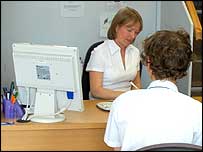 The credit union at work in Hemsworth And despite the dire warnings of the financial forecasters and the experts, Richard says the view from his office in Hemsworth is not as dark as some might think. He believes that members of credit unions like his may still have some belt-tightening to do over the current months, but he refuses to be entirely gloomy: "Because of the number of 'noughts' there are behind our turnover compared to the banks, we don't do mortgages so we're not going to be hit by losing business as that's not part of our business anyway. We've got to be flexible and the flexibility of credit unions will not let [our members] be hit as hard as some of the financial institutions if we go into full recession." In fact Richard Stevens believes that now is the time for credit unions like this one run from a busy shopfront office in Hemsworth to show they can offer a real alternative at a time when things certainly aren't looking great for many people: "Somehow or other we need to get the message out that credit unions are no longer 'the poor man's bank'. They're a service for everyone...We're starting to catch up as they are in the States where credit unions are huge. They do compete with the banks there. We're starting to catch up, but on a local basis." last updated: 16/07/2008 at 17:29 You are in: Bradford and West Yorkshire > Credit Crunch > Riding the 'credit crunch' in Hemsworth? |
| | About the BBC | Help | Terms of Use | Privacy & Cookies Policy |